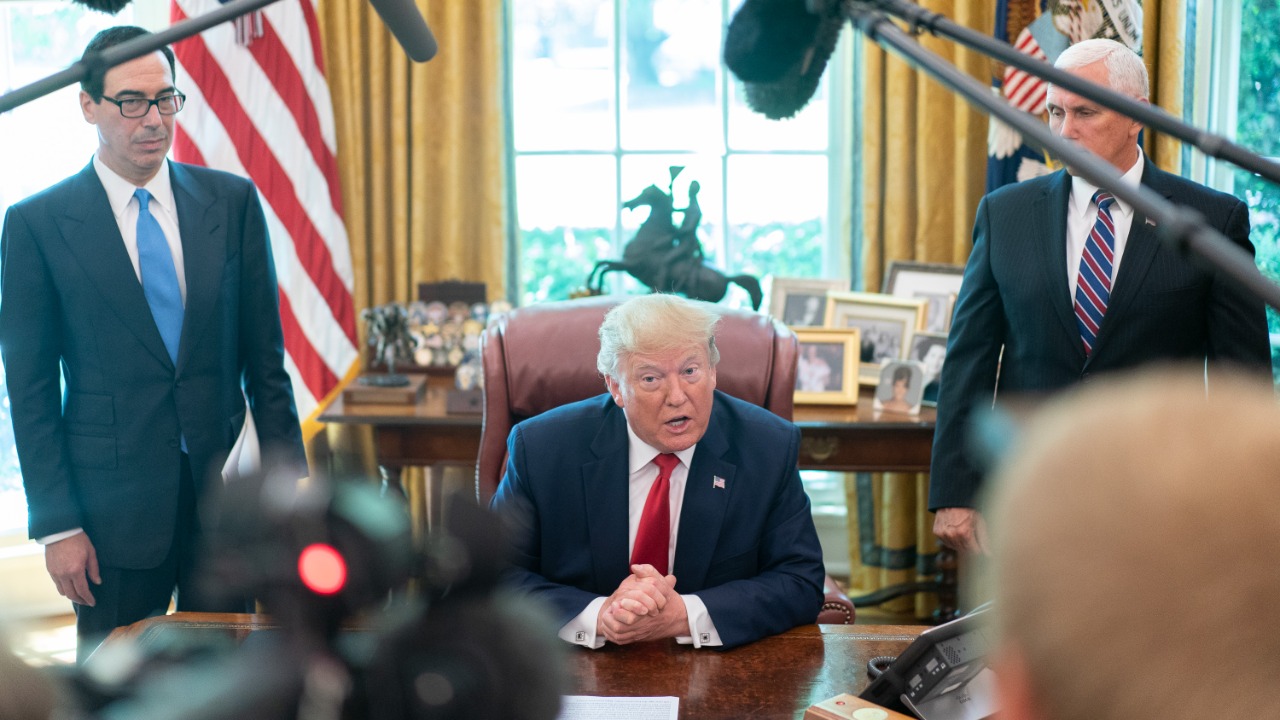
President Donald Trump has opened a new front in his long-running tariff battles, authorizing duties of up to 25% on countries that keep trading with Iran. The move turns access to the US market into a lever for pressuring Tehran, but it also drags in a disparate cast of partners, from major powers to smaller economies like Kenya that rely on both American demand and Iranian links. I see this as less a narrow sanctions tweak than a stress test of how far Washington can weaponize trade without splintering the very networks it is trying to control.
The order lands at a moment when global supply chains are already rewiring after years of trade wars and pandemic shocks. By threatening tariffs on any nation whose companies or banks continue significant dealings with Iran, the White House is effectively forcing governments to choose sides in a high-stakes economic ultimatum. For Kenya and other emerging markets, the risk is not just higher customs bills, but a deeper shift in where they send their exports and from whom they buy critical goods.
The order that turned Iran policy into a global tariff trap
At the heart of the new policy is an executive order in which President Donald Trump authorizes additional tariffs of up to 25% on countries that continue to do business with Iran. The measure targets nations whose firms provide goods, services or financial support to Iranian entities that Washington links to security threats and to what it describes as Iran’s brutal protest crackdown. According to reporting on the order, President Donald Trump has framed the tariffs as a way to raise the cost of enabling Tehran’s behavior, tying economic penalties directly to foreign governments’ willingness to rein in their own companies.
The White House has also tied the move to nuclear concerns, highlighting restrictions on sensitive facilities such as the Fordo plant and presenting the tariffs as part of a broader effort to constrain Iran’s program over a 15 year horizon. In that sense, the order fuses sanctions logic with Trump’s preferred instrument of trade pressure, extending the tariff playbook he once used against rivals into the realm of non-proliferation. Coverage of the announcement notes that President Donald Trump is explicitly threatening countries that continue to trade with Iran, signalling that even long-standing partners will not be exempt if they ignore Washington’s red lines.
A process, not yet a punishment, but with sharp teeth
Despite the fiery rhetoric, the tariffs are not automatic. The order sets up a process in which the secretaries of State and Commerce must jointly determine whether a country meets the criteria for penalties, including the scale and nature of its dealings with Iran. As one detailed account explains, the order empowers State and Commerce to make those findings and then recommend tariffs, rather than slapping duties on immediately, which means there is still room for diplomacy before any customs hikes hit. That procedural step matters, because it gives Washington leverage to extract concessions or policy shifts in exchange for staying off the tariff list.
In practice, this turns the threat into a rolling negotiation with capitals from WASHINGTON to Nairobi. A separate description of the order notes that President Donald Trump signed it on a Friday, establishing the authority to impose tariffs on nations that do business with Iran but making clear that actual duties would follow only after a formal finding that a country’s activities meet the threshold. This sequencing suggests the administration wants to maximize deterrent effect while preserving flexibility, using the specter of tariffs to push allies and rivals alike to scale back Iranian ties before any containers are actually taxed at US ports.
Kenya’s unexpected exposure: tea, oil and a tariff squeeze
Kenya’s appearance among the potential targets has surprised many, but the country’s trade profile makes its vulnerability clear. In recent years, Iran has emerged as a growing market for Kenyan tea, with exports climbing from 3.2 m tons in 2020 to 13 m tons according to one detailed explainer on how Trump’s 25% tariffs could affect Kenyan producers. That same analysis underscores that Iran has become central to Kenya’s export economy in this niche, meaning any disruption to that corridor would hit farmers and processors far from the geopolitical debates in Washington and Tehran.
The relationship runs both ways. Trade data show that in 2024, Iran exported $18.3M to Kenya, with key products including Petroleum Coke valued at $5.92M and Asphalt Mixtur alongside other industrial inputs. Those figures, drawn from a bilateral profile of Iran and Kenya, highlight how deeply Iranian supplies are embedded in Kenya’s construction and manufacturing sectors. Another breakdown of the relationship notes that Kenya exports more than it imports in this pairing but still brings in oil products, construction materials and other goods from Iran that might suddenly become more expensive if US tariffs force Nairobi to reconfigure its supply chains.
From Athi River to Thika: what a 25% tariff means on the factory floor
The macro language of executive orders can obscure the micro reality in places like Athi River and Thika, where Kenya’s export industries live or die by thin margins. A widely shared analysis from Jan warned that industries like textiles and clothing were badly affected by earlier tariff rounds, putting many factory jobs at risk, especially in Athi River and Thika, when global buyers shifted orders or squeezed prices. If the United States now adds a 25% duty on Kenyan goods because of Nairobi’s ties with Iran, the same plants could face a double hit, losing competitiveness in their main market while also paying more for imported Iranian inputs.
Kenyan commentators have already flagged that President Donald Trump has just announced tariffs of up to 25% on countries with notable trade ties with Iran, framing it as a direct threat to sectors that depend on US orders. A follow up warning circulated in Nairobi underlined that, effective immediately, any country that continues to do business with Iran could face tariffs, echoing the language of a TRUMP WARNING reel that linked the policy to Kenya’s own exposure. While social media is not policy, it reflects a growing anxiety among workers and business owners who see their livelihoods caught between Washington’s security agenda and Tehran’s role as a buyer and supplier.
Big powers in the crosshairs: China, India, Turkey and the Gulf
Kenya is far from alone in facing hard choices. Major economies such as China, India, Turkey and the UAE all maintain substantial energy and commercial links with Iran, and several are explicitly mentioned in coverage of the order’s potential reach. One detailed report notes that the process set out by State and Commerce could eventually touch Turkey and China, underscoring that the threat is not confined to smaller states. For Beijing and New Delhi, which have long balanced US ties with energy needs and regional politics, the new tariffs raise the cost of that hedging strategy.
Another account of the move stresses that U.S. President Donald Trump signed an executive order on a Friday that would allow tariffs on any nation whose companies provide goods or services to Iran, either directly or indirectly, making clear that even complex supply chains routed through hubs like the UAE could be scrutinized. A separate summary of the decision notes that after threatening tariffs of up to 25%, President Donald Trump has raised the stakes for Iran’s trade partners, with Nik Martin and agencies such as AFP and Reuters highlighting how this could reverberate through energy markets and regional alliances. The upshot is that the same instrument that alarms Kenyan tea exporters is also aimed squarely at the world’s largest importers and refiners.
Security logic and the Fordo factor
To understand why the White House is willing to risk such broad disruption, it helps to look at how officials are framing the threat. A fact sheet accompanying the order, titled “President Donald J. Trump Addresses Threats to the United States by the Gove of Iran,” casts Tehran as a direct danger that justifies extraordinary economic measures. That document, cited in coverage of US moves to impose tariffs on Iran-linked imports, describes the tariffs as a response to retaliation and positions them as part of a continuum of pressure that includes sanctions, military deterrence and diplomatic isolation.
Reporting on the announcement also notes that the White House has tied the policy to restrictions on Iran’s Fordo plant for 15 years, presenting the tariff threat as a tool to enforce nuclear constraints that might otherwise erode. One detailed piece on Trump’s threat to countries trading with Iran quotes officials saying that the order is meant to address Iran’s brutal protest crackdown as well as its nuclear activities, suggesting a broad human rights and security rationale. In that light, the tariffs are not just about trade balances but about using access to the US market as a kind of economic firewall around sensitive Iranian facilities and behavior.
Kenya’s diplomatic tightrope and the risk of market realignment
For Kenya, the challenge now is to navigate between Washington’s demands and Tehran’s role in its trade portfolio without triggering a crisis on either side. One detailed report on how Trump’s 25% tariffs could affect Kenya notes that Iran has become a key buyer of Kenyan tea and that the two countries have explored deeper cooperation through mechanisms such as a Joint Cooperation (JCC) in Nairobi. At the same time, another account of the executive order highlights that Kenya is among the countries hit as Trump signs the threat, with the advisory urging US citizens to leave Iran immediately if it is safe to do so and warning of broader instability.
Coverage of the same development stresses that Kenya among countries hit as Trump signs order threatening tariffs on Iran trade, quoting President Donald Trump as saying that countries would have to make choices in the next week. That compressed timeline, reported in the MSN summary, suggests Nairobi may be forced into rapid decisions on whether to scale back Iranian ties or risk US tariffs on exports that are central to Kenya’s export economy. In my view, this is where the policy’s real leverage lies: not in the immediate imposition of duties, which has not yet occurred, but in the way it forces governments like Kenya’s to reassess their entire trade strategy under intense time pressure.
More From The Daily Overview
*This article was researched with the help of AI, with human editors creating the final content.

Grant Mercer covers market dynamics, business trends, and the economic forces driving growth across industries. His analysis connects macro movements with real-world implications for investors, entrepreneurs, and professionals. Through his work at The Daily Overview, Grant helps readers understand how markets function and where opportunities may emerge.

