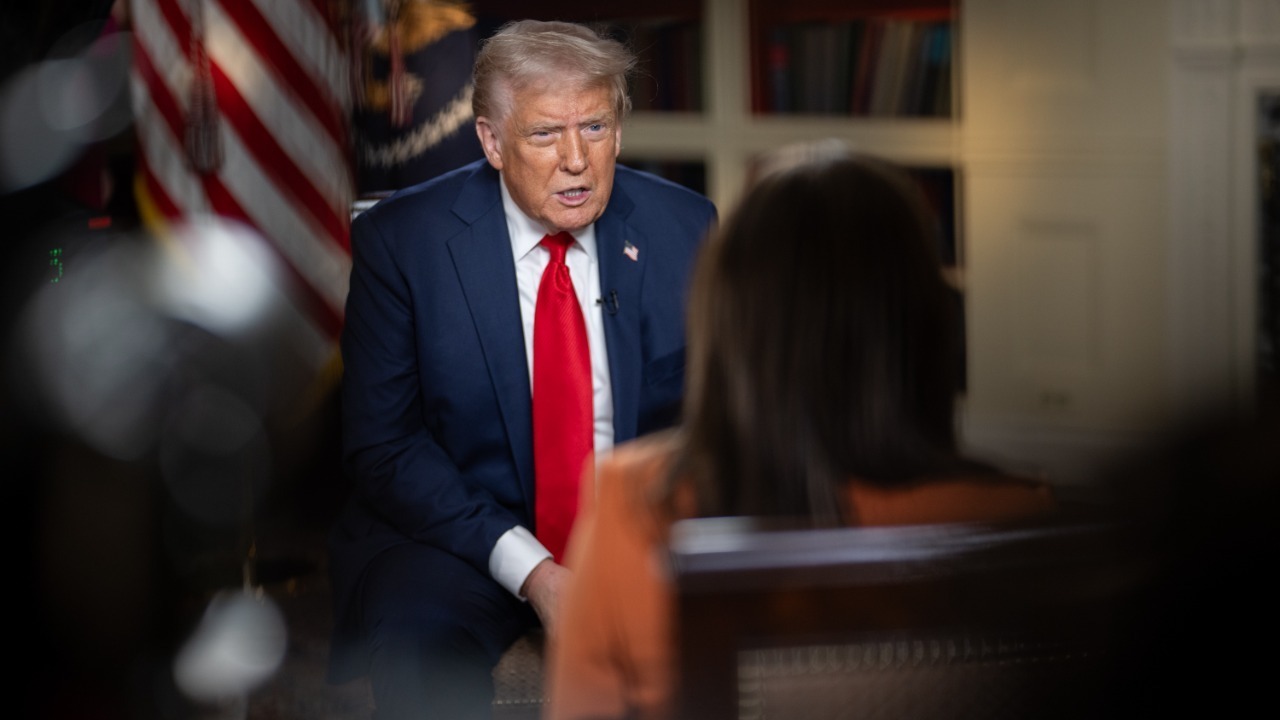
President Donald Trump is promising that tariff revenue will soon translate into direct cash for households, telling supporters that new “dividend” payments of $2,000 per person could arrive by the middle of 2026. The pledge, framed as a way to turn trade policy into a populist payout, would mark one of the most visible attempts yet to link tariffs to household finances. It also raises hard questions about cost, timing, and whether Congress will ever sign off.
I see the plan as a collision point between campaign-style promises and the constraints of governing: the White House is selling a simple check, but the mechanics behind it are anything but simple. The gap between the headline number and the underlying math is already drawing scrutiny from economists, fact-checkers, and even Republicans on Capitol Hill.
What Trump is actually promising with $2,000 tariff checks
At the core of the proposal is a straightforward pitch: tariffs on imports would be pooled and redistributed to households as annual payments of $2,000 per person. President Trump has described the idea as a “tariff dividend,” arguing that instead of trade duties disappearing into the federal budget, they should be routed back to families as a visible benefit. In public remarks on Nov 18, 2025, he suggested that these checks could begin arriving by mid-2026, effectively turning trade policy into something that looks and feels like a recurring stimulus payment.
That framing is politically potent because it translates an abstract fight over tariffs into a concrete household figure. A family of four, for example, would hear that they might receive $8,000 a year, a number large enough to cover several months of rent on a three-bedroom apartment in cities like Phoenix or pay off a used 2021 Toyota Camry. By tying the promise to a specific amount and a near-term timeline, Trump is inviting voters to judge his economic agenda not just on growth or jobs, but on whether a check for $2,000 actually shows up in their mailbox.
The mid-2026 timeline and how it evolved
The timeline has become as central to the story as the size of the payment. President Donald Trump has now publicly said that Americans could see the proposed $2,000 rebate checks by “mid-2026,” a pledge he attached to tariff revenue in comments reported from WASHINGTON on Nov 16, 2025. That date is not incidental. It positions the first wave of payments roughly in the middle of his current term, close enough to feel imminent but far enough away that the administration can argue it needs time to finalize legislation and build the distribution system.
Other coverage has echoed that mid-2026 target, with Trump on Nov 18, 2025 again tying the $2,000 figure to a promise that Americans could “actually” receive the money by the middle of that year. The repetition of that timeframe across appearances suggests the White House is trying to lock in expectations around a specific window rather than leaving the pledge open-ended. For voters, that means the question is no longer whether Trump wants to send tariff checks, but whether the political and legislative machinery can realistically deliver them on the schedule he has now attached to his own words.
Who would qualify, and how the plan would work
Eligibility is one of the biggest unknowns, even as the headline number circulates widely. Details on President Trump’s proposed $2,000 dividend remain sparse, but he has indicated that the payments would be targeted to Americans with low or middle income. That suggests an income-tested benefit rather than a universal one, more akin to an expanded tax credit than the broad pandemic-era stimulus checks that went to most households regardless of earnings.
Even so, the structure is still only a concept. Analysts have noted that the program has “no roll out” yet and that it is explicitly a proposal, not a finalized initiative, a point underscored in a Nov 17, 2025 explainer that stressed the plan cannot happen without Congress. Republicans in particular are described as balking at the idea, which means the White House would need to translate the broad promise into detailed legislation, define exactly which Americans qualify, and then navigate the usual fights over income thresholds, phaseouts, and how to handle people who do not file tax returns. Until that happens, the eligibility rules remain more campaign talking point than codified policy.
Congressional roadblocks and Republican resistance
The biggest obstacle between Trump’s pledge and an actual check is not the Treasury’s ability to print payments, it is the need for statutory authority. Fact-checkers have already emphasized that in a Nov 10, 2025 review of the promise to give Americans $2,000 payments from tariff dividends, noting that the president cannot unilaterally redirect revenue on this scale. The Constitution gives Congress the power to levy taxes, including tariffs, and to decide how that money is spent. Any large-scale rebate program would therefore require legislation, not just an executive announcement or a social media post.
That is where the politics get complicated. While the White House has floated the idea as a way to share tariff gains with households, reporting on Nov 18, 2025 has described how Republican lawmakers are giving President Donald Trump’s proposal a cold reception. Some conservatives worry about the precedent of turning tariff revenue into what looks like a permanent entitlement, while others are uneasy about the price tag and the message it sends on fiscal restraint. Even supporters concede that, as one report put it, the proposal would likely need to be passed by Congress, and that it resembles legislation introduced over the summer by a Republican Sen, which has not yet become law.
The staggering cost and economic tradeoffs
Behind the appealing simplicity of a $2,000 check lies a staggering fiscal bill. A recent analysis estimated that Trump’s tariff dividend idea would cost roughly $450 billion if fully implemented, a figure that would put it in the same league as some of the largest pandemic-era relief packages. That estimate, tied directly to Trump’s $2,000 tariff checks, highlights how quickly the math escalates when a per-person benefit is multiplied across tens of millions of eligible recipients. It also underscores the tension between promising a new cash benefit and Trump’s parallel pledges to reduce the national debt and scale back other forms of federal spending.
Economists are also questioning whether tariff revenue can realistically sustain a benefit of this size. One detailed breakdown noted that a $2,000-per-person dividend, even if limited to Americans with low or middle incomes, would require far more tariff income than the United States currently collects. To generate that much cash, the government would likely need to raise tariffs significantly or broaden them to more goods, which could in turn increase prices for consumers and invite retaliation from trading partners. The same analysis warned that the plan could reduce growth by diverting money from investment and by forcing the Treasury to borrow more, offsetting any short-term boost households feel when a $2,000 payment lands in their bank account.
Why the politics may matter more than the policy details
For Trump, the political calculus is clear: a promise of direct cash is easier to sell than a complex discussion of tariff incidence or budget baselines. In speeches and social media posts, he has framed the checks as a way to ensure that Americans, not foreign exporters, reap the benefits of his trade strategy. Coverage on Nov 18, 2025 described how Trump used the figure of $2,000 to anchor that narrative, presenting the dividend as a tangible return on the tariffs he has championed since his first term. In that sense, the policy functions as a capstone to years of arguing that tariffs are a tool for national renewal rather than a tax on imports.
Yet the politics cut both ways. Fact-focused coverage has already highlighted that in a Nov 10, 2025 assessment, the promise to give Americans $2,000 payments from tariff dividends rests on assumptions that may not survive contact with Congress or the bond market. Republicans who once rallied around Trump’s tariff fights are now split over whether to convert that revenue into a new benefit, as reflected in the resistance from GOP lawmakers. As I weigh the reporting, the most important question is not whether a mid-2026 check is technically possible, but whether Trump can persuade a skeptical Congress and a wary public that turning tariffs into a $2,000 dividend is worth the economic and fiscal tradeoffs that come with it.
More From TheDailyOverview
- Dave Ramsey warns to stop 401(k) contributions
- 11 night jobs you can do from home (not exciting but steady)
- Small U.S. cities ready to boom next
- 19 things boomers should never sell no matter what

Julian Harrow specializes in taxation, IRS rules, and compliance strategy. His work helps readers navigate complex tax codes, deadlines, and reporting requirements while identifying opportunities for efficiency and risk reduction. At The Daily Overview, Julian breaks down tax-related topics with precision and clarity, making a traditionally dense subject easier to understand.