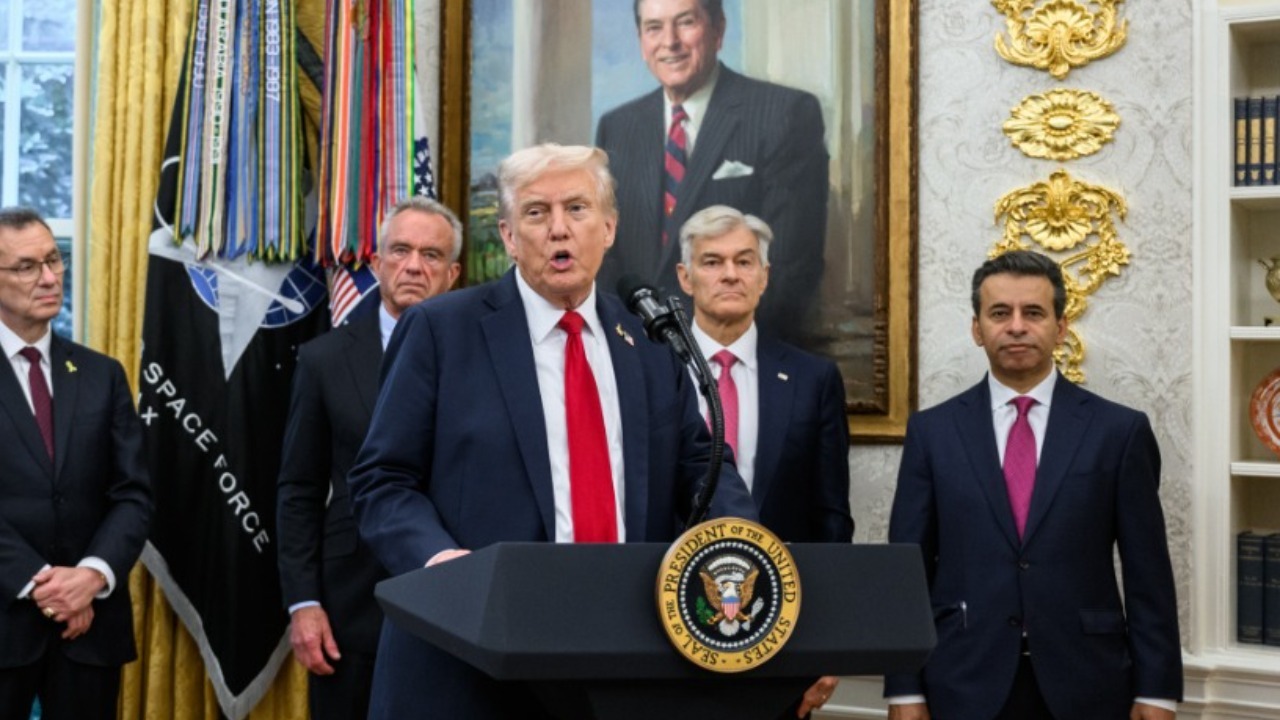
President Donald Trump is again dangling a tantalizing promise in front of voters: tariffs so large and lucrative that Americans could see their federal income tax rate fall all the way to zero. The idea pairs a simple villain, foreign imports, with a simple reward, no April 15 bill, and it lands in a country still frustrated with a tax code that feels both opaque and unfair. The question is not whether the pitch is politically potent, but whether the numbers behind it come anywhere close to working.
When I walk through the math, the gap between the revenue tariffs actually raise and what the income tax currently brings in is not a rounding error, it is a canyon. The figures from federal data and independent experts line up on the same basic point: tariffs are a relatively small, volatile stream of money, while the income tax is the backbone of the federal budget. Turning one into a full replacement for the other would require a transformation of the U.S. economy that looks nothing like what Trump is describing on the campaign trail.
Trump’s new promise: tariffs big enough to erase the income tax
Trump has been steadily escalating his rhetoric on trade, moving from targeted duties to a sweeping vision in which tariffs supposedly generate so much cash that “you’re not going to have income tax to pay.” In recent remarks, he framed the idea as a windfall for ordinary households, suggesting that a muscular tariff regime on imports could shoulder the cost of running the federal government while families keep every dollar of their paychecks. He has even floated the notion that the income tax might linger on the books only as a symbolic relic, because the tariff money would be “so enormous” that, in his telling, it would make the old system irrelevant.
That framing has quickly drawn scrutiny from budget analysts and tax lawyers who live in the numbers every day. One senior attorney adviser, Brandon DeBot, put it bluntly, saying of the claim that tariffs could fully replace federal income taxes, “It’s not possible. It’s not feasible mathematically or economically,” a judgment grounded in the reality that customs duties recently earned nearly $195 billion, a fraction of what the income tax delivers each year, as detailed in a fact-focused review. Trump’s own allies acknowledge that his promise is aspirational at best, but on the stump he presents it as a near-term payoff of his trade agenda, not a distant or conditional goal.
How much money the income tax actually brings in
To understand why experts recoil from the zero-tax promise, I start with the scale of the system Trump wants to replace. Individual income taxes are not a side dish in the federal revenue mix, they are the main course. According to the latest figures from the Treasury Department, income tax currently accounts for over half of total government revenue, with individual income tax revenues alone forming the single largest line item in the federal ledger, a reality underscored in a detailed Treasury-based analysis. That dominance is not an accident; the income tax is designed to track the growth of wages and profits in a way tariffs never have.
More concretely, Individual income taxes account for roughly half of all federal revenue, or about $2.4 trillion in a recent year. That figure alone sets the bar any tariff-based replacement would have to clear. It is not enough for tariffs to rise a little, or even double; they would have to generate a revenue stream on the order of the entire current income tax take, year after year, without collapsing trade flows or the broader economy that produces the very imports being taxed.
What tariffs are bringing in now
Once you put the income tax number on the table, the next step is to look at what tariffs are actually delivering. The U.S. has collected about $257 billion in tariff revenues so far this year, and $167 billion of that stemmed from tariffs that were first imposed during Trump’s earlier term in office. Those are not trivial sums, but they are an order of magnitude smaller than the income tax haul he is promising to wipe away. Even if every existing tariff were doubled overnight, the resulting revenue would still fall far short of the income tax baseline.
Independent estimates of Trump-era trade policy point in the same direction. One prominent tax analyst, York, estimated that the Trump administration’s current tariff policy, assuming it remains in place, would generate about $2 in additional revenue for every $1 of lost economic activity, but even under those assumptions the total take is nowhere near enough to replace the income tax base, as laid out in a careful revenue estimate. When I line up those figures against the $2.4 trillion benchmark, the gap is not a matter of creative accounting, it is a structural mismatch between what tariffs can plausibly raise and what the federal government currently spends.
Why experts say the math does not work
Economists and budget specialists are not just quibbling with Trump’s rhetoric, they are pointing to basic arithmetic. If tariffs are currently bringing in hundreds of billions and the income tax is bringing in trillions, the only way to close that gap is to either slash federal spending to a fraction of its current size or to raise tariffs to levels that would fundamentally change how Americans buy and sell goods. Most experts say that that math does not add up, warning that the combination of required tariff rates and the likely hit to trade volumes would leave the government short of cash even as consumers face higher prices, a concern spelled out in a recent broadcast analysis.
Some of the sharpest criticism comes from specialists who have spent their careers inside the tax system. In one detailed breakdown, experts noted that tariff revenue does not even come close to where it would need to be if federal income taxes were eliminated, and they stressed that the income tax has been the core of federal finance “and it always has been,” as summarized in a fact-checking review. When I put those expert assessments alongside Trump’s confident promises, the distance between campaign language and fiscal reality becomes hard to ignore.
How high tariffs would have to go
If Trump is serious about replacing the income tax, the logical next question is what kind of tariff rates would be required. Analysts who have run that scenario say the answer is “incredibly high,” far beyond the targeted duties Americans have seen so far. One detailed assessment concluded that to increase tariffs enough to equal income tax revenue, rates would have to be pushed well over current levels, and if imports fell in response, rates would have to rise further to keep revenue from collapsing, a dynamic spelled out in a tariff-revenue scenario. At that point, tariffs stop looking like a targeted tool and start looking like a wall around the U.S. market.
There is also the question of what such tariffs would do to prices and supply chains. A separate analysis noted that in November, Trump promised Americans that his plan would allow them to stop paying federal income tax while still funding Social Security, Medicare, and a muscular military, but experts countered that the required tariff levels would likely drive up consumer prices by double digits in some categories and could shrink trade volumes by a third, at about 11 percent of GDP, as highlighted in a closely watched breakdown. When I imagine those kinds of price spikes hitting everything from 2025 Honda CR-Vs to the latest iPhone, the political appeal of “zero income tax” starts to collide with the reality of much higher checkout totals.
Who really pays tariffs, and how they hit low income Americans
Trump often frames tariffs as a bill sent to foreign governments or overseas companies, but the economic incidence looks very different. In practice, tariffs are paid by importers at the border and then passed along through the supply chain in the form of higher prices on shelves and in online carts. That means the burden falls heavily on consumers, including Low income Americans who spend a larger share of their paychecks on goods, and who, crucially, already pay little or no income tax, as explained in a detailed distributional analysis. For those households, eliminating the income tax would not deliver a big refund, but higher tariffs would still show up in the price of groceries, clothing, and basic electronics.
That mismatch is why many economists argue that a tariff-for-tax swap would be regressive. High earners who currently pay substantial income tax bills could see large savings, while lower earners, who already have minimal or zero income tax liability, would see little direct benefit but would still face higher prices on imported goods and on domestic products that use imported components. One careful review concluded that replacing the income tax with higher tariffs would not help struggling Americans and could instead reduce jobs and invite foreign retaliation, a warning laid out in the same economic brief. When I weigh those effects, the promise of relief for working-class voters looks far less straightforward than Trump suggests.
What independent fact-checkers and modelers are finding
Independent fact-checkers have tried to map out the limited ways Trump’s vision could work, and they keep running into the same wall. One detailed review, summarized through WMUR, reported that PolitiFact said there are three theoretical ways the government could try to use tariffs to replace income taxes: dramatically raise rates, massively broaden the tariff base, or combine tariffs with deep spending cuts, each of which would risk disrupting markets and the broader economy, as outlined in a fact-checking segment. None of those paths looks like the painless swap Trump describes at rallies.
Other modelers have focused on the sheer scale of the income tax and the relative smallness of tariff revenue. One comprehensive review, published under The Blueprint, emphasized that Experts say tariff revenue is far too small to replace federal income taxes and noted that Individual income taxes remain the central pillar of federal funding, a point reinforced in a Blueprint-branded analysis. When I line up those independent assessments, the consensus is not that Trump’s idea is bold or disruptive, it is that it is arithmetically out of reach without changes so extreme they would amount to a different economic system altogether.
What a tariff-funded government would look like
Some economists have tried to imagine the world Trump is sketching, if only to show what it would entail. In a commentary for CEPR, Baker wrote that if the government relied on new tariff revenue to replace an income tax that currently brings in roughly 13 percent of GDP, the result would be a radically different fiscal structure, with trade taxes sitting where broad-based income levies now stand, as described in a CEPR-linked essay. That shift would not just change how Washington collects money, it would reshape incentives for businesses, workers, and trading partners around the world.
In that hypothetical world, the United States would be betting its fiscal health on a steady flow of imports and on the willingness of trading partners to keep selling into a market that is taxing their goods at punishing rates. Experts say there is also a risk that other countries would retaliate with their own tariffs, hitting U.S. exporters and potentially shrinking the very trade flows that generate tariff revenue in the first place, a feedback loop flagged in a cautionary assessment. When I picture that scenario, it looks less like a tax holiday and more like a high-stakes gamble with the global trading system as collateral.
The political appeal versus the fiscal reality
None of this is to say that Trump’s message lacks political resonance. The idea of never filing another 1040, of watching the IRS fade into the background while foreign producers foot the bill, is a powerful story to tell in a campaign season. Trump has said tariff revenue may allow Americans to stop paying income taxes, and he has paired that with talk of “tariff dividends” that would supposedly flow back to households, but the underlying numbers show that the federal income tax, meanwhile, brought in about $2.4 trillion in 2024, which is more than 14 times what Trump’s second-term tariff plan is projected to raise, as laid out in a comprehensive revenue comparison. That ratio alone makes clear how far reality is from the campaign trail sound bite.
When I step back from the spreadsheets, the pattern is consistent. Trump, earlier this year, renewed his call to eliminate the federal income tax and suggested that tariffs could eventually shoulder the load, but detailed reviews keep coming back to the same conclusion: tariff revenue is far too small, the required rates would be economically dangerous, and the burden would fall heavily on consumers, especially those with the least room in their budgets. The U.S. has collected about $257 billion in tariff revenues so far this year, and $167 billion of that came from Trump-era duties, figures that look modest next to the trillions raised by the income tax, as documented in a detailed tariff tally. The promise of a 0 percent income tax funded by tariffs may be an effective applause line, but based on the available evidence, it does not add up.
More From TheDailyOverview
- Tennessee loses $2.6B megafactory and faces major layoffs
- Retired But Want To Work? Try These 18 Jobs for Seniors That Pay Weekly
- What to do with your pennies after the U.S. stops minting them
- Home Depot CEO warns of a troubling customer trend in stores

Julian Harrow specializes in taxation, IRS rules, and compliance strategy. His work helps readers navigate complex tax codes, deadlines, and reporting requirements while identifying opportunities for efficiency and risk reduction. At The Daily Overview, Julian breaks down tax-related topics with precision and clarity, making a traditionally dense subject easier to understand.

