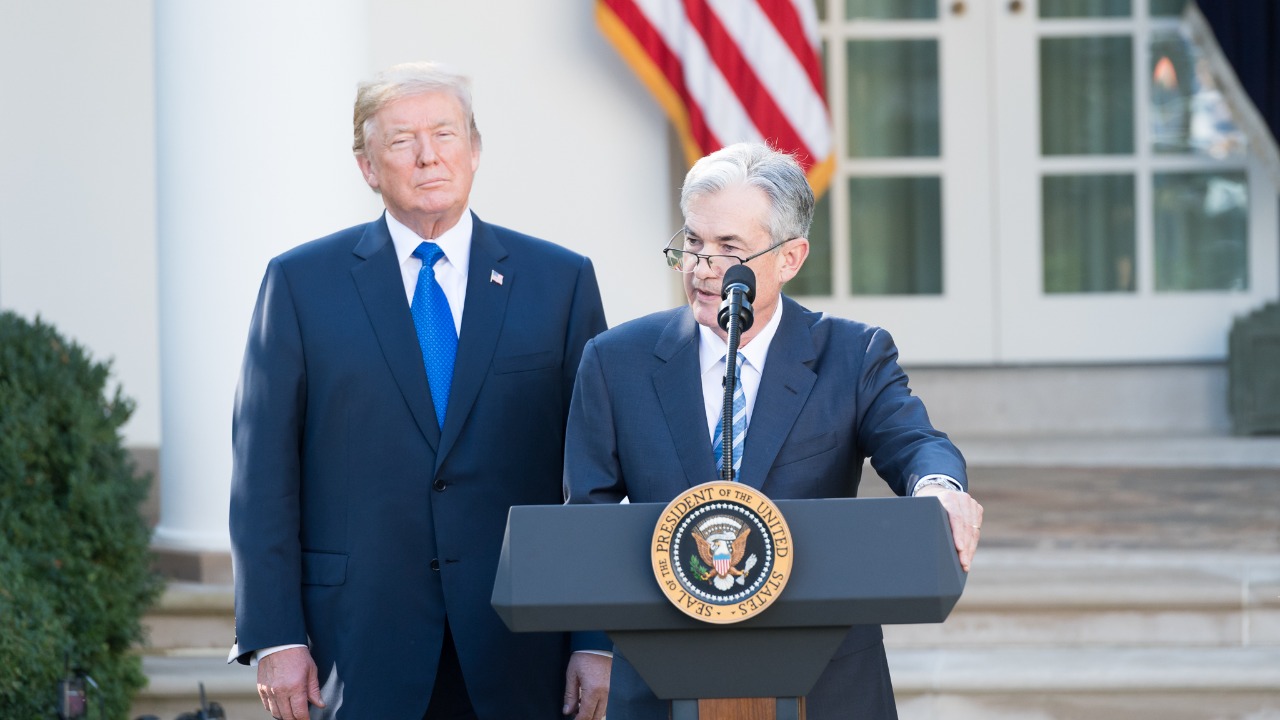
President Donald Trump has turned his long-running feud with Federal Reserve Chair Jerome Powell into a fresh test of presidential power, claiming that advisers and lawyers have stopped him from removing the central bank chief. His latest comments sharpen a yearslong pattern of public threats, legal pushback and political theater around the Fed, even as Powell’s term is set to run into 2026.
By casting himself as a president constrained by others, Trump is trying to reframe a story that has often focused on his own mixed signals about Powell’s fate. The result is a revealing clash between a White House that wants looser money, a central bank guarding its independence and a legal system that has already signaled limits on how far Trump can go.
Trump’s new claim: ‘People are holding me back’
Trump’s latest line, that “people are holding me back” from firing Powell, is less a legal argument than a political one. I read it as an attempt to show his base that he is still spoiling for a fight with the Federal Reserve while shifting responsibility for inaction onto unnamed advisers. Reporting on his recent remarks describes him venting that he would oust Powell if it were entirely up to him, a complaint that fits neatly with his broader narrative of being hemmed in by the Washington establishment.
In that telling, Trump portrays himself as the champion of borrowers and workers who want cheaper credit, and Powell as the obstacle. Coverage of his comments on Nov 18, 2025, notes that he has privately discussed replacing Powell and publicly aired a personal animosity that goes beyond policy disagreements, with one account citing the figure 40 as part of the political backdrop and crediting reporter Sylvan Lane for detailing how his frustrations have escalated. In that same reporting, Trump’s complaint that “people” are stopping him from acting is framed as a window into how his inner circle has tried to steer him away from a direct confrontation with the Fed chair.
Years of threats, denials and mixed messages
Trump’s suggestion that others are blocking him only makes sense against a history of whiplash statements about Powell. Over the summer, he publicly denied that he was planning to fire the Fed chief, even as he made clear he was thinking about the possibility. In one account dated Jul 16, 2025, President Trump is quoted saying it was “highly unlikely” he would try to remove Fed Chair Jerome Powell, a formulation that left the door open while signaling that his lawyers and economic team were still debating whether he should oust him, as described in a Quick Summary of those internal deliberations.
That same day, another account of his remarks captured the tension even more bluntly. Trump, speaking as President Donald Trump, again said it was “Highly unlikely” he would move against Powell, while still criticizing the Fed’s stance on interest rates and hinting that he wanted more freedom to “speak candidly on the issue.” In that coverage, the names Jul, Trump, Powell, President Donald Trump and Fed are all tied to a single moment when he tried to reassure markets without fully abandoning the threat, a balancing act documented in detail in a business-focused report on his comments.
Legal limits: what the Supreme Court and federal law say
Behind Trump’s rhetoric sits a stubborn legal reality: the president’s power to fire a Fed chair is far from clear, and recent court signals have cut against him. Earlier this year, the Supreme Court indicated that Trump cannot simply remove Fed Chair Powell at will, a significant win for the central bank that underscored its protected status within the federal government. The order, described in detail on May 22, 2025, highlighted how the Supreme Court views the Fed’s leadership as insulated from direct political retaliation, a point made explicit in coverage that framed the decision as the court signaling that Trump cannot fire Fed Chair Powell.
Legal analysts have also stressed that the underlying statute is murky, which helps explain why Trump keeps talking about firing Powell but has not tried it. Federal law says members of the Federal Reserve Board can only be removed “for cause,” and some experts argue that this protection extends to the chair’s four-year term. One detailed explainer, dated Jul 17, 2025, notes that Whether the president can fire Powell before his term ends is legally untested and that any attempt would likely rattle the market if he did, a warning laid out in a Federal Reserve explainer that walks through the role of the Federa system and the risks of politicizing it.
The Supreme Court’s posture has been reinforced in specialized reporting that tracks the legal beat. A subscription account of the same May order spells out that the Supreme Court has again signaled Trump cannot fire Fed Chair Powell, emphasizing that the justices see the Fed’s leadership as distinct from typical executive branch appointees. That analysis, which repeatedly names Supreme Court, Trump and Fed Chair Powell, underscores how the judiciary has boxed in the White House on this question, as detailed in a closely watched legal brief.
Escalating personal attacks on Powell
As his legal options have narrowed, Trump has leaned harder into personal attacks on Powell, turning what began as a policy dispute into a running insult campaign. In recent days he has described the Fed chair as having “some real mental problems” and suggested he would “love” to fire him if he could, language that goes well beyond the usual sparring between presidents and central bankers. I see that shift as deliberate: by questioning Powell’s competence and sanity, Trump is trying to delegitimize the institution’s decisions in the eyes of his supporters.
On Nov 19, 2025, President Donald Trump repeated his attacks on Federal Reserve Chair Jerome Powell during a public appearance, saying he would “love to” remove him and blaming the Fed for economic headwinds. A widely shared clip from that Wednesday event shows him tying Powell directly to voter frustrations over borrowing costs, a moment captured in a short video reel that highlights how he has turned the Fed chair into a staple of his stump rhetoric. In another account from the same day, President Donald Trump is quoted saying he thinks Federal Reserve Chair Jerome Powell has “some real mental problems,” and the report notes that Powell’s term ends in 2026, a detail laid out in a local news post that underscores how personal the feud has become.
The Bessent factor and Trump’s pressure campaign on rates
Trump’s anger at Powell is not just about personalities, it is also about interest rates and the internal dynamics of his own economic team. He has repeatedly used public events to pressure the Fed to cut rates more aggressively, casting himself as the voice of ordinary Americans squeezed by high borrowing costs. In that context, his claim that “people” are stopping him from firing Powell doubles as a warning shot to his advisers: get the central bank to move faster, or risk his wrath.
That strategy was on display when Trump recently singled out Treasury Secretary Scott Bessent and Commerce Secretary Howard Lutnick by name. In one account dated Nov 19, 2025, Trump appeared to suggest that Bessent has been the “voice of reason” on monetary policy, while saying Commerce Secretary Howard Lutnick is a lot more hawkish about confronting the Fed, a dynamic described in a detailed political report on his internal team. At the same time, Trump teased that he would fire Bessent if the Fed does not cut interest rates, effectively turning his own Treasury secretary into a public emissary to Powell and the rest of the Federal Reserve Board.
Trump’s language at that event was even sharper in other tellings. One national report quotes him saying, “I’d love to fire his a**,” referring to Powell, and noting that Trump has frequently called Powell “stupid” and “too late Powell” when criticizing the timing of rate moves. That account, which names Nov, Trump, Powell and Tuesday as key markers, describes how he used a campaign-style setting to accuse the Fed of keeping the cost of living too high, as laid out in a nationwide broadcast. Another account of the same exchange quotes Trump telling Scott, “Scott, you’ve gotta work on this guy,” addressing Treasury Secretary Scott Bessent directly and insisting that Powell has “some real mental problems,” a scene described in a regional news report that also highlights how he tied Powell to the complaint that the cost of living is too high.
Why the fight over Powell still matters
Trump’s insistence that others are stopping him from firing Powell is, in one sense, a face-saving way to acknowledge that he has run into legal and political constraints. Yet it also signals that he has no intention of easing off his campaign against the Fed, even as the Supreme Court and federal law limit his formal options. By keeping the threat alive rhetorically, he preserves a powerful scapegoat if the economy slows and a ready applause line when he wants to channel voter anger over mortgages, car loans or credit card bills.
For Powell and the Federal Reserve, the stakes are just as high. The more Trump personalizes the conflict, the harder it becomes for the central bank to convince the public that its decisions are based on data rather than politics. That is why the legal protections around the Fed chair’s term, the Supreme Court’s signals and the careful language of “Highly unlikely” from Trump himself all matter so much. They are not just procedural details, they are the guardrails that separate a president’s frustration from a full-blown assault on the independence of the institution that sets the price of money in the United States.
More From TheDailyOverview
- Dave Ramsey warns to stop 401(k) contributions
- 11 night jobs you can do from home (not exciting but steady)
- Small U.S. cities ready to boom next
- 19 things boomers should never sell no matter what

Grant Mercer covers market dynamics, business trends, and the economic forces driving growth across industries. His analysis connects macro movements with real-world implications for investors, entrepreneurs, and professionals. Through his work at The Daily Overview, Grant helps readers understand how markets function and where opportunities may emerge.

