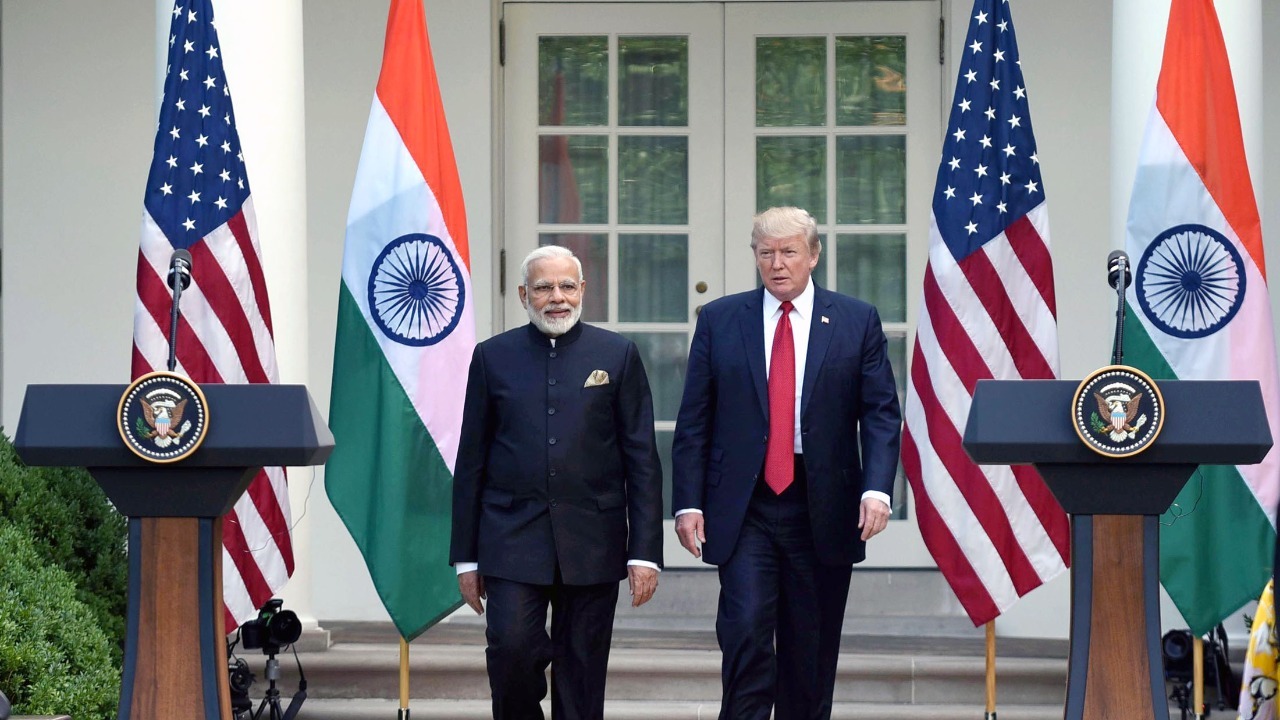
President Donald Trump has moved to sharply reduce tariffs on Indian goods, tying the cut to his claim that Prime Minister Narendra Modi has privately promised to halt purchases of Russian oil. The decision folds a long-running trade dispute into the geopolitics of the war in Ukraine, with Trump arguing that cheaper imports and a shift in India’s energy sourcing can serve U.S. consumers and global security at the same time.
The move also tests how far Washington can push a key Asian partner that has built its recent growth on discounted Russian crude. By linking tariff relief to an unverified pledge on oil, Trump is betting that public pressure and economic incentives will pull New Delhi closer to the Western line on Moscow, even as Indian officials tread carefully in what they still describe as a policy of strategic autonomy.
Trump’s tariff cut and the 18% benchmark
The core of the announcement is straightforward: President Donald Trump says he will lower U.S. tariffs on goods from India to 18%, down from 25%, as part of a new trade understanding with New Delhi. He has framed the shift as a win for American consumers and exporters, arguing that lower duties on products from India will ease prices while opening space for reciprocal gains in services and investment. According to his public comments, the 18% level is meant to be both a symbolic reset from the higher Trump-era tariffs and a practical rate that still gives Washington leverage in future talks.
Trump has presented the tariff cut as part of a broader deal in which he says Prime Minister Narendra Modi agreed to stop buying Russian oil, a claim he has linked directly to his decision to ease duties. In his telling, the trade move is not just about bilateral commerce but about using economic tools to reshape energy flows away from Moscow. Reporting on the negotiations indicates that Trump’s team sees the 18% rate as a ceiling that could be revisited if India does not follow through on what the president describes as Modi’s private assurances, a linkage that has already raised questions among analysts about enforceability and transparency.
What Trump says Modi promised on Russian oil
Trump has been explicit that, in his view, the tariff shift is conditional on India cutting off Russian crude. He has told supporters that Prime Minister Narendra Modi personally pledged to end purchases of Russian oil, and that this commitment was central to his decision to move ahead with the trade deal. In one account of the talks, Trump’s aides described the understanding as a pledge that Russian oil buys would continue once the new tariff schedule takes effect, casting it as a major diplomatic win that could tighten pressure on Moscow’s war economy.
At the same time, the public record from New Delhi is more cautious than Trump’s rhetoric suggests. Coverage of the deal notes that Modi welcomed the tariff reduction and highlighted the benefits for Indian exporters, but did not spell out a detailed timetable or mechanism for ending Russian imports. Trump has nonetheless insisted that the understanding is real and that he expects India to comply, portraying the oil pledge as proof that his transactional approach can deliver both economic and strategic gains where previous administrations relied on slower multilateral pressure.
India’s careful messaging and what Modi actually said
Indian officials have so far avoided confirming Trump’s most sweeping claims, instead emphasizing the trade aspects of the agreement. Prime Minister Narendra Modi publicly hailed the tariff cut as “wonderful” news for Indian businesses and workers, but his statements stopped short of explicitly promising to halt purchases of Russian crude. Detailed coverage of his response notes that Modi’s message on X focused on the benefits of lower duties and the strengthening of ties with the United States, while sidestepping the specifics of any Russia oil commitments that Trump has described.
That gap between Trump’s framing and Modi’s public language has fueled debate in both capitals about what, exactly, was agreed. One account of the deal points out that Modi did not use the word “halt” in relation to Russian imports, even as Trump claimed that India would “stop” buying from Moscow. Another report notes that Indian officials have continued to stress their right to pursue diversified energy supplies, a stance that has underpinned New Delhi’s purchases of discounted Russian barrels since the invasion of Ukraine. The result is a diplomatic gray zone in which Trump is touting a sweeping pledge while Modi appears to be keeping his options open.
From trade fight to geopolitical bargain
The tariff move caps a long period of friction in U.S.–India trade relations, during which Trump had previously raised duties and threatened further action over market access and digital taxes. By announcing that he will cut tariffs on Indian goods to 18%, he is now recasting that pressure campaign as a prelude to a broader strategic bargain. One detailed account of the new understanding notes that President Donald Trump has told supporters the deal will help END THE WAR in Ukraine by squeezing Russian revenues, a claim that links the tariff rollback directly to his foreign policy narrative.
Trump has also used the moment to underscore his personal rapport with Modi, presenting the Indian leader as a partner who responded to tough talk with concessions on both trade and energy. In one retelling of his recent diplomacy, Trump even joked with executives from Rolex about whether his earlier tariffs had prompted a U.S. Open invitation, a story that he used to illustrate how his tariff threats could be turned into leverage. That anecdote surfaced alongside reporting that highlighted how he now sees the India deal as proof that his approach can deliver results, with references to Related stories about his past tariff battles reinforcing the sense of a broader strategy.
Economic stakes for both countries
For India, the tariff cut offers immediate commercial upside. Lower duties on its exports to the United States could boost sectors from textiles to pharmaceuticals, while also signaling that Washington sees New Delhi as a preferred partner in its broader economic competition with China. Industry groups have already welcomed the deal, with one live update noting that business leaders expect the tariff reductions to enhance growth and competitiveness after U.S. President Donald Trump announced the agreement with Prime Minister Narendra. The prospect of more predictable access to the U.S. market is particularly significant for Indian manufacturers that have been trying to move up global value chains.
On the U.S. side, Trump has argued that the 18% tariff level still protects domestic producers while easing costs for consumers and deepening ties with a major democracy in Asia. One detailed breakdown of the plan notes that President Donald Trump has framed the reduction as a calibrated step that keeps pressure on India to deliver on its side of the bargain, including what he describes as a pledge to stop buying Russian oil, while still offering meaningful relief to importers of Indian goods. The administration is also signaling that the deal could be a template for future arrangements that tie trade benefits to security and energy commitments.
More From The Daily Overview
*This article was researched with the help of AI, with human editors creating the final content.

Grant Mercer covers market dynamics, business trends, and the economic forces driving growth across industries. His analysis connects macro movements with real-world implications for investors, entrepreneurs, and professionals. Through his work at The Daily Overview, Grant helps readers understand how markets function and where opportunities may emerge.

