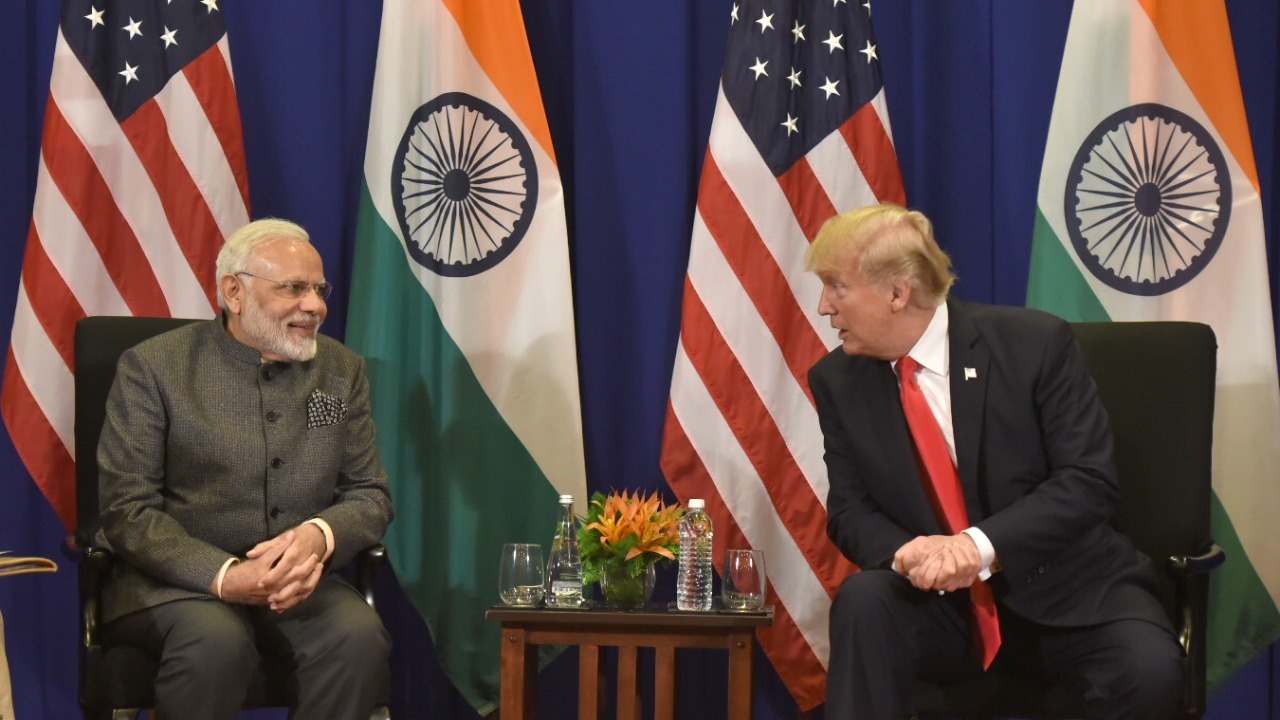
President Donald Trump’s abrupt decision to cancel the 25 percent penalty tariff on Indian goods tied to Russian oil purchases marks a sharp turn in a dispute that had threatened to spill over into a broader trade rupture. The move, delivered through an executive order after an interim trade framework with New Delhi, recasts a punitive measure into a bargaining chip for a wider reset. I see it as less a climbdown than a recalibration, folding sanctions pressure on Moscow into a larger strategy on energy, supply chains and Asia power politics.
At stake is not only the cost of Indian exports entering the United States, but also how far Washington can push a key partner to align with its Russia policy without driving New Delhi toward alternative blocs. The new understanding, which pairs tariff relief with Indian commitments on Russian oil and future tariff bands, suggests both sides are trying to turn a bruising standoff into a managed, transactional partnership.
The executive order that flipped the script
The core development is straightforward: President Trump has revoked the additional 25 percent duty that the United States had slapped on a swath of Indian products because of New Delhi’s continued purchases of Russian crude. According to detailed accounts of the decision, the executive order removes the extra levy on Indian goods that had been explicitly linked to direct or indirectly importing Russian Federation oil, reversing a measure that had become a symbol of friction between the two capitals. The order is framed as the first concrete step in implementing a new trade understanding, rather than a unilateral concession.
Officials in Washington describe the tariff rollback as part of a broader interim trade deal framework that sets the stage for a new bilateral tariff regime and energy commitments. Reporting on the executive action notes that the United States has formally lifted the 25 percent tariff on Indian goods tied to Russian oil purchases, with the White House presenting it as a reward for India’s willingness to adjust its energy sourcing and cooperate on sanctions-related concerns, a linkage underscored in India goods. The same framework is described as an interim step, which signals that the tariff story is not over, but has moved into a more negotiated phase.
What India agreed to on Russian oil
The price of this relief lies in New Delhi’s commitments on Russian barrels. Multiple accounts of the interim framework state that Prime Minister Narendra Modi has agreed to stop buying Russian oil, or at minimum to phase out purchases that had surged as Moscow redirected exports after Western sanctions. A White House official is cited explaining that the understanding is explicitly tied to India’s Russian oil imports, with the punitive tariff originally designed to penalize those flows and the rollback now conditioned on their reduction. This is not a vague political pledge, but a core clause of the new arrangement, as highlighted in coverage of how Trump cuts India tariffs to 18 percent as Modi agrees to stop buying Russian oil, reflected in Trump cuts.
The interim deal framework released alongside the executive order goes further, spelling out that the United States is lifting the 25 percent penalty in exchange for India’s commitment to curb or halt purchases of Russian crude and related products. Reports on the framework emphasize that the punitive duty had been imposed specifically because India was continuing to buy Russian oil, and that its removal is explicitly linked to that behavior changing, a conditionality described in detail in the interim deal. I read that as Washington using tariffs as a sanctions enforcement tool by proxy, effectively outsourcing part of its Russia containment strategy to trade partners who value access to the US market.
From 25 percent to 18 percent: the new tariff landscape
Beyond the headline-grabbing removal of the Russia-linked surcharge, the broader tariff architecture between the two countries is being reset. Earlier this year, the United States signaled that it would cut its general levy on Indian goods to 18 percent from 25 percent, a level described as lower than most Asian peers and framed as a reward for cooperation. That shift, which sits alongside the scrapping of the extra 25 percent punitive duty, effectively moves India from being treated as a sanctions problem to being treated as a preferred partner in the Asia trade hierarchy, a change captured in reporting that The US will cut its levy on Indian goods to 18 percent, as detailed in surprise deal.
The new understanding is not just about headline rates, it is also about predictability. Analyses of the evolving tariff regime note that the US tariff on India had previously included layers of duties that pushed effective rates to 50 percent on some categories, with the additional 25 percent punitive charge sitting on top for goods linked to Russian oil. The interim framework now sketches a path toward a flatter 18 percent band, while explicitly removing the Russia-related surcharge, a structure that is unpacked in detail in tariff analysis. I see this as Trump converting a blunt instrument into a tiered incentive system, where India’s treatment can be adjusted within a narrower range depending on how faithfully it sticks to the energy and trade commitments.
Winners, losers and the sectoral fallout
On the ground, the end of the 25 percent penalty and the shift toward an 18 percent general rate will be felt unevenly across Indian industries. Earlier breakdowns of the US tariff on India list affected products and rates, highlighting that sectors such as textiles, auto parts, steel and some agricultural goods had faced steep combined duties, while pharmaceuticals and IT services remained relatively resilient because they were less directly hit by the punitive layer. The removal of the Russia-linked surcharge should ease pressure on exporters in those more exposed sectors, particularly manufacturers of labor-intensive goods that compete on thin margins, a dynamic laid out in the punitive tariff coverage.
Financial market reaction offers an early proxy for who investors think will benefit. Detailed commentary on the stock market reaction to the tariff announcement notes that shares of export-oriented Indian companies, especially in manufacturing, rallied on the prospect of lower US duties, while pharmaceuticals and IT remained resilient because they had already weathered the earlier tariff shock relatively well. The same analysis points out that debt-laden companies were seen as particular beneficiaries of any relief that improves cash flows from US sales, a pattern described in the stock reaction. For ordinary workers in Indian textile hubs or auto-component clusters, this is not an abstract geopolitical story, it is the difference between overtime shifts and layoffs.
Energy leverage and the Russia factor
Behind the tariff choreography sits a hard calculation about energy flows and Russia’s war economy. The original 25 percent penalty was explicitly tied to India’s continued buying of Russian oil, and the language of the US decision to lift it still centers on that link, with official descriptions referring to Indian goods that were directly or indirectly importing Russian Federation oil, as spelled out in the tariff lift. The interim framework that accompanies the rollback reinforces this conditionality, making clear that the penalty is being removed because India has agreed to change its Russian oil behavior, as highlighted in the framework text.
There is also an energy quid pro quo that runs in the other direction. Accounts of Trump’s executive order emphasize that US President Donald Trump signed the measure removing the 25 percent penalty tariff on India for buying Russian oil as part of a broader trade deal that includes commitments on energy purchases, including references to plans to increase energy purchases from India, a detail noted in energy clause. That two-way flow suggests Washington is not only trying to choke off Russian revenue, but also to rewire regional energy trade so that US and Indian suppliers capture more of the market that Moscow is losing.
More From The Daily Overview
*This article was researched with the help of AI, with human editors creating the final content.

Grant Mercer covers market dynamics, business trends, and the economic forces driving growth across industries. His analysis connects macro movements with real-world implications for investors, entrepreneurs, and professionals. Through his work at The Daily Overview, Grant helps readers understand how markets function and where opportunities may emerge.


