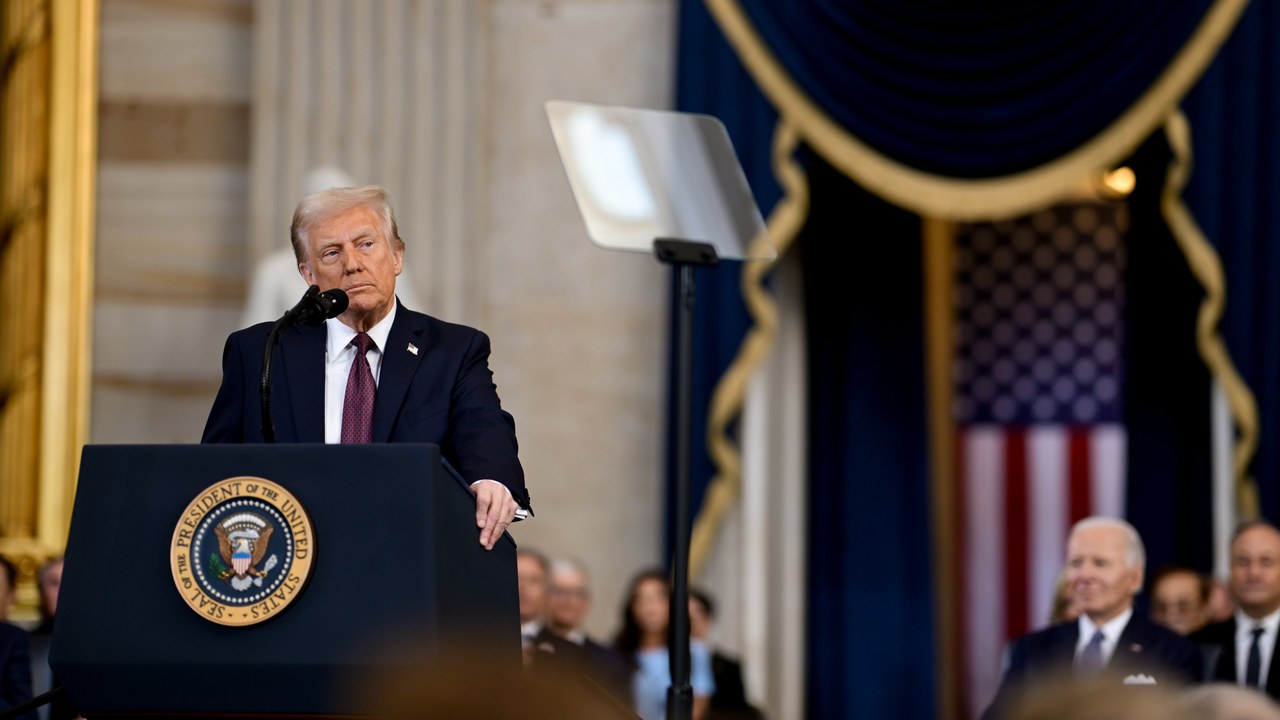
Factories are slowing, housing markets are cooling and business leaders are quietly shelving investments as President Trump’s latest tariffs ripple through the real economy. The national numbers still look deceptively solid, but underneath, nearly half the states are already flirting with outright contraction as trade policy collides with high borrowing costs and fragile confidence.
I see a widening gap between the administration’s promises of industrial revival and the on-the-ground reality of stalled orders, squeezed margins and rising prices for everyday goods. The pattern is clearest in manufacturing-heavy regions and trade-exposed states, where the tariff shock is landing on top of an already slowing cycle and pushing local economies to the brink.
The tariff shock meets an “economy of uncertainty”
The core problem is not just that tariffs raise costs, it is that they inject chronic uncertainty into decisions that normally unfold over years, from building a new plant to hiring a second shift. On Aug 4, 2025, analysis of the trade fight described how The Trump administration’s inconsistent and erratic economic policymaking, spanning tariffs and immigration rules, had already created an “economy of uncertainty” that discouraged long term investment and was one reason interest rates remain high. When executives cannot predict whether the next round of duties will hit steel, semiconductors or auto parts, they tend to delay capital spending, which shows up first as softer factory output and then as weaker state level growth.
That uncertainty is now colliding with a manufacturing sector that is already under strain. By Nov 17, 2025, data showed that the U.S. manufacturing sector had contracted in eight straight months, even as President Trump continued to argue that tariffs are necessary to rebuild domestic industry. The prolonged slump in factory activity, documented in that eight month contraction, is precisely the kind of slow burn that drags state economies into contraction even while headline national GDP still looks respectable.
Nearly half the map tilts toward contraction
When I look across the country, the damage is not evenly spread. Trade exposed states in the industrial Midwest, the South and parts of the West are bearing the brunt, while a smaller group of service heavy and tech driven states continues to grow. A detailed map published on Oct 21, 2025 showed which states are already flirting with recession and which are still expanding, highlighting how tariff sensitive regions are slipping into contraction while others remain resilient. That analysis, which flagged a Media Error in video playback but still laid out the underlying data, underscored that nearly half the states are either shrinking or on the cusp, with business confidence and higher costs weighing on their forecasts.
The pattern lines up closely with where tariffs bite hardest. States that rely on exporting machinery, autos and agricultural products, or that import large volumes of intermediate goods for assembly, are seeing orders dry up and margins compress. Economists who track these regional trends point to a combination of weaker global demand and the specific hit from Trump’s trade war, which has raised input costs and invited retaliation against U.S. producers. As more states slip from “slowing growth” into outright contraction, the national picture starts to look less like a soft patch and more like a rolling, region by region downturn driven in no small part by tariff policy.
Texas cools as higher costs squeeze growth
Texas is a telling example of how a once red hot state economy can cool when tariffs collide with higher interest rates and stretched consumers. After years of rampant growth, a recent analysis by the Federal Reserve Bank of Dallas found that the Texas economy is now clearly losing momentum, with businesses struggling to pass higher costs on to customers. The report highlighted how Homes available for sale in the Cartwright Ranch by D.R. Horton community in Crandall on Thursday, April 10, 2025 illustrate a housing market that is no longer racing ahead, as higher mortgage rates and construction costs cool demand.
For a state that depends heavily on energy, petrochemicals and advanced manufacturing, tariffs on industrial inputs and foreign retaliation against U.S. exports are a direct hit. Texas producers that once benefited from cheap imported components now face higher bills, while global buyers of oil field equipment and refined products are rethinking orders in light of trade tensions. The Dallas Fed analysis noted that, after years of rampant growth, firms are finding it harder to pass those higher costs onto customers, a classic sign that demand is softening and pricing power is fading. That combination of cooling housing, squeezed margins and weaker export demand is exactly how a booming state can slide toward the contraction column on the national map.
Tariffs as tax hikes on states, not just trading partners
At the national level, the tariff program is often framed as a tool to extract concessions from foreign governments, but the economic mechanics look a lot more like a tax increase on U.S. states. On Nov 17, 2025, a detailed assessment of the trade war laid out how President Trump has imposed tariffs under the International Emergency Economic Powers Act, or IEEPA, on a wide range of U.S. trading partners. The Key Findings in that analysis showed that the revenue raised by these tariffs is actually lower than conventional estimates once you account for reduced trade volumes, while the burden on importers and consumers is substantial.
Because tariffs are collected at the border, they show up first as higher costs for businesses that rely on imported inputs, from auto plants in Michigan to electronics assemblers in Texas and agricultural processors in the Midwest. Those firms then face a choice: absorb the hit in their margins or pass it on through higher prices, which can depress demand and feed into inflation. Either way, the effective tax is paid by companies and households in the states where those goods are produced and consumed, not by distant foreign governments. When layered on top of already elevated interest rates, that tariff tax is a powerful drag on state level growth, especially in regions that are deeply integrated into global supply chains.
States push back and search for a smarter tariff strategy
Some state leaders are no longer content to simply absorb the fallout. Earlier this year, Governor Whitmer of Michigan signed an executive directive instructing State of Michigan departments to compile detailed data on how tariffs are affecting local industries and consumers, including the cost of canned goods on grocery store shelves. In a Nov 16, 2025 op ed, she argued that if the country is going to use tariffs, it should “do them right,” with a clearer strategy, better coordination with allies and targeted relief for communities that bear the brunt. The directive, described in a State of Michigan release, reflects a growing recognition that trade policy is no longer an abstract Washington debate but a direct line item in state budgets and household finances.
I see that pushback as an early sign of a broader realignment in how states think about federal economic policy. Governors and local officials, facing slower growth and rising costs, are starting to demand more transparency about who pays for tariffs and how long they will last. They are also experimenting with their own mitigation strategies, from targeted tax credits for manufacturers to workforce programs aimed at cushioning job losses in trade exposed sectors. While those efforts cannot fully offset the impact of federal tariffs, they signal that states are no longer passive recipients of trade shocks but active players trying to shape a more predictable and equitable framework.
From rolling contractions to a national test
Put together, the evidence points to a country in the midst of a rolling, state by state contraction driven in significant part by tariff policy layered on top of high interest rates. Manufacturing has already endured eight consecutive months of contraction, Texas and other former boom states are clearly cooling, and nearly half the map is either shrinking or on the edge. The erratic nature of The Trump administration’s approach, flagged on Aug 4, 2025 as a key source of uncertainty, has amplified the damage by making it harder for businesses and state governments to plan beyond the next headline.
Whether this evolves into a full blown national recession will depend on how quickly trade tensions ease, how the Federal Reserve responds to weakening data and whether the White House adjusts course. For now, the burden is falling disproportionately on the states that were supposed to benefit most from an “America First” industrial revival. As more governors follow the lead of figures like Governor Whitmer and demand a smarter, more targeted tariff strategy, the political pressure to rethink the current approach will only grow. The question is whether that shift comes before the rolling contractions visible on today’s state maps harden into a broader downturn that is much harder to reverse.
More From TheDailyOverview
- Dave Ramsey warns to stop 401(k) contributions
- 11 night jobs you can do from home (not exciting but steady)
- Small U.S. cities ready to boom next
- 19 things boomers should never sell no matter what

Grant Mercer covers market dynamics, business trends, and the economic forces driving growth across industries. His analysis connects macro movements with real-world implications for investors, entrepreneurs, and professionals. Through his work at The Daily Overview, Grant helps readers understand how markets function and where opportunities may emerge.