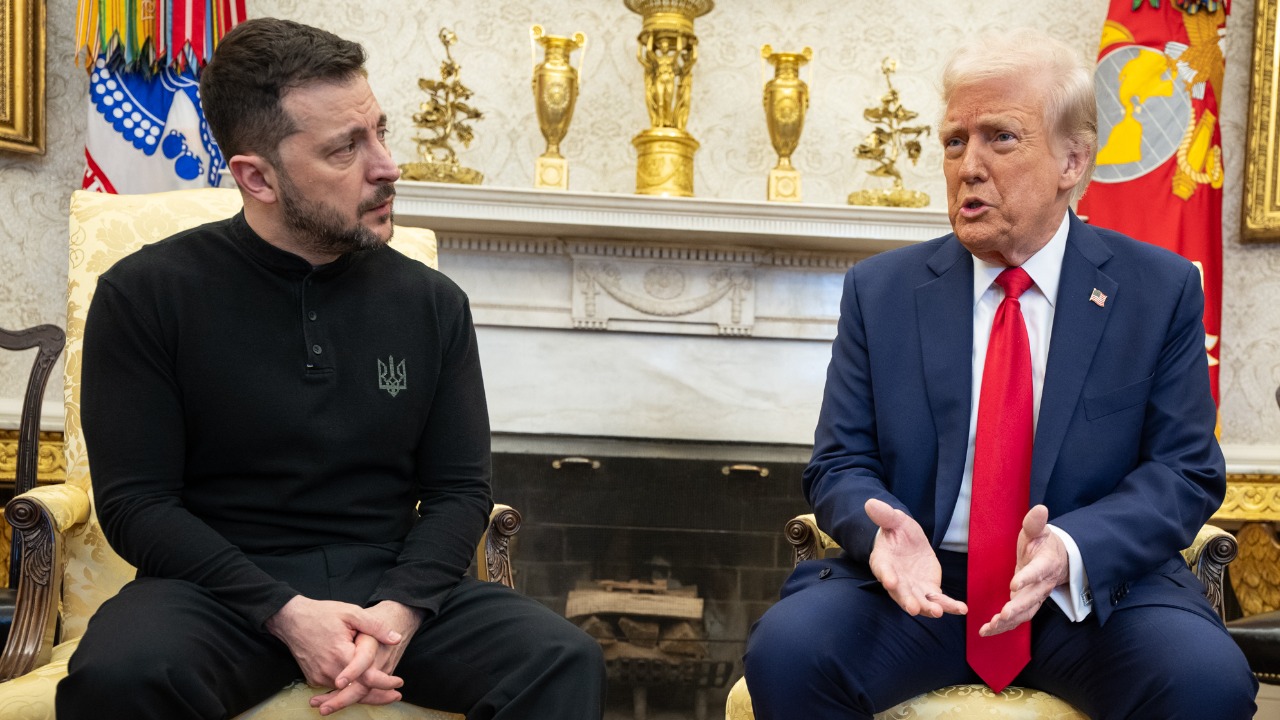
Donald Trump is now facing questions over reports that he floated a multitrillion dollar “peace” scheme for Ukraine that would also unlock a massive cash windfall for the United States. The alleged $2 trillion concept, framed as a way to end the war while monetizing frozen Russian assets, has quickly become a test of how far Washington is willing to go in turning sanctions into a revenue stream.
As details of the reported plan seep out, the stakes extend well beyond Kyiv and Moscow, touching global financial stability, the future of sovereign immunity, and Trump’s own promise to “cash in” on America’s leverage over Russia. I see the emerging debate as less about one headline number and more about whether the United States is prepared to rewrite the rules of wartime finance in real time.
What the reported $2 trillion “peace” proposal actually envisions
The core of the leaked concept, as described by people familiar with Trump’s thinking, is deceptively simple: use frozen Russian state assets as both a bargaining chip and a funding source to push Ukraine and Russia toward a settlement. In this telling, Trump would seek to convert a large share of those immobilized reserves into a structured payout that could reach roughly $2 trillion over time, with a portion earmarked for Ukraine’s reconstruction and a substantial slice flowing back to the United States budget as a kind of geopolitical dividend. That framing aligns with broader discussions in Washington about tapping Russian funds for Kyiv, but the reported scale and the explicit promise of a U.S. “profit” mark a sharp escalation from existing proposals anchored in more limited asset-use mechanisms documented in European plans and U.S. legislative drafts.
What makes the $2 trillion figure so striking is how far it stretches beyond the roughly $300 billion in Russian central bank reserves that Western governments have frozen, a total that multiple analyses of Russian assets place in that same ballpark. To get anywhere near Trump’s reported target, the plan would have to assume long-term financial engineering on top of the principal, such as securitizing expected returns, leveraging future interest income, or pairing Russian funds with additional borrowing that is repaid from sanctions-related revenue. That kind of structure echoes, in exaggerated form, the way the European Union has already agreed to channel profits generated by immobilized Russian reserves into Ukraine support, a move laid out in detail in recent EU documentation on using interest income rather than seizing the underlying capital.
How frozen Russian assets became the centerpiece of Ukraine financing
To understand why a U.S. president would even contemplate a multitrillion dollar “peace cash-in,” it helps to trace how Russian assets turned into the West’s favorite funding source for Ukraine. After Russia’s full-scale invasion, the United States, the European Union, and partners moved quickly to immobilize Russian central bank reserves held in their jurisdictions, ultimately locking down about $300 billion, with roughly two thirds parked in European financial institutions according to EU figures. That unprecedented step created a vast pool of idle money that could not be repatriated to Moscow but also could not be easily confiscated without colliding with long-standing norms on sovereign immunity and property rights.
Over the past year, policymakers have edged from caution toward more aggressive use of those funds, though they have mostly stopped short of outright seizure. The European Union has already approved a framework to skim the net profits generated by the frozen reserves and direct them to Ukraine’s military and reconstruction needs, a shift spelled out in technical guidance that carefully distinguishes between using interest income and expropriating the principal. In Washington, lawmakers have debated broader tools, including legislation that would authorize the United States to confiscate Russian state assets outright and transfer them to Kyiv, a concept that appears in several congressional proposals. Trump’s reported $2 trillion idea effectively jumps to the end of that conversation, treating the frozen reserves not just as a support mechanism for Ukraine but as a revenue engine for the United States itself.
The legal and financial minefield behind a $2 trillion “cash-in”
Turning immobilized Russian reserves into a multitrillion dollar payout would collide with a thicket of legal constraints that current policymakers have only begun to test. Sovereign assets held in foreign central banks are typically protected by immunity doctrines that make them extremely difficult to seize, a principle that Western governments have long defended to safeguard their own reserves abroad. The European Union’s decision to use only the profits on Russian assets, rather than the principal, reflects that caution and is explicitly framed in EU legal analysis as a way to stay within international law while still extracting value for Ukraine. Any U.S. move to go further, especially at the scale implied by a $2 trillion scheme, would invite immediate legal challenges from Russia and potentially from private institutions that hold or manage the funds.
Beyond the courtroom, the financial system itself could react sharply if Washington is seen as monetizing frozen reserves for domestic gain rather than strictly for war-related reparations. Central banks in countries that are not aligned with U.S. sanctions policy already monitor how Russian assets are treated, and several market-focused reports have warned that aggressive confiscation could accelerate efforts to diversify away from the dollar and euro. A Trump-led push to convert Russian funds into a long-term revenue stream for the U.S. Treasury would likely intensify those concerns, especially if it is framed as a “cash-in” rather than a narrowly tailored reparations mechanism. That is why current Western plans emphasize limited, rules-based use of profits and stress that any broader seizure would be tied to a negotiated settlement or a clear legal finding of Russian responsibility for war damage, as reflected in recent EU and G7 communiqués.
Trump’s political calculus and the promise to “profit” from peace
Politically, the leaked $2 trillion idea fits neatly into Trump’s long-running narrative that the United States should treat its geopolitical leverage as a business asset. He has repeatedly argued that allies should pay more for security guarantees and that Washington should extract tangible returns from its role as the world’s dominant financial power, themes that surface in his public comments on NATO burden sharing and trade. A plan that claims to end the war in Ukraine while delivering a massive cash benefit to U.S. taxpayers would allow him to present sanctions not just as punishment for Russia but as a lucrative deal for Americans, a framing that echoes his broader rhetoric about turning foreign policy into a series of profitable transactions documented in campaign coverage.
At the same time, the politics of such a proposal are more complicated than a simple “America gets paid” slogan suggests. Many Republicans in Congress have grown skeptical of open-ended Ukraine aid, but they have also championed strong sanctions on Russia and cast themselves as defenders of the dollar-based financial order, positions that could clash with a plan that risks undermining global trust in U.S. reserves. Democrats, for their part, have generally supported using Russian assets to help Ukraine but have framed it as a matter of accountability and reconstruction, not as a windfall for the U.S. budget, a distinction that appears in several legislative debates over asset seizure authority. If Trump pushes a “peace cash-in” as a signature initiative, I expect the fight in Washington to center less on whether to tap Russian funds at all and more on whether it is legitimate to turn them into a domestic profit center.
What it would mean for Ukraine, Russia and the wider sanctions regime
For Ukraine, a Trump-driven settlement built around monetizing Russian assets would be a double-edged proposition. On one hand, a structured use of frozen reserves could provide a predictable stream of funding for reconstruction and security, potentially more stable than annual appropriations battles in Western parliaments. That is precisely why Kyiv has lobbied so hard for full confiscation of Russian state assets and why Ukrainian officials have welcomed EU moves to direct profits from immobilized reserves to their war effort, a stance reflected in recent diplomatic readouts. On the other hand, if the United States positions itself as the primary financial beneficiary of a $2 trillion structure, Ukrainian leaders could find themselves pressured to accept territorial or political concessions in exchange for a deal that is marketed in Washington as a fiscal victory.
For Russia and the broader sanctions regime, the implications would be even more far reaching. Moscow has already condemned Western moves to use profits from its frozen reserves as “theft,” and officials have warned that any outright seizure of principal would be treated as a permanent rupture with the West, a stance captured in multiple Russian statements. If the United States were to go further and openly structure a multitrillion dollar payout for itself, it would likely harden the Kremlin’s resolve to retaliate against Western assets in Russia and accelerate efforts by countries like China, India and Saudi Arabia to reduce their exposure to U.S. and EU financial systems. That is the strategic trade-off at the heart of the leaked plan: a short-term “cash-in” that could deliver a headline-grabbing sum for Washington, at the potential cost of weakening the very sanctions architecture that gave the United States that leverage in the first place, a risk that several policy analyses have flagged as the debate over Russian assets intensifies.
More From TheDailyOverview
- Dave Ramsey says these two simple questions show whether you’re rich or poor
- Retired But Want To Work? Try These 18 Jobs for Seniors That Pay Weekly
- IRS raises capital gains thresholds for 2026 and what’s new
- 12 ways to make $5,000 fast that actually work

Grant Mercer covers market dynamics, business trends, and the economic forces driving growth across industries. His analysis connects macro movements with real-world implications for investors, entrepreneurs, and professionals. Through his work at The Daily Overview, Grant helps readers understand how markets function and where opportunities may emerge.

