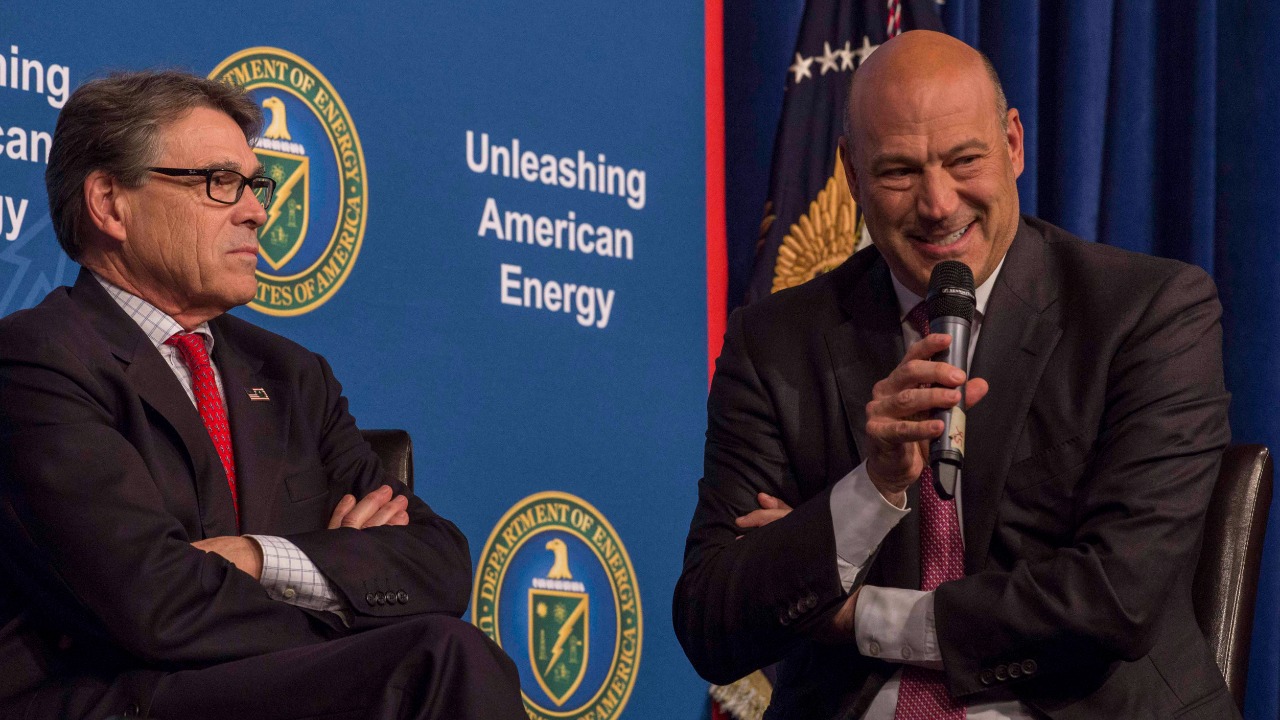
Donald Trump’s former top economic adviser is sounding an alarm that cuts against the usual victory laps about growth and markets. Gary Cohn, who once helped sell the promise of broad prosperity, now argues that the United States has split into a “K-shaped” economy where asset owners surge ahead while workers struggle to cover the basics. His warning lands at a moment when headline numbers look solid but the lived reality for many Americans is defined by rising bills, stagnant savings, and a sense that the ladder up is pulling away.
At the heart of Cohn’s critique is a simple contradiction: the same forces that have inflated stock portfolios and home values have also magnified the cost of everyday life. When a former chief economic adviser to Trump says workers are “suffering,” he is not talking about a technical recession. He is describing a country where the top of the “K” enjoys a massive wealth effect and the bottom fights to keep the lights on.
The K-shaped split Cohn says is leaving workers behind
Gary Cohn has framed today’s landscape as an “interesting economy” in which the aggregate data looks strong but the distribution of gains is deeply skewed. He argues that the United States is experiencing a “massive wealth effect at the top end,” with affluent households benefiting from surging asset prices while “hardworking Americans” find it “very difficult” to pay their bills. In his view, the same boom that has lifted stock indices and luxury real estate has not translated into security for the typical paycheck-to-paycheck household, a gap that he says is leaving workers “suffering” in America’s K-shaped recovery and expansion, a point he has pressed in recent comments.
Cohn’s diagnosis is not just rhetorical. He has stressed that “affordability will be the issue” that defines the economic debate, warning that the divergence between those riding the upper arm of the “K” and those stuck on the lower arm is becoming a central fault line in America. He points to the way asset inflation has enriched investors while wages struggle to keep pace with the cost of housing, healthcare, and other essentials, a pattern he has described as a “key issue going forward” for Americans as they weigh their economic choices and political priorities, a concern he underscored in a detailed assessment.
Why the top is thriving while the bottom strains
The K-shaped metaphor captures a simple reality: some sectors and households are climbing sharply while others flatten out or decline. Analysts who have tracked this pattern since the pandemic say it reflects how technology, financial markets, and policy choices have favored capital over labor. A recent examination of the “K-shaped economy in 2026” notes that the term, first popularized during the Covid shock, now describes a structural divide in which high earners and asset owners continue to pull away, while lower income workers face entrenched Inequality and limited mobility, a trend that report identifies as a central Key challenge for the next phase of growth.
That split is visible in everything from stock ownership to job security. Households with significant investments in equities and property have seen their net worth swell, reinforcing the “massive wealth effect” Cohn describes. At the same time, many service workers, renters, and those without large savings are contending with higher borrowing costs and volatile hours. Earlier this year, one analysis described “the K-shaped economy of the rich doing fine and everyone else struggling” as having returned in full force, warning that this pattern could make 2026 a rocky period for those outside the upper tier even as markets respond to decisions by the Federal Reserve and its voting members, a concern laid out in a recent overview.
Strong macro numbers, fragile household budgets
Part of what makes Cohn’s warning so striking is that it comes against a backdrop of relatively upbeat macroeconomic projections from the White House. Officials have talked about a return to growth of 3% to 4% by early 2026 after the drag from a government shutdown, with White House economic adviser Kevin Hassett pointing to a strong recovery following the disruption as a realistic goal, a case he laid out in recent projections.
Independent forecasters, however, have been more cautious about how that growth will feel on the ground. In one survey of economists, None saw tariffs boosting growth, and Their median projection was for the economy to grow 1.8% in 2025, compared to 1.3% projected in the prior year, a modest improvement that still leaves little margin for error for households squeezed by higher costs and debt, according to those estimates. The gap between upbeat official targets and more restrained private forecasts mirrors the broader disconnect Cohn is highlighting: a system that can post respectable growth rates while leaving large parts of the workforce feeling no better off.
The affordability crunch hitting the working class
For workers on the lower arm of the “K,” the problem is not abstract. It shows up in the grocery aisle, at the pharmacy counter, and in the monthly rent notice. A detailed look at household finances under the banner “The Affordability Crisis Is Here, Hitting the Working Class the Hardest” describes how rising prices for healthcare, groceries, and other essentials are battering Americans who already juggle medical bills, credit card balances, and personal loans. That reporting notes that Americans in the working class are being hit hardest as they try to manage medical debt, higher insurance premiums, and everyday expenses that outpace their paychecks, a burden documented in a recent investigation.
Cohn’s focus on affordability echoes that reality. He has warned that even as the upper tier enjoys the benefits of rising portfolios, many families are forced to lean on credit to cover basics, leaving them exposed to interest rate hikes and economic shocks. In his view, the K-shaped pattern is not just about income inequality but about the erosion of financial resilience for those outside the top. When a car repair or a surprise medical bill can tip a household into delinquency, the promise of a “strong” economy rings hollow, a point he has tied directly to the way affordability has become the defining issue for working Americans in his recent warnings.
What policy shifts could bend the “K” back toward the middle
If the diagnosis is a K-shaped America, the obvious question is how to flatten the divergence. Joe Brusuelas, the chief economist of RSM, has argued that the United States will need meaningful policy shifts to reshape this trajectory. In a recent briefing, he said the country must confront “fundamental inequality in coming years,” suggesting that without deliberate changes in tax policy, labor standards, and investment in human capital, the current pattern will harden into a permanent feature of the economy, a view he outlined as RSM’s assessment of the road ahead.
Cohn, for his part, has framed the stakes in political as well as economic terms. He has warned that the combination of a “massive wealth effect at the top end” and “hardworking Americans” struggling to pay their bills will shape voter behavior and policy debates well beyond the next election cycle. In his view, the persistence of this divide will be a “key issue going forward” as Americans decide whether current strategies are delivering for them, a concern he has linked to the broader conversation about growth, inequality, and the direction of Trump-era and post-Trump economic policy in his recent analysis.
More From TheDailyOverview
*This article was researched with the help of AI, with human editors creating the final content.

Grant Mercer covers market dynamics, business trends, and the economic forces driving growth across industries. His analysis connects macro movements with real-world implications for investors, entrepreneurs, and professionals. Through his work at The Daily Overview, Grant helps readers understand how markets function and where opportunities may emerge.

