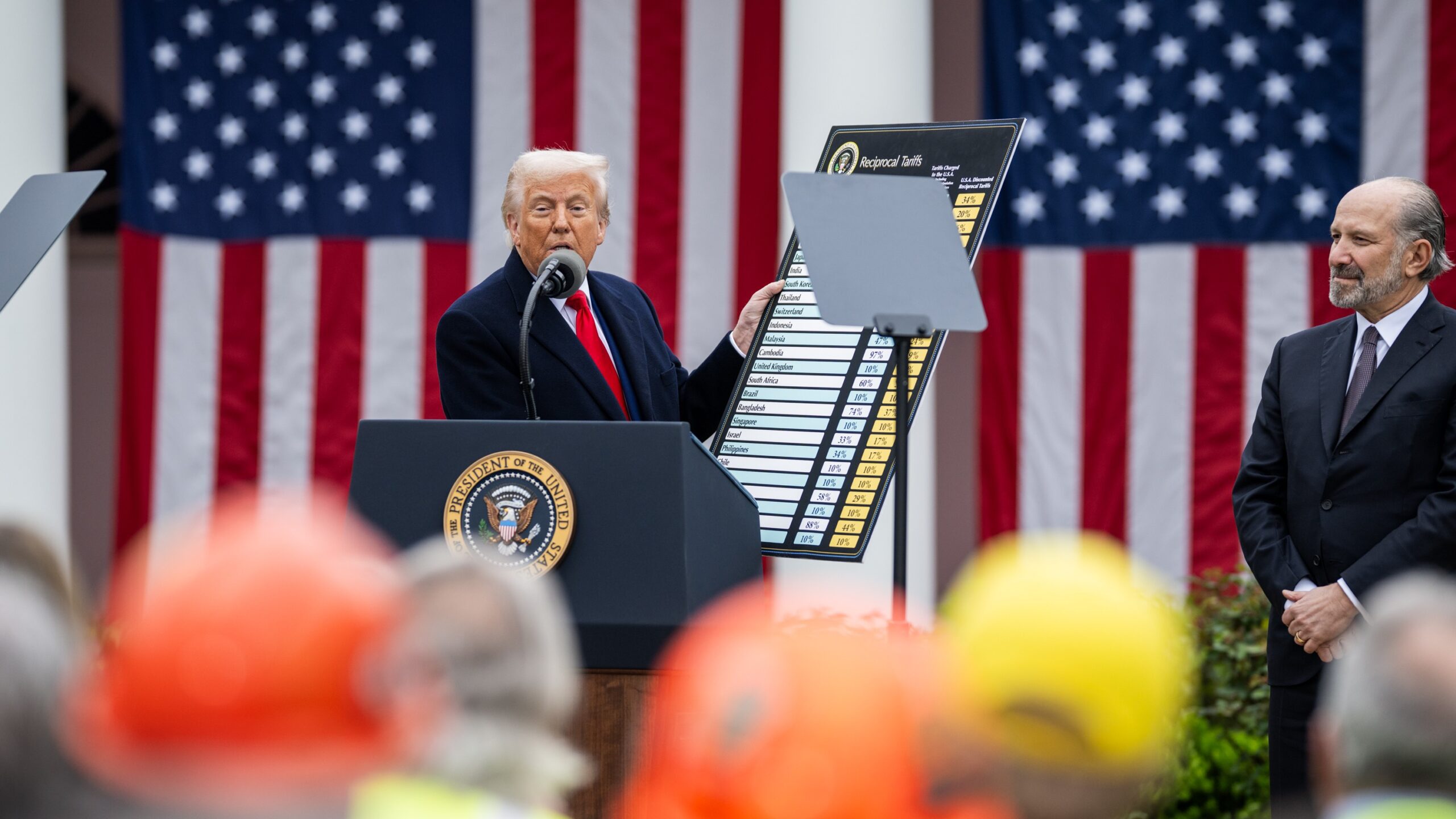
Donald Trump is pitching his second-term economic agenda as a one-two punch: sweeping tax cuts paired with tough new tariffs on imports. New modeling shows those two promises collide, leaving typical households worse off even after they receive income tax refunds. The average American is projected to lose $300 a year on net, as higher prices from tariffs overwhelm what Trump calls “the largest tax cut in American history.”
Behind that headline figure is a straightforward story about who really pays for tariffs and how they operate as a hidden tax. Rather than foreign governments footing the bill, research finds that American consumers and businesses absorb nearly all of the cost through higher prices, reduced wages, or both. When those costs stack up to four figures per household, the promised tax cut starts to look less like a windfall and more like a partial rebate on a bigger bill.
How Trump’s tariffs function as a tax hike
Trump has framed tariffs as a way to shift the tax burden away from workers and toward foreign producers, but the mechanics of trade policy do not work that cleanly. A broad review of Trump tariffs finds that import duties behave like an extra sales tax layered on top of existing prices, raising costs throughout the supply chain. When a container of steel, electronics, or clothing enters a U.S. port, the tariff is paid by the importer, who then passes that cost along to wholesalers, retailers, and ultimately households.
Economists who examined the trade war under the International Emergency Economic Powers Act, or IEEPA, describe a pattern that looks less like targeted punishment of foreign firms and more like a general tax on American consumption. Their analysis concludes that the Trump tariffs reduce wages, trim employment, and lower economic output, a profile that mirrors other broad-based taxes on production and trade. In practical terms, tariffs raise the cost of everyday goods from smartphones and washing machines to construction materials, which is why they show up in household budgets even if families never see a line item labeled “tariff” on a receipt.
The $300 net loss behind the “largest tax cut” claim
Trump’s headline political claim is simple: he says he will deliver the biggest tax cut in U.S. history, financed in part by tariffs on imports. The fiscal math behind that promise is far less flattering for households. A detailed estimate of the combined plan finds that, once both the income tax reductions and the higher prices from tariffs are accounted for, the average person ends up losing $300 each year on net, even after receiving their refund. In other words, the tax cut is more than offset by the extra money siphoned away at the checkout line and in higher business costs.
The same modeling also shows why the rhetoric about foreign countries “paying” for the tax cut does not match the data. Over the next decade, tariffs will raise a net $1.9 trillion in revenue between 2025 and 2034, while the income tax cuts reduce federal receipts by a larger amount. The problem for households is that the revenue from tariffs is not coming from abroad; it is being collected from Americans through higher prices. When the same families who receive tax relief also supply the tariff revenue, the net effect looks less like a gift and more like shifting money from one pocket to another, with some lost to slower growth.
Household hit: from $1,000 to $1,300 and beyond
Zooming in on family budgets shows just how large the tariff bite becomes before any tax cuts are applied. A recent analysis of The Trump tariffs calculates that they amount to an average tax increase per U.S. household of $1,000 in 2025 and $1,300 in 2026. Those figures reflect the combined effect of higher prices on imported goods and the ripple impact on domestically produced items that rely on foreign components.
Comparing those numbers to the promised tax relief makes the gap clear. Even if a family sees a few hundred dollars shaved off its income tax bill, the tariff burden alone can easily surpass that benefit, especially for households that spend a larger share of their income on goods rather than services. A separate breakdown of the new report from the Tax Foundation confirms that the average tariff burden for U.S. households already sits in that four-figure range, which makes a $300 net loss after refunds entirely plausible once the full policy package is in place.
Who really pays: Americans, not foreign exporters
The core political selling point of tariffs is that they supposedly shift the burden to other countries, but the latest trade data tell a different story. One detailed analysis of Americans paying the cost of Trump’s tariffs finds that domestic consumers and firms shoulder about 90 percent of the total. That means when tariffs generate revenue for the U.S. Treasury, the money is overwhelmingly coming from American pockets, not from foreign treasuries or overseas manufacturers.
The same dataset tracks how the burden has shifted over time. In October, the tariff incidence inched lower to 92%, and by November, the most recent data available, it stood at 86%. In October the share of the burden carried by Americans was slightly higher, and although it eased somewhat by November, the overwhelming majority of the cost still fell on U.S. households and businesses. While there is some variation month to month, the pattern is consistent with what trade economists have long argued: tariffs behave like a domestic tax, not a foreign subsidy.
From $1.9 trillion in tariff revenue to slower growth
Looking beyond individual households, the combined plan has major implications for the federal budget and the broader economy. The current proposal would generate a large stream of tariff revenue, with tariffs will raise a net $1.9 trillion between 2025 and 2034 according to one estimate. At the same time, the income tax cuts would reduce federal receipts by roughly twice that amount, creating a fiscal gap that would need to be financed through higher borrowing, spending cuts, or future tax increases.
Independent macroeconomic modeling suggests that the growth hit from tariffs is large enough to undercut some of the benefits of lower income taxes. Researchers at PWBM describe Trump’s tariffs as an “otherwise highly distorting tax” and warn that many trade models understate the full harm. Their projections show that the new duties would reduce long-run economic output, cut investment, and lower wages compared with a scenario without the tariffs. When slower growth is layered on top of higher consumer prices, the package starts to look less like a growth plan and more like a reshuffling of who pays which tax, and when.
Tax cuts, tariff rebates, and the $2,000 promise
Trump has tried to square this circle by talking up “tariff rebates” that would send money directly back to households. Over the summer he promised $2,000 in such rebates for every American, a pledge that has circulated widely on social media and in campaign speeches. A widely shared post about $2,000 tariff rebates highlights how attractive that kind of simple, round-number promise can sound compared with the more complicated reality of who pays tariffs and how the revenue is used.
The policy details behind those rebates remain vague, and the fiscal math is challenging. To send $2,000 to every American would require hundreds of billions of dollars a year, far more than the typical household’s net gain from the income tax cuts. Meanwhile, a separate explainer on why Tariffs, which are on imported goods, are generally considered regressive underlines the distributional problem. Lower income households spend a larger share of their budgets on tradable goods, so they would need disproportionately large rebates just to break even. Without a detailed mechanism that channels more money back to those groups, the combination of tariffs and flat rebates risks widening inequality rather than narrowing it.
How economists measure the trade war’s damage
Behind all of these numbers is a growing body of research on the economic impact of the Trump trade war. A major study of the average tax increase from tariffs concludes that they function as a broad-based levy on consumption that depresses wages and employment. By raising the cost of imported inputs, tariffs make it more expensive to produce everything from cars and appliances to housing and infrastructure, which in turn reduces investment and hiring across the economy.
Another line of research from the Federal Reserve Bank of New York focuses on how the tariff burden is split between foreign and domestic actors. A new report from confirms what trade economists had already suspected: foreign exporters have not meaningfully cut their prices to absorb the tariffs, leaving U.S. firms and consumers to pick up almost the entire tab. Taken alongside the household-level estimates, the picture is consistent. Tariffs are not a free lunch paid for by other countries; they are a domestic tax that shows up in slower wage growth, higher prices, and reduced economic output.
Who wins and who loses from the combined plan
The distributional effects of Trump’s tax and tariff agenda are as important as the averages. A detailed breakdown of how Americans with different incomes fare under the plan shows that high earners tend to benefit more from income tax cuts, while lower and middle income households feel the tariff burden more acutely. That is partly because wealthier families save a larger share of their income and spend more on services that are less affected by tariffs, whereas working class households devote more of their budget to goods like food, clothing, and household items that are directly hit by import duties.
At the same time, the new analysis of how Trump’s tariffs cancel his claimed tax cut shows that the net $300 loss is an average, not a cap. Some households, particularly those with modest incomes and high exposure to import-heavy spending, will lose more than that, while a smaller group of high earners could still come out ahead. The result is a policy mix that narrows the benefits of the tax cuts and spreads the costs of tariffs widely, a combination that runs counter to the populist framing of the plan.
Why the politics still favor tariffs
Given the data, it might seem surprising that tariffs remain politically attractive, but the incentives are clear. Tariffs are collected quietly at the border, while income tax cuts are highly visible in paychecks and refunds, so voters feel the benefit more directly than the cost. Many people also find the story that foreign governments will “pay” for domestic tax cuts intuitively appealing, especially when it is paired with anger over trade deficits or factory closures. That gap between perception and reality helps explain why a policy that functions as a tax hike can be sold as a tax cut.
Communication choices also matter. Campaign messaging tends to focus on simple promises like $2,000 rebates and the “largest tax cut,” not on the fine print of tariff incidence or the mechanics of the International Emergency Economic Powers Act. A concise summary of how Americans are paying the bulk of the tariff costs rarely fits into a rally speech or a short social media clip. That asymmetry leaves room for policies that look generous on the surface but, once the math is done, leave the typical household paying more overall, not less.
More From The Daily Overview
*This article was researched with the help of AI, with human editors creating the final content.

Grant Mercer covers market dynamics, business trends, and the economic forces driving growth across industries. His analysis connects macro movements with real-world implications for investors, entrepreneurs, and professionals. Through his work at The Daily Overview, Grant helps readers understand how markets function and where opportunities may emerge.

