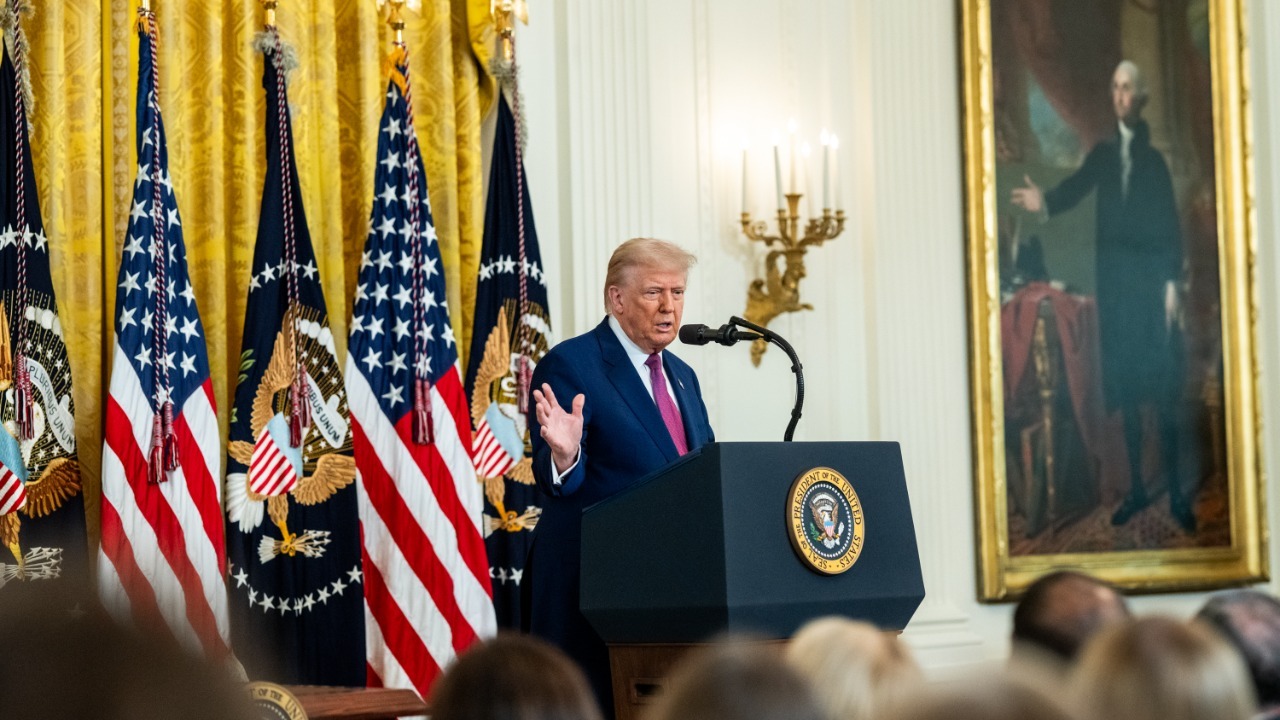
President Donald Trump promised that his corporate tax overhaul would unleash a wave of investment and jobs. Buried in the fine print, it also delivered a quiet windfall to one of the country’s most powerful companies, Amazon, by sharply reducing what the retailer owes the federal government. The result is a multibillion dollar shift in who pays for public services, with Amazon’s shareholders on one side of the ledger and ordinary taxpayers on the other.
I see the story of Trump’s tax law and Amazon as a case study in how modern tax policy is written: in technical language that obscures very large numbers. The law’s mix of rate cuts, special deductions, and timing gimmicks did not just trim Amazon’s bill at the margins, it rewired the way the company accounts for investment and profit in the United States.
How Trump’s tax law rewrote Amazon’s bill
The centerpiece of the overhaul was a deep cut in the corporate tax rate combined with a suite of targeted preferences for capital spending and research. For a company that spends heavily on data centers, logistics hubs, and software, that structure was almost tailor made. Reporting on the law’s impact shows that Breaks for investment and research significantly lowered Amazon’s payments to the U.S. government, turning what would have been a far larger tax liability into a manageable line item. Those provisions did not emerge by accident, they reflected a policy choice by Republicans to reward companies that could move quickly to expand their capital base.
Earlier this year, detailed accounts of Amazon’s filings showed just how large the benefit became. The company recorded $11.1 billion in deferred U.S. taxes alongside $1.2 billion in current taxes, a structure that lets it push much of its obligation into the future while enjoying the cash flow today. That accounting outcome is not a loophole in the traditional sense, it is the direct product of how Trump’s law told companies to treat investment and profit over time.
The “Big Beautiful” bonus for capital spending
One of the most lucrative features of the overhaul was a provision that let companies immediately deduct the full cost of certain investments. Supporters framed this as a way to spur factories and equipment purchases, but for a tech and logistics giant it was even more powerful. The law effectively reinstated 100% bonus depreciation, a rule that lets companies write off the entire cost of qualifying assets in the year they are placed in service instead of spreading deductions over many years. For Amazon, which constantly builds fulfillment centers and server farms, that meant an immediate reduction in taxable income every time it poured money into physical infrastructure.
Analysts described this as a Big Beautiful benefit for Amazon and other capital intensive tech firms, because it turned long term investment plans into near term tax shelters. The more the company spent on warehouses, robotics, and cloud infrastructure, the more it could shield its profits from the Internal Revenue Service. That is how a policy sold as a broad incentive for U.S. investment became a particularly rich subsidy for a handful of giants that already dominated their markets.
A multibillion dollar gift, measured in the fine print
To understand the scale of the advantage, it helps to look at how much Amazon’s tax bill fell relative to its earnings. Reporting on the company’s recent results shows that the New Law’s preferences helped Amazon.com cut its US significantly, with federal income taxes declining to roughly the same $1.2 billion figure highlighted in its disclosures. When I compare that to the company’s soaring profits, the gap between what Amazon earns and what it pays in U.S. tax looks less like an accident and more like the intended outcome of the statute.
Critics of the overhaul argue that the law did not just lower Amazon’s effective rate, it structurally tilted the system in its favor. One analysis of the Trump backed package concluded that the measure congressional Republicans and US enacted slashed Amazon’s tax bill by a large percentage compared with the prior two years, underscoring how targeted the benefits were. When I look at those numbers, the phrase “multibillion dollar gift” feels less like rhetoric and more like a straightforward description of the fiscal transfer.
Political backlash and the $16 billion flashpoint
The scale of the tax savings has fueled a sharp political backlash, especially from lawmakers who see the law as a giveaway to corporate America. One of the most pointed critiques came from a social media post arguing that Trump gave Amazon a $16 billion tax break to accelerate its investments, framing the benefit as a conscious choice by the White House. That critique reflects a broader concern that the law’s most generous provisions were not neutral incentives but tailored advantages for firms with the scale and sophistication to exploit them fully.
The same post went further, warning that Trump and Amazon were effectively subsidizing automation, with the claim that 600,000 workers could be replaced with robots as a result. That figure is a political argument rather than a formal forecast, but it captures a real tension: the same tax rules that reward rapid investment in technology can also accelerate the shift away from human labor. When I weigh those concerns against the law’s stated goal of boosting jobs, the disconnect is hard to ignore.
Who pays when Amazon does not
Behind the technical language of deferred taxes and bonus depreciation lies a simple question about who ultimately funds the government. When Amazon records $11.1 billion in deferred obligations while paying a fraction of that today, the shortfall has to be covered by other taxpayers or by higher deficits. Analyses of the Trump era package stress that the law Republicans crafted for Amazon and similar firms shifted the burden away from large corporations and toward everyone else, a pattern that is now visible in the federal books.
Supporters of the overhaul argue that the investment it encouraged will eventually expand the tax base, but the early evidence is mixed. Detailed reviews of how the Big Beautiful incentives worked in practice show that Amazon and other tech giants reaped large near term savings while the promised surge in broadly shared prosperity remains harder to trace. When I connect those dots with the evidence that the New Law’s Tax Breaks Help, it is clear that Trump’s tax overhaul did more than tweak the code. It quietly rewrote who wins and who pays in the modern American economy.
More From The Daily Overview
*This article was researched with the help of AI, with human editors creating the final content.

Grant Mercer covers market dynamics, business trends, and the economic forces driving growth across industries. His analysis connects macro movements with real-world implications for investors, entrepreneurs, and professionals. Through his work at The Daily Overview, Grant helps readers understand how markets function and where opportunities may emerge.

