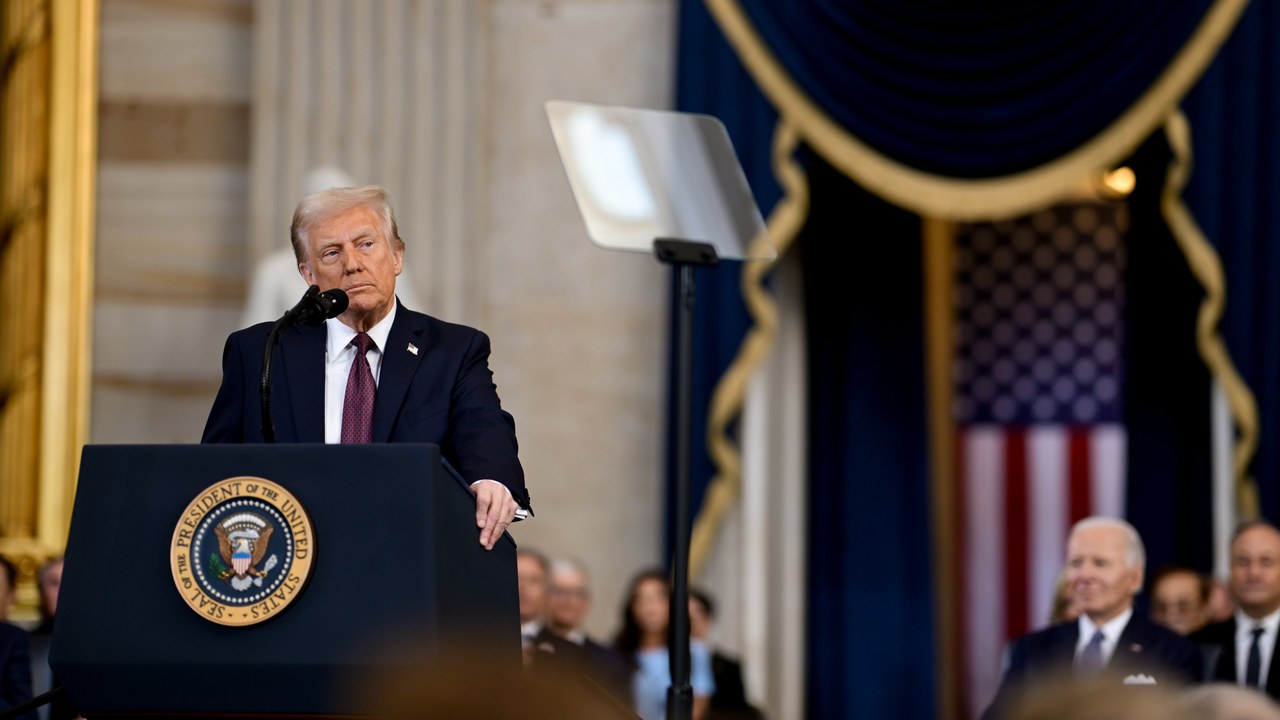
US tariff collections have exploded under President Trump, with federal receipts reportedly up roughly 300% compared with pre-tariff levels and fresh monthly data showing another powerful jump at the start of the year. That surge has turned import duties into a central pillar of Trump’s economic and fiscal pitch just as The Supreme Court prepares to rule on whether his aggressive use of emergency trade powers is legal. The outcome will determine whether this new revenue stream, and the higher consumer prices that come with it, is a lasting feature of the United States economy or a temporary experiment.
Behind the headline numbers is a high-stakes argument over who really pays for tariffs, how much they help with the deficit, and whether the president has stretched national security and emergency statutes too far. The coming decision will not only decide the fate of the current tariff wall, it will also set the ground rules for any future president who wants to use trade taxes as a political and budgetary weapon.
Tariff revenue explodes as Trump leans on import taxes
The federal government has long collected a modest share of its income from import duties, but the Trump era has turned tariffs into a much larger line item. Government data show that tariff revenue historically accounted for only a small fraction of total receipts, far below income and payroll taxes. After Trump’s latest round of levies, officials now report that US tariff revenue has surged by roughly 300%, a scale of increase that would have been hard to imagine a decade ago.
Recent monthly figures underline how aggressive the ramp-up has been. Earlier this year, analysts reported that tariff collections surged again in January, with receipts sharply higher from the year-ago period and the cumulative haul now more than 300% above pre-Trump baselines. A related breakdown notes that tariff collections surged alone compared with the same month a year earlier, underscoring how quickly the new regime is reshaping federal cash flow.
The Supreme Court showdown over Trump’s emergency powers
The revenue boom is colliding with a major legal test. Last November, the Supreme Court heard arguments over whether Trump lawfully invoked the International Emergency Economic Powers Act to impose broad new levies on trading partners, including so-called trafficking tariffs that hit Canada, Mexico, and China. Legal analysts describe how the contested measures fall into two main buckets, with one category targeting alleged trafficking links in Canada, Mexico, and and the other focused on sectors Trump framed as national security priorities.
Multiple lawsuits from importers and trade groups have already worked their way through the lower courts, challenging both the scope of the emergency declaration and the way the administration implemented the duties. Those cases have now converged in a single high-profile review by the Supreme Court, which will decide whether Trump’s interpretation of IEEPA is compatible with the statute and the Constitution. A separate analysis of the current regime stresses that The Supreme Court has not yet ruled on the constitutionality of the tariff wall and warns that, depending on the outcome, the current system could either be cemented or unwound, with potentially large consequences for U.S. economic momentum.
Who really pays: households, businesses, and “America Inc”
Trump has repeatedly argued that foreign exporters bear the cost of his tariffs, but economic research and business behavior tell a different story. One widely cited assessment of Trump’s trade war finds that President Trump’s imposed duties under the International Emergency Economic Powers Act, or IEEPA, will raise substantial federal revenue while reducing wages, employment, and output, concluding that Trump’s imposed tariffs revenue but at the cost of lower economic performance. Another projection, drawing on World Bank estimates, calculates that the higher import taxes are expected to cost American families about $1,300 in 2026, with analysts warning that the burden of the tariffs and related tax changes will fall unevenly across income groups, according to World Bank estimates.
The pain is not limited to households. From March 2025 through last November, data tracking import flows and price changes show that businesses across sectors have been squeezed by higher costs, with some factories and retailers warning they may have to cut jobs or close. That pattern is especially visible in state-level reports on affordability and inflation, where data shows that 2025, when the Trump administration began its wide-ranging tariffs, some firms have already shuttered completely because of the added costs. On the corporate side, a growing number of multinationals have joined smaller importers in challenging the levies, with one report describing how Tariff lawsuit ‘free reveal the political quandary facing America Inc as multinationals and Republicans weigh the benefits of the revenue against the hit to global supply chains.
Fiscal promises, tariff dividends, and the tax-cut clash
Trump has framed the tariff windfall as a way to tame the national debt and fund new benefits, even as independent analysts warn that the math is far from straightforward. In one fiscal projection, experts estimate that tariffs will raise a net $1.9 trillion between 2025 and 2034, while Trump’s tax cuts will reduce revenue by significantly more, leading to the conclusion that $1.9 trillion in new tariff revenue still leaves a large fiscal gap. A separate snapshot of the current situation notes that US Tariff Revenue Surges Over 300% Amid Supreme Court Wait, highlighting how the extraordinary growth in tariff receipts has become central to the budget conversation as Tariff Revenue Surges Over 300% while the Supreme Court deliberates.
Trump has also tried to translate the tariff gains into a direct political promise. President Donald Trump has again proposed $2,000 tariff dividends for most Americans, excluding high-income individuals, pitching the idea that the government could send out rebate checks funded by the import taxes. Economists cited in that debate point out that such $2,000 payments would cost billions of dollars and would not change the fact that higher prices at the checkout line are already eroding household budgets. Even some supporters acknowledge that the benefits of the tariffs and tax cuts will be felt unevenly, with one analysis of Trump’s agenda noting that President Trump’s pro-growth is delivering results despite criticism from the media and economists, while critics counter that the headline revenue figures obscure who is actually footing the bill.
Economic risks and the stakes of the Supreme Court ruling
Behind the political fight is a deeper question about long-term economic damage. A detailed analysis warns that the current tariff wall may ultimately erode U.S. economic momentum, with researchers arguing that the combination of higher import costs, retaliatory measures abroad, and uncertainty for investors could weigh on growth, according to the analysis of The Supreme Court’s pending decision. Financial market commentary echoes that concern, noting that while tariff revenue soars more than 300% as the United States awaits the ruling, the same policies are prompting reciprocal tariffs on individual countries and complicating trade relationships, as described in a report that found tariff revenue soars while partners retaliate.
More From The Daily Overview
*This article was researched with the help of AI, with human editors creating the final content.

Grant Mercer covers market dynamics, business trends, and the economic forces driving growth across industries. His analysis connects macro movements with real-world implications for investors, entrepreneurs, and professionals. Through his work at The Daily Overview, Grant helps readers understand how markets function and where opportunities may emerge.