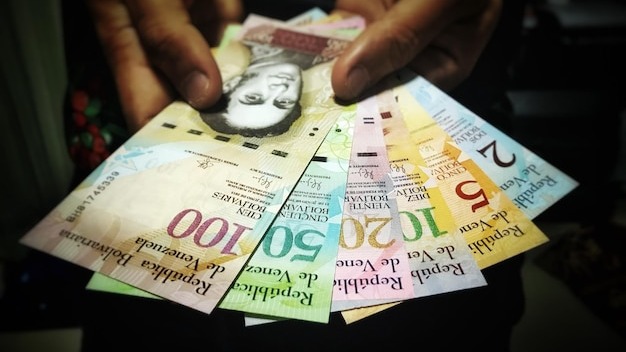
The Venezuelan government is turning again to dollar auctions as a last‑resort tool to slow a fresh collapse of the bolivar, after a sharp slide that followed the capture of Nicolás Maduro and renewed disruption to oil exports. The move signals both how fragile the country’s currency regime remains and how central access to US dollars still is for an economy battered by sanctions, inflation and years of underinvestment.
By reviving official dollar sales through local banks, officials are trying to rebuild a thin foreign‑exchange market that had largely dried up, while buying time for broader oil and economic reforms to take hold. I see this as an attempt to reassert some control over a currency that has been whipsawed by political shocks at home and shifting sentiment toward the dollar abroad.
The bolivar’s latest slide and the return of dollar auctions
The immediate trigger for the policy shift was the bolivar’s steep weakening after the United States captured Nicolás Maduro, a political shock that rattled already fragile expectations. According to one account, the currency lost more than 20 percent of its value, sliding to roughly 800 per US dollar on the parallel market, a level that underscored how little confidence remained in domestic money. That plunge came on top of earlier volatility, including a period when the official rate was updated to around 375.30 bolívares per dollar, a shift that highlighted how far the official and market prices had drifted apart.
In response, authorities have moved to restart the sale of dollars to local banks, reviving a mechanism that had been used in previous crises to inject hard currency into the system. Reports indicate that banks have begun collecting bids from clients for these auctions, although no funds had yet been disbursed as of a recent Thursday, suggesting the program is still in its early operational phase. The intention is clear: by supplying dollars directly into the local foreign‑exchange market, officials hope to halt what one description called a Halting Bolivar Rout and restore at least a semblance of price discovery.
Oil, sanctions and the scramble for hard currency
The decision to resume dollar sales cannot be separated from the country’s dependence on oil exports and the impact of US sanctions. Crude has long been Venezuela’s main source of foreign earnings, and the latest US oil blockade disruption has further constrained the flow of dollars into state coffers. One report notes that Venezuela is preparing these auctions precisely because oil remains the main source of foreign currency, and any interruption quickly feeds into exchange‑rate stress.
At the same time, the political transition after Maduro’s capture has produced new actors and new promises. Acting President Rodríguez has announced an oil reform agenda that aims to adapt to the sanctions environment, including arrangements under which US manufacturers will be allowed to buy some Venezuelan crude. Economic outlet Bitácora Económica has reported, citing unofficial sources, that the Venezuelan Central Bank is already preparing to channel part of those inflows into the revived auction system. In other words, the government is trying to turn whatever limited oil revenue it can still access into a stabilizing force for the bolivar, even as the broader sanctions regime continues to bite.
A fragile economy under pressure from inflation and low incomes
Even if the auctions succeed in slowing the currency’s fall, they will be operating against a daunting macroeconomic backdrop. Analysts have warned that 2026 could be another difficult year for the Venezuelan economy, with growth prospects constrained by weak investment, limited credit and persistent uncertainty about the policy framework. One assessment notes that While Venezuela’s government has highlighted growth figures for 2024 and 2025, economist Contreras points out that the macroeconomic outlook remains fragile and that many workers still earn less than $50 a month, leaving households extremely vulnerable to any renewed inflation.
Inflation itself has already re‑accelerated. Over the past year, high inflation has returned as a central concern, with the International Monetary Fund estimating annual price increases at about 270%, the highest in the region. Several causes have been cited, including expansive fiscal policy, exchange‑rate slippage and the lingering effects of sanctions on supply chains. In that environment, any sharp weakening of the bolivar quickly passes through to consumer prices, eroding real wages and deepening poverty. From my perspective, this is why authorities are so focused on the exchange rate: stabilizing the currency is not just a financial objective, it is a political imperative in a country where inflation has repeatedly destroyed savings.
How the auction mechanism works and what it can realistically achieve
The mechanics of the new intervention are relatively straightforward. The Venezuelan Central Bank, or BCV, allocates a pool of dollars to commercial banks, which then collect bids from companies and, in some cases, individuals seeking foreign currency. Recent reporting indicates that banks are collecting, although the first tranches of dollars had not yet been delivered when those accounts were written. Earlier in the month, the BCV had already been updating official exchange rates more frequently, a process described in one report as Venezuela Currencies Experience as the central bank adjusted its reference rate.
In theory, by supplying dollars at a transparent auction rate, the BCV can narrow the gap between the official and parallel markets, reduce speculation and give importers a clearer basis for pricing goods. In practice, the impact will depend on the volume and consistency of the interventions. If the central bank sells too few dollars, or does so sporadically, the market may treat the auctions as a temporary reprieve rather than a credible anchor. I see a risk that, without broader fiscal discipline and a clearer commitment to monetary stability, the auctions could simply slow the pace of depreciation rather than reverse it. Still, for businesses that have struggled to access foreign currency, even a modest and predictable supply can make the difference between importing essential inputs and shutting down production.
Global dollar jitters and Venezuela’s place in a shifting currency order
Venezuela’s renewed reliance on dollar sales is unfolding at a moment when the US currency itself is under scrutiny in global markets. As 2026 begins, analysts have noted that the dollar is under sustained pressure after a notably weak 2025, trading near multi‑month lows against a basket of peers. One commentary argues that the capture of Maduro should make Washington worry about the dollar’s geopolitical role, since the global financial system ultimately runs through US institutions and can be weaponized through sanctions, but that same leverage can encourage some countries to seek alternatives. The analysis of these dynamics is laid out in detail in a piece that examines why the dollar faces new challenges.
At the same time, global investors have been shifting into hard assets, with Gold climbing to a fresh record above $4,600 an ounce as part of a broader “sell America” mood in markets. For Venezuela, which has long been at the sharp end of US financial power, these global tremors are a reminder that its domestic currency drama is nested inside a larger debate about the future of the dollar system. Yet for now, the country has little choice but to keep using the US currency as both a lifeline and a policy instrument, even as some of its allies talk about de‑dollarization. That tension, between dependence and resistance, is likely to shape how far the new authorities can go in rebuilding confidence at home.
More From TheDailyOverview

Grant Mercer covers market dynamics, business trends, and the economic forces driving growth across industries. His analysis connects macro movements with real-world implications for investors, entrepreneurs, and professionals. Through his work at The Daily Overview, Grant helps readers understand how markets function and where opportunities may emerge.

