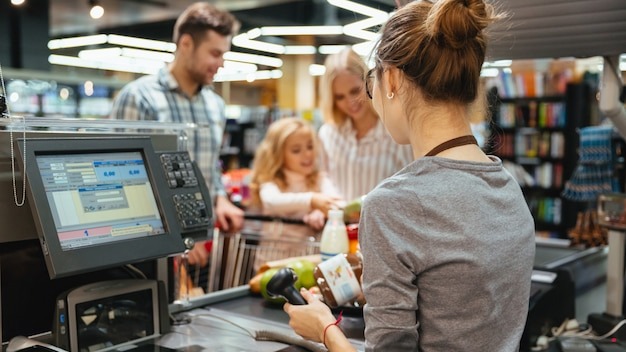
Walmart is changing how its members check out in stores, and the update is designed to eliminate one of the most common frustrations in retail: waiting in line. The retailer’s Mobile Scan and Go feature lets Walmart+ members use their phones to scan items as they shop, then complete payment at a self-checkout kiosk in seconds. The result is a faster, more self-directed shopping trip that could reshape how millions of people move through Walmart’s stores.
How Phone-Based Scanning Replaces the Register Line
The core idea behind Mobile Scan and Go is simple: instead of loading a cart, standing in line, and unloading everything onto a belt or scanner, shoppers use the Walmart app to scan items while shopping. Each product’s barcode gets logged directly into the app as the customer walks the aisles, creating a running tally of the cart in real time. The process turns the entire store into a kind of rolling checkout, with the phone acting as both scanner and running receipt, so shoppers can see their total as it builds and adjust on the fly.
Once a shopper finishes picking up everything they need, the final step happens at a self-checkout kiosk. The customer taps checkout in the app and scans a QR code displayed on the kiosk’s screen. That QR code pairs the phone to the register, transferring the full cart digitally in a single handshake. There is no need to re-scan each item individually at the kiosk, which is where the real time savings kick in for anyone who has ever stood behind a full cart at a traditional self-checkout station. Instead, the kiosk session is focused on confirming details and paying, compressing what used to be several minutes of scanning into a brief stop.
What Happens After the QR Code Pairs
Pairing the phone to the kiosk is not the absolute last step. According to Walmart’s terms, customers follow on-screen prompts that may include weighing or counting produce and completing age verification for restricted items like alcohol or certain over-the-counter medicines. These steps mirror what happens at any standard self-checkout lane, but the difference is that the bulk of the scanning work is already done before the shopper reaches the kiosk. For most baskets, that means the only remaining tasks are confirming a few details, bagging, and paying.
After clearing any prompts, the customer selects a payment method from Walmart Wallet options and completes the transaction. A digital receipt is generated instantly, which means there is no paper slip to lose and no ambiguity about what was purchased. For returns or price disputes, that digital trail is stored directly in the app, giving shoppers a clean record of every Scan and Go transaction without having to dig through email or physical folders. The app-based record also makes it easier to track household spending over time, since each visit’s total is tied to a specific store, date, and list of items.
The Spot-Check Trade-Off
One detail that shoppers should be aware of is that Walmart reserves the right to conduct an item check after a Scan and Go purchase is completed. This means a store associate may ask to verify that the items in the cart match what was scanned and paid for, much like receipt checks at warehouse clubs. The policy is spelled out in the retailer’s terms and applies to any customer using the feature, regardless of basket size. In practice, this can look like an associate scanning a few items at random or comparing the digital receipt to what is in the cart.
This is where the convenience story gets a bit more complicated. Scan and Go puts trust in the customer to accurately scan every item, and the spot-check mechanism is Walmart’s way of managing that risk. For honest shoppers, it adds a brief pause on the way out the door, cutting into but not erasing the time saved by skipping the traditional line. For Walmart, it serves as a deterrent against shrinkage, which has been a persistent concern across the retail industry as retailers balance convenience with loss prevention. The trade-off is real, faster checkout in exchange for the possibility of a quick audit. Most coverage of Scan and Go glosses over this friction point, but it is a meaningful part of the experience, especially for shoppers who expect a completely hands-off exit. That said, the spot-check is not guaranteed on every visit; it appears to be selective rather than universal, which means most trips will likely end with a smooth walk to the parking lot and no additional steps beyond paying at the kiosk.
Why This Matters for Everyday Shoppers
The practical appeal of Scan and Go is straightforward: it collapses the checkout process into something that happens alongside the shopping itself. Instead of two distinct phases (browsing and then waiting), the work overlaps. For parents managing kids in a cart, for shoppers on a tight lunch break, or for anyone doing a large weekly run, that overlap can turn a 45-minute trip into something noticeably shorter, especially during peak hours when lines tend to form. The ability to scan as items go into the cart also helps shoppers avoid last-minute surprises at the register, since the running total is visible on the phone screen the entire time.
Walmart’s own marketing frames the feature with a direct pitch to shoppers who value speed, describing it as a way to shop and check out fast with a phone. The feature is available to Walmart+ members, tying it directly to the retailer’s broader subscription strategy. By making the in-store experience faster and more convenient for paying members, Walmart adds a tangible reason to maintain or start a Walmart+ subscription beyond perks like free delivery and fuel discounts. For frequent in-store shoppers, the time savings and app-based receipts can be compelling enough to turn a subscription from a nice-to-have into something that feels like part of their weekly routine.
Where Scan and Go Fits in the Bigger Picture
Self-checkout technology has been a polarizing topic in retail for years. Some shoppers appreciate the independence and speed, while others find the machines clunky and error-prone, especially when prompts interrupt the flow of scanning. Scan and Go sidesteps many of the common complaints about traditional self-checkout by moving the scanning step away from the kiosk entirely. The kiosk becomes a payment terminal, rather than a scanning station, which reduces the bottleneck that forms when one customer struggles with a barcode or an unexpected item in the bagging area. By shifting the workload to the phone, Walmart is effectively spreading out the checkout process across the entire store instead of concentrating it at the front.
The approach also shifts the labor question. Traditional self-checkout still requires associates to monitor lanes, clear errors, and verify age-restricted purchases, often for multiple customers at once. Scan and Go does not eliminate those needs entirely, since produce weighing and age checks still happen at the kiosk, but it does reduce the per-customer interaction time and the number of scans handled by store hardware. That could allow stores to reallocate staff toward stocking, customer service, or other floor tasks during peak hours, while still maintaining oversight at the front end. There is a broader competitive angle as well. Other retailers have experimented with app-based checkout and cashierless concepts, but Walmart’s version is built around existing self-checkout infrastructure, which makes it easier to roll out widely. With thousands of locations across the country, even a modest adoption rate among Walmart+ members could affect how tens of millions of shopping trips play out each year, gradually changing shopper expectations about what “normal” checkout looks like.
More From The Daily Overview
*This article was researched with the help of AI, with human editors creating the final content.

Grant Mercer covers market dynamics, business trends, and the economic forces driving growth across industries. His analysis connects macro movements with real-world implications for investors, entrepreneurs, and professionals. Through his work at The Daily Overview, Grant helps readers understand how markets function and where opportunities may emerge.