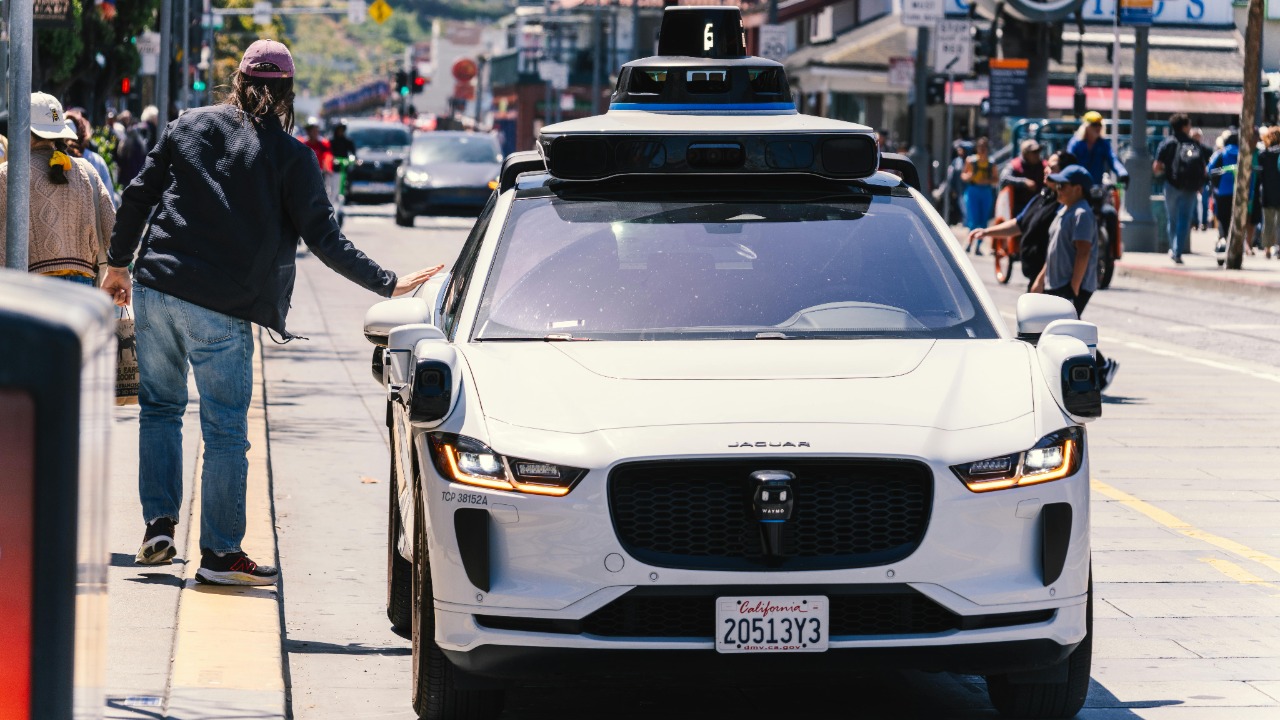
Waymo has quietly turned a long‑running autonomy experiment into a real business, now logging roughly 450,000 paid robotaxi rides every week and putting clear distance between itself and Tesla in the race to commercialize self‑driving cars. That scale is no longer a proof of concept, it is a transportation network that is starting to look like a new kind of ride‑hailing utility in cities where it operates. As the numbers climb, the question is shifting from whether robotaxis will work to how quickly incumbents like Tesla can catch up to Waymo’s head start.
Waymo’s 450,000‑ride milestone and what it really signals
Waymo’s latest milestone is striking in its simplicity: the company is now providing about 450,000 weekly paid rides, a figure that would have sounded fanciful even a few years ago. That volume, disclosed in a letter from investor Tiger Global and echoed in internal performance updates, confirms that Waymo has crossed 450,000 weekly paid trips after scaling up from earlier pilots in Phoenix and the Bay Area, where it had already built a base of commercial ride‑hailing users. The robotaxi unit, owned by Alphabet, is no longer just testing in a handful of neighborhoods, it is running a dense network of rides that rivals mid‑sized human‑driver fleets in some markets, and it is doing so with vehicles that operate driverless like Waymo’s fleet vehicles rather than relying on safety drivers in the front seat.
The growth curve behind that headline number is just as important as the absolute figure. Earlier this year, Waymo’s service was handling about 250,000 weekly trips across Phoenix and the Bay Area, including San Jose, before ramping to the current 450,000 level, which means the company has effectively notched an 80 percent jump in weekly volume in a matter of months. External trackers and investor commentary describe Waymo as the autonomous taxi division owned by Alphabet that has surpassed 450,000 paid rides per week, while a separate breakdown notes that Waymo crossed 450,000 weekly paid rides after building up ride‑hailing in the Bay Area. Social media posts amplified the same point, with one update stating that NEWS: Waymo is now providing over 450,000 paid Robotaxi rides per week, up from 250,000 per week in April 2025, underscoring how quickly the service has scaled.
From 250,000 to 450,000: how Waymo pulled ahead of Tesla
The jump from 250,000 to 450,000 weekly rides is not just a marketing milestone, it is the clearest sign yet that Waymo has turned its early operational lead into a widening gap over Tesla in actual robotaxi deployments. Earlier this year, Key Takeaways from independent analysis highlighted Waymo’s Operational Lead, noting that Waymo had completed 10 million paid rides and was running 250,000 weekly trips across Phoenix and the Bay Area, including San Jose, at a time when Tesla’s robotaxi efforts were still in the planning and limited‑pilot phase. Since then, Waymo has nearly doubled that weekly volume, while Tesla has continued to focus on data collection from its consumer fleet rather than launching a comparable, fully driverless ride‑hailing network.
That divergence is why investors now describe Waymo as having crossed 450,000 weekly paid rides as Alphabet robotaxi unit widens lead on Tesla. One detailed breakdown of the competitive landscape notes that Waymo hits 450K weekly rides, pulling ahead of Tesla in the robotaxi race, and stresses a crucial distinction: Tesla often cites total miles driven on its driver‑assist systems, but those are total miles, not weekly paid rides, and Tesla is focusing on data collection and software updates rather than operating a large‑scale, fully autonomous taxi fleet. In contrast, Waymo is now providing over 450,000 paid Robotaxi rides per week, a figure that multiple sources tie directly to its commercial service footprint, and that is why observers say the robotaxi wars just shifted into overdrive as Waymo hits 450K weekly rides and pulls ahead.
Two opposite visions: sensors, data, and the path to autonomy
Behind the raw numbers sit two very different philosophies about how to build self‑driving cars. Tesla’s Contrarian Bets are built around a camera‑only approach that rejects lidar and radar, while Waymo relies on a stack that layers lidar, radar, and high‑resolution cameras to create a richer picture of the world. Technical analysis of the great sensor debate points out that first, the dimensionality, quality, and redundancy of Waymo’s sensor suite give it a more structured view of the environment, while the data Tesla has collected may be noisy because it depends on consumer‑driven behavior and a narrower set of inputs. That is why one deep dive frames the discussion as Tesla, Waymo, and the great sensor debate, with Waymo leaning into hardware redundancy and Tesla betting that software can make up the difference.
At the same time, Tesla’s Data Edge is real, and it is central to the company’s argument that it can eventually leapfrog rivals even if it is behind in robotaxi deployments today. Tesla has a camera‑only fleet of hundreds of thousands of vehicles on the road, each feeding back driving clips that train its neural networks, and the company is making in‑house chips and software to process that firehose. Analysts who focus on Tesla’s software stack describe this as Tesla’s Data Edge, arguing that the breadth of real‑world scenarios captured by Tesla’s fleet could, in theory, offset the lack of lidar and radar. A separate technical comparison titled Waymo vs Tesla: Who is closer to Level 5 Autonomous Driving? underscores that Tesla and Waymo both have different sensor stacks, and that While Waymo relies on a stack that includes lidar, Tesla leans on cameras and software, a contrast that shapes everything from how each company labels data to how quickly they can validate safety in new cities, as detailed in the Who is closer to Level 5 analysis.
Robotaxis today: Waymo’s operations versus Tesla’s ambitions
On the ground, the gap between Waymo’s operating network and Tesla’s ambitions is stark. Unlike Waymo, Tesla does not use lidar or radar, and the company has bet big on computer vision and vertical integration, from chips to software, to eventually deliver a dedicated robotaxi. Yet, while Tesla has announced plans for a dedicated robotaxi, this remains a goal only, and Tesla has no operational deployment that comes close to Waymo’s current scale or autonomy level. Industry trackers who compare active fleets note that Waymo is already running hundreds of fully driverless vehicles in multiple cities, while Tesla’s roughly 500 test vehicles and consumer cars with driver‑assist features are not fully autonomous, a contrast captured in coverage that explains how Unlike Waymo, Tesla doesn’t use lidar or radar and is still working toward a future robotaxi fleet.
That is why broader market analysis of autonomous driving growth emphasizes that While Tesla has announced plans for a dedicated robotaxi, Tesla has no operational deployment comparable to Waymo’s current scale or autonomy level. In other words, Tesla is still in the pre‑commercial phase for robotaxis, even as it rolls out advanced driver‑assist features to retail customers, whereas Waymo is already monetizing rides at city scale. One industry blog on robotaxis and robobuses notes that While Tesla has announced plans for a dedicated robotaxi, the company still has to prove it can match Waymo’s combination of autonomy level and operational scale. That gap is reinforced by on‑the‑ground observations from Austin, where one analyst who watched dozens of Tesla robotaxi videos noted that it took almost five years for Waymo to expand from its first commercial service in Phoenix in 2018 to its second city, but Tesla is now trying to expand much faster than Waymo did, a dynamic captured in the review of what was learned watching Tesla’s Austin robotaxis.
What 450,000 weekly rides means for the broader autonomy race
Waymo’s scale is reshaping how executives and investors talk about the future of autonomous driving. Industry leaders increasingly frame the contest as Tesla and Waymo having fundamentally different approaches to solving autonomous driving, with Tesla pushing a camera‑only, software‑heavy strategy and Waymo leaning on a more traditional robotaxi model with dedicated fleets and multi‑sensor hardware. Commentators who follow the sector closely note that Follow Lloyd Lee Tesla and Waymo have become shorthand for these two philosophies, and that automotive and technology leaders are placing their bets accordingly, as reflected in analysis that tracks how Follow Lloyd Lee Tesla and Waymo have fundamentally different approaches and how that shapes investment decisions.
For now, the scoreboard is simple: Waymo, the autonomous taxi division owned by Alphabet, has surpassed 450,000 weekly paid rides as Alphabet robotaxi unit widens lead on Tesla, while Tesla is still working to turn its software and data edge into a comparable commercial service. Analysts who frame the competition as Waymo crosses 450,000 weekly paid rides, widening Tesla lead are effectively saying that operational reality has caught up with years of hype. The next phase of the autonomy race will test whether Tesla’s contrarian bet on cameras and massive data can close that gap, or whether Waymo’s methodical, sensor‑rich approach will keep it in front as robotaxis move from novelty to everyday infrastructure.
More From TheDailyOverview

Grant Mercer covers market dynamics, business trends, and the economic forces driving growth across industries. His analysis connects macro movements with real-world implications for investors, entrepreneurs, and professionals. Through his work at The Daily Overview, Grant helps readers understand how markets function and where opportunities may emerge.

