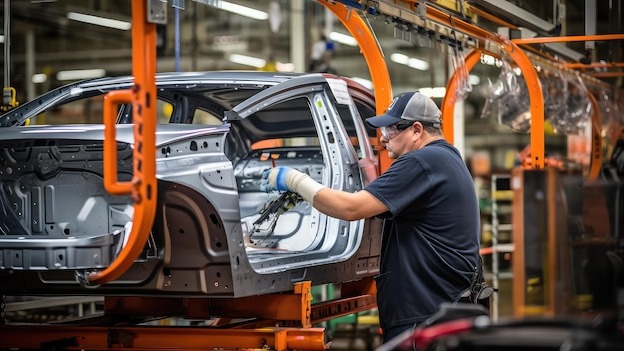
When a carmaker valued at roughly $148 million shuts its doors without warning, the shock does not land on investors first. It hits the 900 people who suddenly discover their wages are frozen, their benefits in limbo, and their workplace gone. The overnight collapse of Bollinger Motors turned a high‑flying electric vehicle bet into a case study in how quickly a $148M dream can leave real workers stranded.
The company’s quiet disappearance, after months of mounting debts and missed paychecks, exposes a brutal truth about the new auto economy. Startups can rise fast on hype and venture cash, but when the money runs out, there is often no safety net for the people who kept the lines moving and the prototypes rolling.
The overnight shock that froze 900 paychecks
The most jarring part of Bollinger’s collapse was its speed. One day, employees were building toward the next production milestone, and the next, 900 workers discovered they had lost access to their pay with no advance notice. Reporting on the shutdown describes how staff learned that the $148 auto maker had effectively vanished overnight, leaving them scrambling to cover rent, groceries, and loan payments while their final wages sat out of reach in a failed payroll system linked to a company that no longer functioned. That sudden loss of income for 900 people is not an abstract statistic, it is a cascading financial emergency for hundreds of households tied to a single employer.
Behind the scenes, the warning signs were already there, even if they were not shared with the workforce. Internal communications showed that the Company’s cash crunch had become so severe that an October 31 payroll simply did not go out, a failure that marked the point where operations began to unravel. According to one detailed account, the money troubles struck without warning from the workers’ perspective, but inside the Company leadership knew that Without fresh funding, the missed payroll would lead straight to the company’s end. By the time the shutdown was communicated, the damage to employees’ finances was already done.
From $148 m valuation to a silent factory floor
On paper, Bollinger Motors looked like a success story in the making. The Car manufacturer was once valued at about $148 m, a figure that reflected investor faith in its rugged electric trucks and SUVs and in a broader wave of EV optimism. At its peak, the company was described as being worth $148 million, a number that suggested staying power and scale, not a business that would quietly shut down all operations. Yet as debts piled up and suppliers demanded payment, that headline valuation did nothing to keep the lights on or the assembly lines running.
The end came not with a dramatic bankruptcy spectacle but with a quiet shutdown in its entirety. Reports describe how the Car brand simply stopped production, closed facilities, and left workers without pay as obligations mounted. For employees, the contrast between the lofty $148 m valuation and the reality of locked gates and unanswered emails was stark. It underscored how startup valuations can be more about future expectations than present stability, and how quickly those expectations can evaporate when creditors lose patience and cash dries up.
Inside the rise, pivot, and Persistent Production Delays
Bollinger’s trajectory followed a familiar arc for ambitious EV startups. The company’s Rise was fueled by bold promises of boxy, utilitarian electric trucks that could carve out a niche alongside mainstream brands. Early prototypes drew attention, and the firm leaned into a rugged identity that set it apart from sleeker rivals. Yet as the market evolved and competition intensified, the company attempted a Pivot, shifting focus from consumer vehicles toward commercial platforms and fleet customers in search of a more reliable revenue base. That strategic turn signaled both adaptability and underlying strain.
What ultimately undermined those plans were Persistent Production Delays that kept pushing real deliveries further into the future. Each delay meant more months of burn without incoming cash, more pressure from lenders, and more uncertainty for the workforce. One detailed analysis of the collapse notes that the company’s end shows how fragile this generation of electric vehicle startups can be when they cannot convert prototypes into scalable manufacturing. The glossy Photo of early concept trucks, credited to Mr.choppers, captured the promise, but not the mounting operational problems behind the scenes.
Payroll failure and the human cost of a quiet collapse
For the people on the factory floor and in the offices, the collapse was not about valuations or strategy decks, it was about paychecks that never arrived. Earlier reporting describes how 900 workers lost pay access after the auto manufacturer shut down overnight, leaving them unable to withdraw wages they had already earned. That sudden cutoff hit line workers, engineers, and support staff alike, many of whom had no warning that their next direct deposit would not land. The Story of those 900 employees, as recounted by Julian Fernandez, turns a corporate failure into a deeply personal financial crisis.
In interviews and accounts collected after the shutdown, workers described the shock of learning that their employer had ceased operations while their pay was still pending. Some had already worked overtime to meet production targets, only to discover that the overtime, like their base pay, was frozen. The reporting by Julian Fernandez on the Bollinger shutdown highlights how little recourse many of these employees had once the company’s accounts were locked and the Sour reality of insolvency set in. Without severance, and with benefits abruptly cut off, they were left to navigate unemployment systems and emergency savings at the very moment their income disappeared.
What Bollinger’s fall signals for the next wave of auto workers
As I look at the details of Bollinger’s collapse, I see more than a single company failure. The pattern that emerges, from the missed October 31 payroll to the final closure, mirrors other cases where a truck maker was crippled by payroll failure and hundreds were laid off as doors shut. In that earlier example, internal emails showed that the Company’s money troubles struck without warning from the staff’s point of view, and Without new capital the inability to meet payroll led directly to the company’s end. Bollinger’s story fits that same template, suggesting that workers at high‑growth manufacturers are often the last to know when the numbers no longer add up.
For the broader auto workforce, especially those joining young EV brands, the lesson is sobering. A firm can be valued at $148 million, celebrated for its Rise and Pivot, and still leave 900 people without pay overnight if Persistent Production Delays and mounting debts are allowed to fester out of sight. I see a clear need for stronger safeguards that prioritize workers when a Car manufacturer quietly shuts down all operations, whether through escrowed payroll funds, mandatory early warning systems, or tighter oversight of how startups manage cash as they scale. Until those protections are in place, the next generation of auto workers will continue to shoulder the riskiest part of the industry’s transition, discovering only at the end that the company they helped build can disappear faster than a missed direct deposit.
More From TheDailyOverview
*This article was researched with the help of AI, with human editors creating the final content.

Grant Mercer covers market dynamics, business trends, and the economic forces driving growth across industries. His analysis connects macro movements with real-world implications for investors, entrepreneurs, and professionals. Through his work at The Daily Overview, Grant helps readers understand how markets function and where opportunities may emerge.