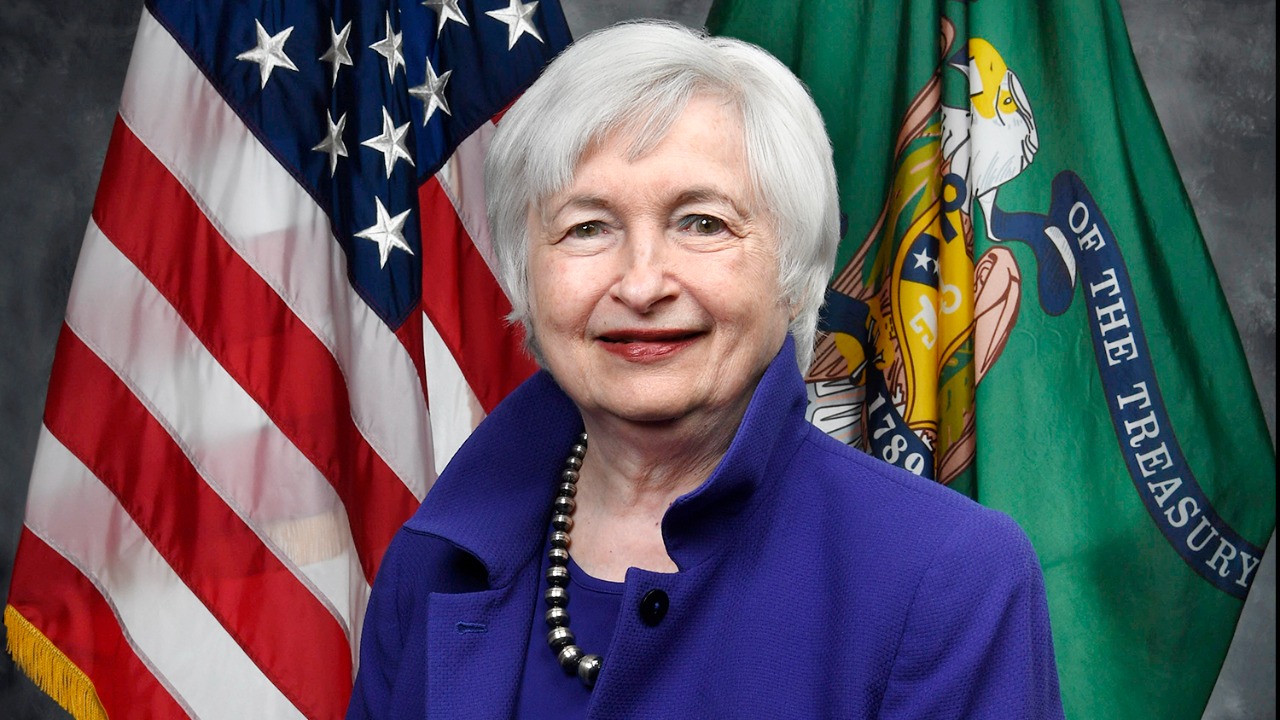
The United States has crossed a threshold that many economists once treated as a distant warning, not an imminent reality. With federal obligations now measured in the tens of trillions of dollars, Janet Yellen is arguing that the country is edging toward a line that earlier generations of policymakers hoped never to test. I see her alarm as less about a single number and more about the growing risk that debt, interest rates, and politics could start to dictate economic choices instead of the other way around.
Yellen’s stark message and why it matters now
Janet Yellen chose a gathering of professional economists, not a campaign rally, to deliver one of her bluntest assessments of U.S. finances. Speaking at a panel hosted by the American Economic Association, she warned that the federal balance sheet is now large enough that it could begin to constrain how the government responds to future shocks. In her view, the problem is not only the size of the obligations but the sense that there is “little” political appetite to adjust course, a concern she raised while discussing the long run risks that the current trajectory poses to growth and stability, as summarized in a detailed What To Know briefing.
Her warning carried extra weight because it came from someone who has spent years on both sides of the policy table, first as Federal Reserve chair and then as Treasury secretary. At the American Economic Association event, Yellen framed the issue as a test of whether elected officials are willing to confront the trade offs that come with a debt stock that is no longer a background variable. By tying her concerns to the broader debate over long term fiscal sustainability, she signaled that the red line economists have discussed for decades is no longer theoretical, but something the United States may be approaching in real time.
The $38 trillion threshold and a fast rising tab
When Yellen talks about a red line, she is pointing to a concrete figure as well as a trend. Federal borrowing has climbed to roughly $38 trillion in outstanding obligations, a level that would have been hard to imagine even a decade ago. In one recent analysis, she highlighted that if households and investors do not believe taxes will eventually rise to cover that $38 trillion, they are likely to treat the extra government spending as a permanent windfall and increase their own consumption, a dynamic that can fuel inflation rather than long term investment, as explained in a breakdown of how people respond when they see large deficits as a “gift” rather than a loan to be repaid in the future in the $38 trillion discussion.
Official data show just how quickly that tab has grown. Treasury’s own fiscal dashboard puts the national debt at $38.42 T in total outstanding borrowing by the U.S. Federa government, a figure that captures both debt held by the public and intragovernmental accounts and that is laid out in the government’s explanation of $38.42 trillion in obligations. That number is not static. A separate congressional dashboard notes that the Change in gross national debt over a single year recently totaled +$2.23T, underscoring how quickly the burden is compounding and how little time policymakers have if they want to slow the pace of accumulation.
Debt in context: ratios, dashboards, and projections
Raw dollar figures can be misleading without context, so I look closely at how the debt compares to the size of the economy. One recent market focused analysis reported that the U.S. national debt has reached $38.5 trillion, with a debt to GDP ratio of over 120%, and that over 70% of that total is held by domestic investors and institutions, a snapshot that highlights both the scale of the obligations and the extent to which they are financed at home, as laid out in a concise summary of $38.5 trillion, 120%, and 70% ownership. A debt load that exceeds annual GDP does not automatically spell crisis, but it does mean that small shifts in interest rates or investor confidence can have outsized effects on the federal budget.
Congressional scorecards tell a similar story from a different angle. A Republican led Debt Dashboard from the Joint Economic Committee notes that the Change in gross national debt over a recent twelve month window was +$2.23T and that the Gross national debt per person is now roughly $284,914, figures that dramatize how much of the burden would fall on each American if the tab were divided evenly, as highlighted in the committee’s Released December overview of the trend. Looking ahead, projections compiled for the United States show the National debt continuing to rise through 2030 in a table that tracks the Characte of federal borrowing year by year, reinforcing the sense that the current path is not a temporary spike but a structural climb, as laid out in the long term series for the United States National obligations.
From textbook theory to “fiscal dominance” fears
What makes Yellen’s warning especially pointed is her suggestion that the United States is drifting away from the clean separation between monetary and fiscal policy that Economics 101 textbooks often assume. In that simple framework, the central bank sets interest rates to manage inflation while elected officials decide how much to tax and spend, and the two spheres interact but do not control each other. Yellen and several academic economists now worry that with such a large stock of debt, the Federal Reserve could come under pressure to keep rates lower than it otherwise would, not because inflation is subdued, but because higher borrowing costs would make the budget math untenable, a scenario that some analysts describe as the expansionary paradox of interest rates and that is discussed in detail in a Economics focused analysis.
At the American Economic Association panel on Sunday, Yellen engaged directly with scholars who have spent their careers modeling what happens when governments cross from a regime where central banks dominate inflation dynamics to one where fiscal policy takes the lead. In that latter world, sometimes called “fiscal dominance,” markets begin to doubt that future surpluses will materialize, and inflation expectations can become unmoored even if the central bank raises rates. By voicing concern that the United States might be getting closer to that regime, she was effectively warning that the old playbook may not work if debt continues to climb unchecked, a point that was underscored in a detailed recap of her remarks at the American Economic Association event.
How interest payments are crowding out other priorities
One of the most immediate ways the debt burden shows up in daily politics is through interest payments that now compete with core government functions. As rates have risen from their pandemic era lows, the cost of servicing existing obligations has surged, turning what once looked like a manageable line item into one of the largest components of federal spending. A former Treasury official, Wichai Ngarmboonanant, recently warned that interest payments on the national debt have now surpassed defense outlays, arguing that this shift in the hierarchy of spending should force a rethink of how Washington sets its priorities, a point captured in a section on Changing Fiscal Priorities.
When I look at the budget through that lens, the trade offs become stark. Every additional dollar devoted to interest is a dollar that cannot be used for infrastructure, education, or tax relief, and the shift is happening automatically, without fresh votes in Congress. Ngarmboonanant’s warning suggests that if the current trajectory continues, the federal government could find itself locked into a pattern where servicing past borrowing constrains its ability to respond to new challenges, from climate shocks to geopolitical crises, even before any formal austerity program is debated.
What the official data say about who holds the risk
Another crucial question is who ultimately bears the risk of a debt load this large. Treasury’s own breakdown shows that the $38.42 T in obligations are split between debt held by the public and intragovernmental holdings, with a significant share owned by domestic investors, pension funds, and institutions that rely on Treasurys as a benchmark asset, as detailed in the government’s explanation of how much What the national debt is and how it is structured. That composition can be a source of resilience, since a homegrown investor base may be less likely to stage a sudden buyers’ strike, but it also means that any repricing of risk would ripple directly through American retirement accounts and financial institutions.
Market oriented snapshots add another layer of nuance. The report that pegged the total at $38.5 trillion and the debt to GDP ratio at over 120% also noted that over 70% of the obligations are held domestically, suggesting that the United States is both borrower and lender to itself on a massive scale, as highlighted in the summary of Over 70% domestic holdings. In practical terms, that means any policy shock that undermines confidence in Treasurys would not just be a foreign policy problem, it would be a domestic financial stability issue, with implications for everything from mortgage rates to the valuation of blue chip stocks.
Economists’ red line: from theory to present danger
For decades, academic debates about debt thresholds played out in journals and conferences, with little impact on day to day politics. Yellen’s latest remarks suggest that those theoretical red lines are now informing real world decisions. At the American Economic Association panel, she referenced work by economists who have long argued that once debt reaches a certain share of GDP, the risk of fiscal dominance and inflationary pressures rises sharply, and she indicated that the United States may be nearing that zone, a concern that was captured in the detailed recap of her comments on Sunday.
What stands out to me is how closely her language tracks the models that once seemed abstract. When she worries that people will treat large deficits as a permanent gift if they do not expect future tax hikes, she is effectively describing a breakdown in the usual intertemporal budget constraint that underpins much of modern macroeconomics, a point spelled out in the analysis of how households respond when they see the $38 trillion stock of debt as something that will never be repaid in full in the Jan discussion. That shift in expectations is precisely what many economists have warned could turn a high but manageable debt load into a genuine macroeconomic problem.
Political gridlock and the “Media Error” problem
Even as the numbers grow more alarming, the political system has struggled to translate warnings into action. Coverage of Yellen’s remarks has sometimes been overshadowed by the daily churn of partisan conflict, and in one case, a video segment summarizing her comments was interrupted by a Media Error that prevented playback, a small but telling example of how technical glitches and short attention spans can blunt the impact of serious fiscal analysis, as noted in a recap that flagged the Media Error during an attempt to explain Why It Matters.
From my vantage point, that kind of fragmentation mirrors a broader problem. Policymakers face strong incentives to focus on immediate controversies rather than long term balance sheet risks, and voters rarely reward early action on issues that do not yet feel like a crisis. Yellen’s decision to raise the alarm at a professional gathering rather than a political event underscores her belief that the expert community needs to keep pressing the case, even when the broader media environment makes it hard for sustained, nuanced discussions of debt and deficits to break through.
What it would take to step back from the brink
If the United States is indeed approaching the red line that Yellen and other economists describe, the obvious question is what it would take to move back from it. The answer is not a single policy lever but a mix of slower spending growth, more targeted programs, and a tax code that raises enough revenue to cover the commitments that voters actually want. The Treasury’s own explanation of the national debt makes clear that the $38.42 T figure is the cumulative result of many years of choices about how much to borrow and for what purposes, and that any serious adjustment will require a similarly sustained effort, as outlined in the government’s overview of how the Federa debt evolved.
In practical terms, that means confronting the reality that interest payments are already crowding out other priorities, as Ngarmboonanant’s warning about Changing Fiscal Priorities makes clear, and that the debt to GDP ratio of over 120% leaves little room for complacency. Yellen’s message at the American Economic Association was that the window for gradual, orderly adjustment is still open but narrowing. If policymakers wait until markets force their hand, the eventual corrections are likely to be more abrupt and more painful than anything that would be required today, a risk that should focus minds in Washington even if the politics of debt remain as fraught as ever.
More From TheDailyOverview

Grant Mercer covers market dynamics, business trends, and the economic forces driving growth across industries. His analysis connects macro movements with real-world implications for investors, entrepreneurs, and professionals. Through his work at The Daily Overview, Grant helps readers understand how markets function and where opportunities may emerge.