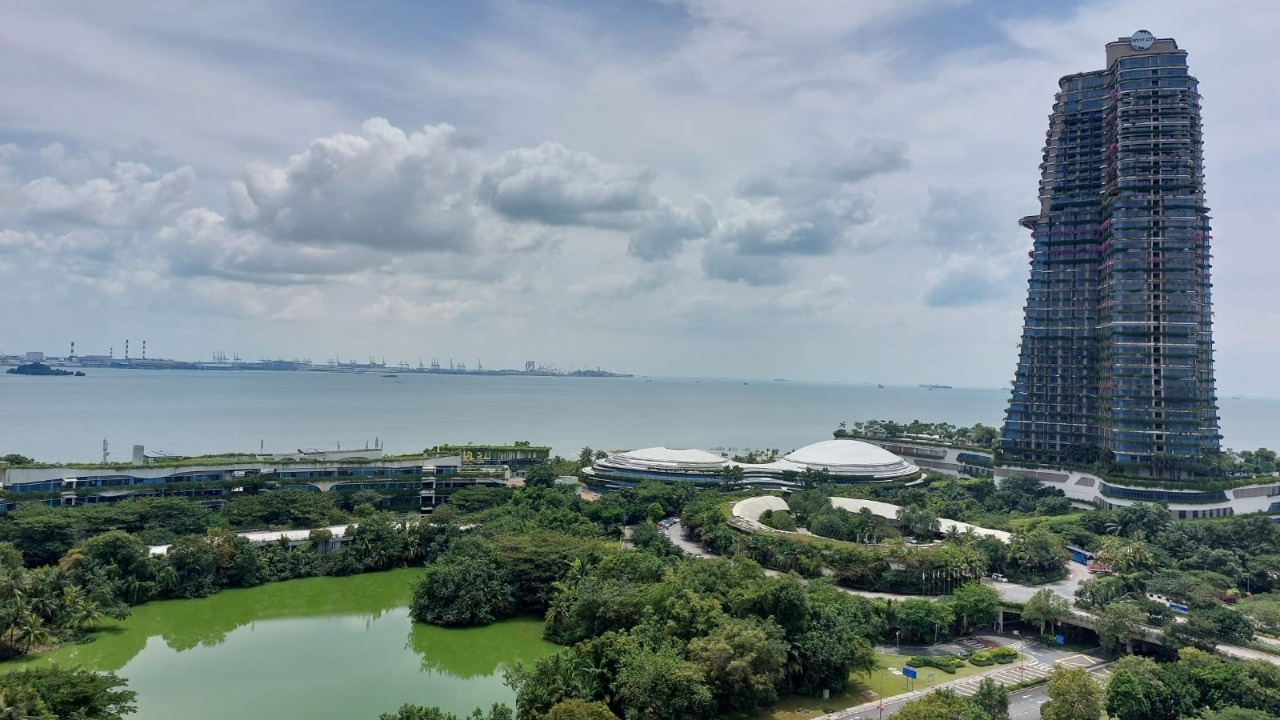
Forest City, a massive development on reclaimed land off the southern coast of Malaysia, was designed to house roughly one million residents and cost an estimated $100 billion. Instead, the project has attracted only about 9,000 people, turning what was once billed as a futuristic urban hub into one of Southeast Asia’s most conspicuous real estate failures. The gap between ambition and reality raises hard questions about who this city was really built for, and whether a state-led rescue plan can fix problems that run far deeper than sluggish sales.
A $100 Billion Bet on Reclaimed Land
Forest City sits on four artificial islands in the Strait of Johor, just across the water from Singapore. The project involved extensive land reclamation from the sea, a process that physically manufactured the ground beneath the development’s towers, malls, and green corridors. Chinese developer Country Garden, one of the largest homebuilders in the world, partnered with a local royal-linked firm to finance and construct what was marketed as a self-contained metropolis. The vision included schools, hospitals, commercial districts, and transit links, all wrapped in lush greenery meant to justify the “Forest” branding and appeal to environmentally conscious buyers, even as the engineering works reshaped coastal ecosystems.
The scale of the financial commitment is staggering. The development is expected to cost around $100 billion, a figure that would place it among the most expensive urban projects ever attempted anywhere. Yet that price tag was predicated on demand that never materialized at the expected pace. Country Garden executives have acknowledged that units are not selling fast enough, a frank admission that the project’s commercial model has not performed as planned. Thousands of completed apartments sit empty, their balconies overlooking streets with almost no foot traffic, while partially finished towers testify to a construction schedule that outran both market interest and political support.
9,000 Residents in a City Built for a Million
The most striking number attached to Forest City is not the cost but the population. Reporting based on on-the-ground observation found the development had attracted about 9,000 residents, a figure that represents less than one percent of the intended capacity. That ratio turns the project into something closer to a gated residential compound than a functioning city. Basic urban services, from restaurants to public transit to retail, struggle to justify their existence when the customer base is that thin. The result is a feedback loop: low population discourages new businesses, and the absence of amenities discourages new residents, reinforcing the sense that the city is more concept than community.
Several forces converged to produce this outcome. The original sales pitch leaned heavily on Chinese buyers looking to park capital abroad, but Beijing tightened restrictions on overseas property purchases, cutting off the primary demand pipeline just as towers were rising from the reclaimed land. Meanwhile, Malaysian political sentiment shifted against large-scale foreign ownership of domestic land. Former Prime Minister Mahathir Mohamad publicly criticized the project, and policy changes made it harder for foreign nationals to obtain long-term residency through property investment. Forest City found itself caught between two governments pulling in opposite directions, neither of which prioritized filling its towers, and domestic buyers were never numerous or affluent enough to replace the vanished foreign clientele.
Geopolitical Mismatch, Not Just Market Failure
Much coverage of Forest City frames the underpopulation as a straightforward market miscalculation: Country Garden built too much, too fast, for buyers who never showed up. That reading is incomplete. The deeper problem is structural. Forest City was conceived as a cross-border investment vehicle, designed to channel Chinese capital into Malaysian real estate at a moment when both countries appeared aligned on that goal. When the political winds shifted in Beijing and Kuala Lumpur almost simultaneously, the project lost its core economic logic. No amount of marketing could overcome capital controls on one side and sovereignty concerns on the other, and the physical city became hostage to policy choices made far from its empty boulevards.
Compare Forest City to domestically funded urban expansions in Southeast Asia, such as Indonesia’s new capital Nusantara or Vietnam’s satellite cities around Ho Chi Minh City. Those projects face their own delays and cost overruns, but they do not carry the same vulnerability to foreign policy reversals because their financing and buyer base are largely domestic. Forest City’s dependence on a single foreign buyer demographic made it fragile in a way that purely local developments are not. The lesson is not that mega-cities inevitably fail; it is that mega-cities built primarily for foreign capital are exposed to geopolitical risks that no architectural plan can mitigate, especially when they lack a clear role in the host country’s broader urban and economic strategy.
A Royal Rescue Through Special Economic Zones
Malaysia’s leadership has not given up on the project. The country’s monarch has backed an effort to revive the stalled development by rebranding it as part of a special economic zone along the Johor, Singapore corridor. The strategy involves offering tax incentives, relaxed regulations, and other sweeteners to attract businesses and residents who might otherwise have no reason to relocate to a half-empty island city. The involvement of a royal-linked local partner in the ownership structure gives the revival effort political backing that a purely foreign-led initiative would lack, signaling that state institutions have a reputational stake in avoiding outright failure.
Whether special zone status can actually fill Forest City’s towers is a separate question. Tax breaks and regulatory carve-outs have worked in places like Shenzhen and Dubai, but those zones succeeded because they sat at natural trade crossroads or had access to sovereign wealth that could subsidize early growth for decades. Forest City lacks both advantages. It is not a major port, not a tech corridor, and not an established financial center. It is a residential development searching for an economic identity after the fact. Granting it special zone status addresses the symptom of low occupancy without resolving the underlying absence of organic demand. The degree of build-out already completed means sunk costs are enormous, which creates political pressure to keep trying rather than accept the loss, even if the odds of turning it into a thriving hub remain uncertain.
What Forest City Reveals About Mega-Project Risk
Forest City is often described as a ghost city, but that label obscures a more useful takeaway. Ghost cities imply abandonment. Forest City was never truly occupied in the first place. The project represents a specific category of failure: infrastructure that was built to serve a financial thesis rather than an existing population. When the thesis collapsed, no organic community existed to sustain the physical city that had already risen from the sea. The 9,000 residents who do live there are not enough to generate the economic activity that a development of this scale requires to function, leaving public spaces underused and commercial storefronts dark for much of the day.
The broader warning extends well beyond Malaysia. Across the Gulf states, Central Asia, and parts of Africa, governments and developers continue to announce billion-dollar planned cities aimed at attracting foreign investment and global talent. Many of these schemes promise cutting-edge sustainability, smart infrastructure, and lifestyle amenities, but they often rely on the same model that underpinned Forest City: build first, assume international buyers and firms will come later. Forest City suggests that without a grounded assessment of who will actually live, work, and spend money in these environments (and how policy shifts might disrupt those flows) the result can be gleaming but hollow urban shells. For policymakers, the lesson is to align mega-projects with real economic needs and domestic demand; for investors and residents, it is a reminder that not every futuristic skyline rests on solid ground.
More From The Daily Overview
*This article was researched with the help of AI, with human editors creating the final content.

Elias Broderick specializes in residential and commercial real estate, with a focus on market cycles, property fundamentals, and investment strategy. His writing translates complex housing and development trends into clear insights for both new and experienced investors. At The Daily Overview, Elias explores how real estate fits into long-term wealth planning.