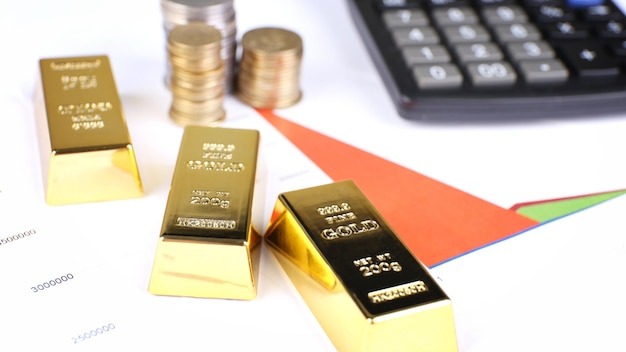
Gold’s latest surge has turned a once-fringe forecast into a live debate. With the metal trading around levels that would have seemed fanciful just two years ago, the idea of prices reaching $6,000 per ounce no longer sits on the outer edge of market imagination. The question now is not whether the call is sensational, but whether the forces driving this cycle are powerful enough to carry it that far, that fast.
Phil Streible, chief market strategist at Blue Line Futures, has become one of the most visible faces of this bullish camp, arguing that a mix of central bank demand, investor anxiety and fiscal excess could push gold to that 6,000 mark in 2026. I see his thesis as a stress test for the global financial system itself: if he is right, it will be because the world’s monetary and political architecture has failed to deliver stability, not because of speculative hype alone.
Streible’s $6,000 roadmap and the new gold math
In recent interviews, Phil Streible has framed 6,000 as a plausible destination rather than a wild guess, tying his outlook to what he describes as “continued central bank buying” and a wave of private investor demand. In a detailed segment with gold prices front and center, he laid out a scenario where official sector purchases remain robust while individual investors treat bullion as portfolio insurance in a world of fiscal strain. The logic is straightforward: if more balance sheets, public and private, decide they need a larger allocation to hard assets, the marginal buyer will have to pay up.
That same appearance, part of a broader discussion hosted by Yahoo Finance Video, underscored how quickly sentiment has shifted from debating whether gold can hold prior highs to gaming out upside scenarios. Streible’s case rests on the idea that the current macro backdrop is not a blip but a regime change, with structurally higher deficits and lingering inflation risk. When I weigh his argument, I see a thesis that depends less on precise timing and more on the cumulative pressure of policy choices that keep eroding confidence in paper assets.
From $2,037 to $5,070: a rally that rewrites the baseline
Any discussion of 6,000 has to start with what has already happened. According to data compiled by World of Statistics, the Gold price per ounce on Feb 11, 2026 was $5,070, up from $2,924 on Feb 11, 2025 and $2,037 on Feb 11, 2024. That is not a gentle bull market, it is a repricing event, the kind of move that forces pension funds, family offices and even retail savers to revisit long-held assumptions about what gold can do in a portfolio.
Moves of that magnitude rarely happen in isolation. They reflect a stew of factors: real yields that have struggled to stay convincingly positive, geopolitical shocks that keep risk premia elevated, and a sense that traditional safe havens like long-dated government bonds no longer offer the same comfort. For everyday investors, the leap from $2,037 to $5,070 in two years is the equivalent of watching a supposedly “boring” asset behave more like a high-beta tech stock, which is exactly why the narrative around 6,000 has caught fire.
Wall Street targets and the post-selloff conviction
Streible is not alone. Large institutions have started to put numbers on the board that would have sounded extreme not long ago. A recent forecast from JPMorgan projected that gold could reach $6,300 per ounce by the end of 2026, while the same report noted that Deutsche Bank reiterated its expectation for the metal to hit $6,000 and that UBS and Société Générale see prices around $6,200 in that timeframe, with some banks also flagging the potential for a move toward $5,000 this year according to one. When multiple global banks cluster around similar targets, it signals that the bullish case has migrated from the fringes into mainstream risk scenarios.
Even sharp pullbacks have not broken that conviction. After a violent bullion selloff rattled traders earlier this month, veteran strategist Ed Yardeni argued that Gold’s $6,000 Target Remains Intact, saying the correction did not invalidate the longer term thesis and that such a level was still “reasonable” in his view put it. I read that as a sign that, for many seasoned observers, volatility is now part of the journey rather than a warning that the destination is wrong.
Central banks, fiscal strain and the YouTube gold narrative
Behind the price action sits a deeper story about who is buying and why. Streible has repeatedly highlighted central bank demand as a core pillar of his 6,000 scenario, arguing in one Power Lunch appearance that official sector buying, combined with private investors seeking protection, could keep pushing prices higher. The subtext is clear: if central banks themselves are diversifying away from traditional reserve assets, they are effectively voting with their balance sheets on the durability of the current monetary order.
That message has filtered into the retail conversation through a wave of online commentary. In one widely viewed Jan video, a veteran investor argued that relentless government spending is now a structural driver for gold, noting that “no one is talking about spending less at this point” and treating bullion as a direct hedge against fiscal profligacy. Another Feb discussion framed 6,000 as a realistic outcome and debated whether investors should wait for a better entry point or accept that the train may already be leaving the station. When YouTube debates start echoing institutional research, it suggests a feedback loop where policy anxiety, online narratives and real money flows reinforce each other.
Charts, sentiment and the risk of a painful detour
For all the enthusiasm, the path to 6,000 is unlikely to be a straight line. In his conversation with Josh Lipton, Streible acknowledged that the Gold market has been prone to sharp reversals, pointing to the way recent rallies have been followed by lower highs on the charts and warning that traders need to respect technical signals even in a bullish macro environment as he discussed. That kind of nuance matters, because it separates a serious forecast from a one-way bet.
Sentiment data and positioning also hint at the risk of overcrowding. Coverage of the recent rally has noted how the precious metal has rallied to records for much of the last year, with some investors rotating out of traditional safe holdings such as US Treasurys and into bullion instead one analysis noted. If that shift accelerates too quickly, it could set the stage for air pockets where any hint of tighter policy or a stronger dollar triggers a scramble for the exits, at least temporarily.
More From The Daily Overview
*This article was researched with the help of AI, with human editors creating the final content.

Grant Mercer covers market dynamics, business trends, and the economic forces driving growth across industries. His analysis connects macro movements with real-world implications for investors, entrepreneurs, and professionals. Through his work at The Daily Overview, Grant helps readers understand how markets function and where opportunities may emerge.

