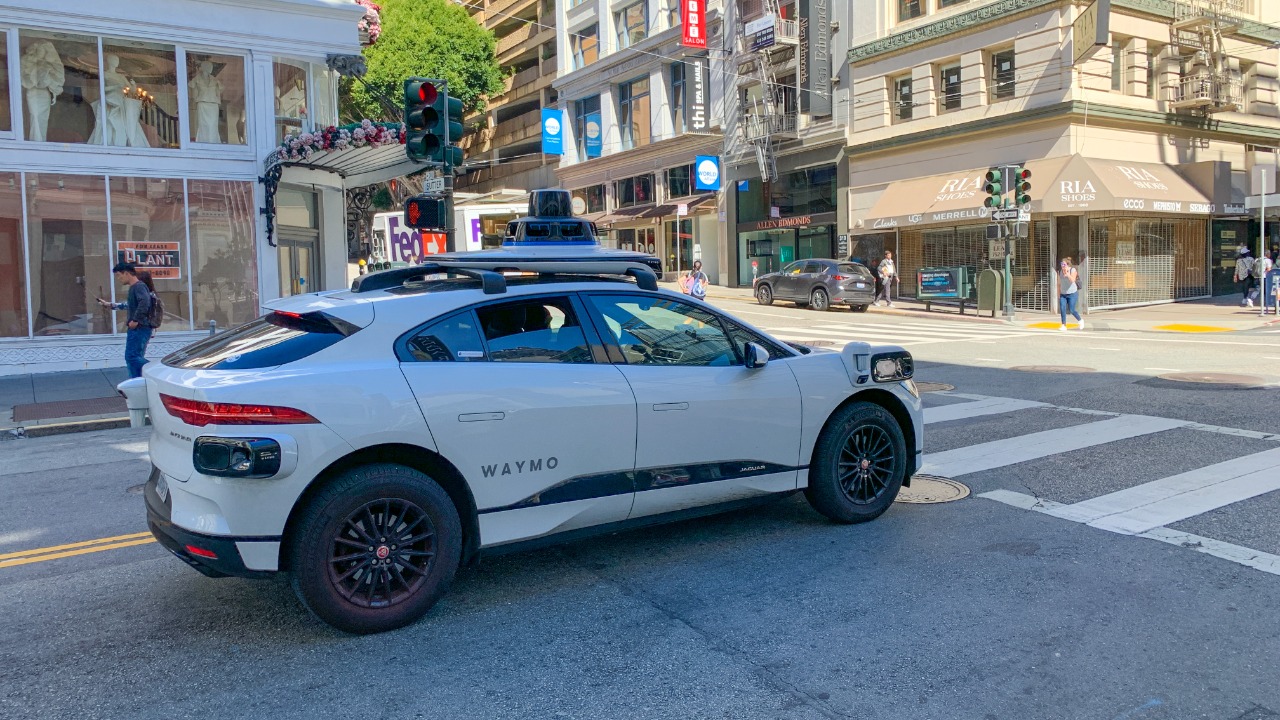
Alphabet has quietly turned Waymo from a money-losing science project into a financial asset that rivals some of the market’s biggest pure-play tech names. A $16 billion capital raise and a valuation that now stretches into the low hundreds of billions effectively blow apart the idea that Waymo belongs in a grab bag of speculative “other bets.” Instead, the self-driving unit is starting to look like a fourth pillar alongside Search, YouTube, and Cloud.
By leaning into outside capital while still writing a very large check of its own, Alphabet is signaling that Waymo is no longer an indulgence, it is a business it expects to scale. That shift has implications not just for Alphabet’s balance sheet, but for how investors value autonomy, robotaxis, and the broader AI stack that underpins them.
Waymo’s $16B raise and the stealth $110B pivot
The core of the story is simple: Waymo has secured a $16 billion funding round that catapults its valuation into territory that would have been unthinkable when it was lumped into Alphabet’s experimental bucket. Alphabet’s self-driving car unit Waymo said on Monday that the round values the company at $126 billion, a level that instantly reframes the unit’s strategic weight inside Alphabet. Earlier coverage of the deal framed it as a “quiet” move targeting roughly $110 billion, underscoring how quickly investor appetite pushed the implied price higher once the process became public.
Behind that headline number sits a deliberate capital structure shift. Reporting on Alphabet’s internal math suggests the company itself is committing an estimated $13 billion to the round, a figure that still represents a small fraction of a parent valued at almost $2.94 trillion. When I look at that ratio, the “stealth” part of the move is not about secrecy, it is about how easily Alphabet can absorb a double digit billion dollar check while still using outside investors to validate Waymo’s standalone worth.
From “other bets” to core growth engine
For years, Alphabet’s narrative has been that Search and YouTube throw off cash, Cloud is the growth engine, and everything else sits in a bucket of “other bets” that may or may not pay off. The new Waymo financing effectively challenges that framing. Analysts who have dug into the deal argue that the unit is now being treated as a grounded all-around performer rather than a drag, with a bull case that sees it contributing alongside Search, Cloud, and AI if management maintains capital expenditure discipline across those segments. That shift is reflected in internal commentary that highlights how the Waymo stake can appreciate without threatening Alphabet’s broader investment in AI infrastructure, as detailed in recent Key Points analysis.
Outside investors are reinforcing that re-rating. A News Editor who previously worked at Washington Post highlighted that Waymo’s $16B funding round is being evaluated not as a moonshot but as a business that can sit comfortably alongside mature platform companies when bundled in a diversified portfolio. That perspective, shared in a LinkedIn brief, lines up with the bull case that sees Waymo as part of a disciplined Alphabet portfolio rather than a speculative side project.
Who is writing the checks, and why that matters
The composition of the investor group tells me as much about Waymo’s trajectory as the headline valuation. In addition to Alphabet’s sustained backing as majority owner, the financing was led by Dragoneer Investment Group and DST Glo, two firms that typically target late stage, scale-ready technology companies. Coverage of the round notes that this is not the first time Dragoneer Investment Group has backed a high growth platform, and its presence here suggests confidence that Waymo can follow a similar path as it expands internationally.
Other reports emphasize that Waymo’s $16B Funding Round Signals Ambitious Expansion Plans, with BUSINESS and NEWS coverage pointing to participation from Dragoneer Investment Group and Mubadala Capital as part of a syndicate that expects global robotaxi deployment rather than a narrow U.S. play. That framing in Funding Round Signals coverage reinforces the idea that this is growth capital, not a lifeline, and that investors are underwriting a multi market rollout of robotaxis rather than a single city pilot.
Valuation whiplash, from $110B target to $126B reality
One of the more striking details in the recent reporting is how quickly Waymo’s valuation expectations moved. Ahead of the round, a News Editor at LinkedIn with a Washington Post background reported that Waymo was eyeing a $16B raise at roughly a $110B valuation, a level that already would have marked a step change from prior funding cycles. That early target, laid out in the Waymo funding preview, already implied that investors were willing to treat the unit as a near mega cap in its own right.
By the time the deal closed, the number had jumped. Multiple accounts now peg the valuation at $126 billion, with one Techbuzz analysis describing how Waymo Lands $16B to Scale Robotaxis Globally at $126B Valuation and another Seeking Alpha note confirming that Waymo, the autonomous driving arm of Alphabet with tickers GOOG and GOOGL, has raised $16B in a new funding round that boosted its valuation to that same level. That kind of last mile repricing is typical of hot late stage deals, but in this case it also serves as a public repricing of Alphabet’s own stake, which now sits on a much larger unrealized gain than the “other bets” label ever suggested, as detailed in the latest funding round coverage.
Safety record, expansion plans, and the robotaxi race
Valuation alone does not justify a strategic re-rating, and here Waymo’s operating metrics matter. Recent reporting notes that Alphabet’s Waymo has nearly tripled its valuation in 2 years with the $16B raise, while touting a “statistically superior” robotaxi safety record compared with human drivers. That safety claim, highlighted in Waymo coverage, is central to the company’s pitch that robotaxis are not just a futuristic convenience but a public safety upgrade that regulators and city planners should welcome.
The new capital is earmarked to turn that pitch into a global footprint. Waymo Raises $16 Billion From Alphabet and Others to Expand, with Ed Ludlow reporting that the company plans to use the money to Expand service into more markets and scale its commercial operations. That expansion thesis is echoed in Bloomberg Law’s Billion From Alphabet coverage and in Techbuzz’s account of how Waymo Lands $16B to Scale Robotaxis Globally at $126B Valuation, which describes plans to Scale Robotaxis Globally with backing from Dragoneer Inv and other large investors.
More From TheDailyOverview

Grant Mercer covers market dynamics, business trends, and the economic forces driving growth across industries. His analysis connects macro movements with real-world implications for investors, entrepreneurs, and professionals. Through his work at The Daily Overview, Grant helps readers understand how markets function and where opportunities may emerge.

