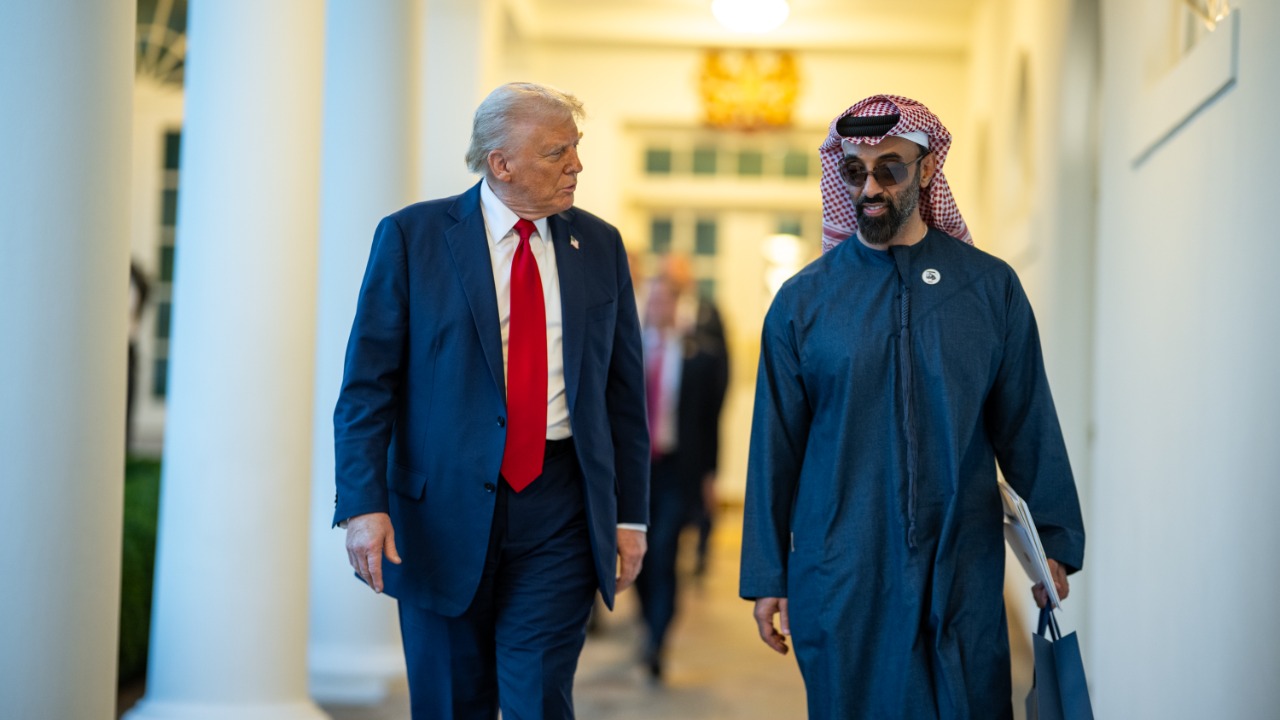
One of President Donald Trump’s most prized business ventures, a flagship crypto company built around his political brand, quietly took on a foreign partner with deep intelligence ties. A powerful member of the Abu Dhabi royal family, widely nicknamed the “spy sheikh,” secured a 49% stake in the firm through a web of intermediaries just as Trump was preparing to enter the White House. The deal fused presidential politics, digital assets and foreign security services in a way that now has Washington asking who really holds influence over Trump’s crown jewel crypto platform.
The arrangement remained largely out of public view until a series of disclosures and congressional questions pulled it into the open. What is emerging is a portrait of a United Arab Emirates power broker, a fast‑growing crypto business and a U.S. president whose private financial interests intersect with a foreign government’s strategic ambitions. The unanswered question is whether this was simply a lucrative investment or a national security vulnerability hiding in plain sight.
The secretive 49% deal at the heart of Trump’s crypto empire
The core of the controversy is simple and stark: a senior royal from the United Arab Emirates, Sheikh Tahnoon bin Zayed Al Nahyan, quietly acquired a 49% stake in the Trump family’s premier crypto venture. According to detailed accounts, the investment was structured so that two trusted lieutenants for Sheikh Tahnoon handled the transaction just days before President Donald Trump took office, giving the foreign investor nearly half of the economic upside in what the Trump family viewed as its digital asset crown jewel. The size of the stake, precisely 49%, was large enough to be transformative yet just shy of outright control, a structure that raises questions about how influence was balanced against optics.
The timing was just as striking as the size. One report describes how, Just four days before President Donald Trump was sworn in, representatives tied to the Abu Dhabi royal family finalized the arrangement that would give their patron a massive foothold in the company. That sequence meant the future president entered office already financially intertwined with a foreign royal who also serves as a top national security figure for his country. The fact that this stake was not widely disclosed to the public or to ethics watchdogs at the time is what now fuels concerns that the Trump crypto venture was built on a foundation of quiet foreign leverage.
Who is the “spy sheikh” behind the investment?
To understand why this deal has rattled lawmakers, it helps to look closely at the man behind it. Sheikh Tahnoon bin Zayed Al Nahyan is not just any investor from the Gulf. He is a senior member of the Abu Dhabi ruling family and a central power broker in the United Arab Emirates security apparatus. As the country’s national security adviser, Sheikh Tahnoon oversees intelligence and strategic operations that touch everything from counterterrorism to cyber capabilities. His reputation as a behind‑the‑scenes operator has earned him the informal label of “spy sheikh,” a moniker that reflects his deep roots in Emirati intelligence circles rather than any single public scandal.
Reports on the Trump crypto deal describe how Sheikh Tahnoon used trusted aides to execute the purchase, insulating himself from direct public association even as he secured the 49% stake. The fact that the investor is both a royal and the national security adviser of the United Arab Emirates means the transaction cannot be viewed as a purely private bet on digital assets. When a figure who helps steer a country’s intelligence strategy quietly buys into a U.S. president’s signature crypto business, it blurs the line between commercial partnership and geopolitical positioning. That dual role is precisely why his involvement is now drawing scrutiny from policymakers and ethics experts.
Inside Trump’s “crown jewel” crypto firm
The company at the center of this storm is widely seen within Trump’s orbit as the family’s flagship digital asset venture, a business that merges the president’s political persona with the speculative energy of crypto markets. Built around licensing the Trump name and image into tokens, trading platforms and branded financial products, the firm has been marketed to supporters as a way to participate in both the movement and the market. For the Trump family, it functions as a high‑growth, high‑visibility asset that sits alongside more traditional holdings in real estate and hospitality.
What made the firm especially attractive to a foreign investor like Sheikh Tahnoon was not only its potential profitability but also its symbolic value. By taking a 49% stake, the Emirati royal effectively hitched his financial interests to the success of Trump’s political brand in the digital economy. The investment came at a moment when crypto exchanges, token issuers and blockchain infrastructure companies were racing to secure global capital and regulatory footholds. In that context, a partnership between a sitting U.S. president’s family business and a senior Abu Dhabi royal from the Abu Dhabi ruling family offered both sides a powerful mix of money, prestige and access.
The Abu Dhabi connection and the 43‑figure intrigue
The involvement of Abu Dhabi is not incidental. The emirate has spent years positioning itself as a global hub for digital assets, artificial intelligence and high‑risk frontier technologies, often through state‑linked investment vehicles. In this case, the Trump crypto stake was reportedly acquired by An Abu Dhabi royal known in financial and diplomatic circles for his aggressive deal‑making. Coverage of the transaction has highlighted that the royal’s camp viewed the Trump venture as a strategic asset, not just a speculative punt, and that they were willing to commit substantial capital up front to secure their position.
One account of the arrangement notes that the Abu Dhabi side was prepared to deploy a figure in the tens of millions, with reporting referencing the number 43 in connection with the scale and structuring of the commitment. While the precise breakdown of that 43‑linked figure remains opaque, the detail underscores how carefully calibrated the investment was, both in financial engineering and in political sensitivity. The fact that the deal was handled through intermediaries, and that the Abu Dhabi royal’s identity surfaced only later, reinforces the impression that the parties involved understood the potential backlash if the full extent of the foreign stake in Trump’s crypto flagship became widely known.
Senator Warren’s alarm and the Washington backlash
The political reaction in Washington has been swift, led in large part by Senator Elizabeth Warren, who has built a reputation as one of Congress’s most vocal critics of crypto’s regulatory gaps. After the revelations about the Emirati stake, Senator Warren publicly demanded a formal investigation into how a foreign intelligence‑linked royal came to own nearly half of a U.S. president’s marquee digital asset business. She framed the issue as both a financial transparency problem and a national security risk, arguing that the public has a right to know whether foreign governments or their proxies hold leverage over a sitting president’s private ventures.
In her calls for scrutiny, the Senator has zeroed in on the fact that the investor is an Emirati national security figure, not a passive fund manager. She has urged regulators and oversight bodies to examine whether the arrangement should have triggered reviews under existing foreign investment rules, and whether Trump or his advisers adequately disclosed the relationship when he entered office. The concern is not only about past conduct but also about ongoing influence, since the stake could give the Emirati partner insight into internal strategy, access to sensitive data flows or a say in future partnerships that intersect with U.S. policy. For Senator Elizabe and her allies, the Trump crypto deal has become a test case for how the United States handles foreign entanglements in the age of digital finance.
National security stakes: crypto, chips and foreign leverage
Beyond the immediate ethics questions, the Trump–Emirati crypto partnership sits at the intersection of several strategic trends that worry security professionals. Digital asset platforms increasingly handle not just speculative trading but also cross‑border payments, identity verification and data analytics that can reveal patterns about users and capital flows. When a foreign national security adviser like Sheikh Tahnoon holds a 49% stake in such a platform, it raises the possibility that a foreign government could gain indirect visibility into sensitive financial behavior by U.S. citizens, political donors or even government contractors who use the service. That risk is amplified if the platform later expands into stablecoins, remittances or tokenized securities that plug into the broader financial system.
Reports have also linked the timing of the Emirati investment to a broader push by the United Arab Emirates to secure access to advanced technologies, including artificial intelligence chips and high‑performance computing infrastructure. One account notes that Sheikh Tahnoon’s 49% stake in the Trump crypto firm was in place before a subsequent AI chip deal involving Emirati entities, suggesting a pattern in which the same power centers in Abu Dhabi pursue influence across both digital finance and cutting‑edge hardware. For U.S. policymakers, that convergence raises the specter of a foreign partner that can combine financial data, AI capabilities and political relationships in ways that traditional oversight frameworks were not designed to handle.
What the Trump–UAE crypto alliance means for future oversight
The revelation that a foreign royal and national security adviser quietly owns nearly half of President Donald Trump’s signature crypto business is already reshaping debates over ethics and regulation. I see three immediate implications. First, disclosure rules for presidents and senior officials will likely come under renewed pressure, with reformers arguing that complex private deals involving foreign partners must be reported in far greater detail. Second, the case is likely to fuel momentum for expanding national security reviews of foreign investments into digital asset platforms, treating major stakes in crypto infrastructure more like acquisitions of defense contractors or telecom networks.
Third, the Trump–Emirati arrangement will probably accelerate efforts to bring crypto businesses under stricter anti‑money‑laundering, data protection and governance standards. If a single foreign figure like Sheikh Tahnoon can quietly secure a 49% position in what amounts to a politically branded financial network, regulators will ask how many other platforms might already be subject to similar hidden influence. For now, the “spy sheikh” deal stands as a vivid example of how personal business, presidential power and foreign intelligence interests can collide in the digital age, and it will shape how Washington approaches both Trump’s finances and the broader crypto sector for years to come.
More From TheDailyOverview

Grant Mercer covers market dynamics, business trends, and the economic forces driving growth across industries. His analysis connects macro movements with real-world implications for investors, entrepreneurs, and professionals. Through his work at The Daily Overview, Grant helps readers understand how markets function and where opportunities may emerge.

