Amazon’s warehouse network is racing toward a future in which fleets of machines handle much of the lifting, sorting, and shuttling that once fell to human workers, and internal projections suggest that as many as 600,000 roles could eventually be automated away. Yet one of the most influential investors in modern capitalism, Warren Buffett, keeps telling Americans not to panic about robots or artificial intelligence, arguing that productivity booms have always reshaped work rather than erased it. The tension between those two realities, a company aggressively scaling automation and a billionaire insisting society can adapt, captures the stakes of the next decade of work.
I see a story that is less about a single company’s technology roadmap and more about how the United States chooses to distribute the gains from that productivity. Amazon’s robots are already embedded deep inside the consumer economy, and Buffett’s optimism rests on the idea that policy and markets can turn disruption into broadly shared prosperity instead of permanent precarity.
Amazon’s automation push moves from experiment to operating system
Amazon no longer treats robotics as a side project, it has turned automation into a core operating system for its logistics empire. The company’s consumer site is the public face of a sprawling infrastructure that now depends on machines to keep millions of daily orders flowing through a dense web of fulfillment centers, sortation hubs, and last mile stations, all orchestrated behind the familiar interface of Amazon. What began as a way to shave seconds off walking time in warehouses has evolved into a strategy to reengineer how goods move from suppliers to doorsteps.
Inside those buildings, Amazon Robotics has become the quiet engine of that transformation, deploying fleets of mobile units that ferry shelves, lift heavy totes, and position packages for human workers. Company materials describe more than 1 million robots that now sort, lift, and carry items in fulfillment centers, a scale that signals how deeply automation is woven into daily operations rather than confined to pilot projects, with Amazon Robotics framed as a way to make work faster and safer instead of a simple headcount reduction tool.
From one robot to more than a million
The speed of that shift is striking. Amazon’s robotics journey started in 2012 with a single system and a narrow mandate, but within just over a decade the company had deployed its one millionth robot into operations. That milestone is not just a round number, it marks the point at which automated systems became inseparable from how the company promises two day or even same day delivery to Prime customers, a promise that would be impossible to keep at scale without the dense choreography of machines described in Key.
Amazon now highlights how these robots work alongside people, not only in picking and packing but in maintenance and engineering roles that did not exist before the automation wave. The company’s own descriptions emphasize that the machines are designed to reduce repetitive strain and heavy lifting while helping inventory stowers and order pickers reach more items per hour, a framing that appears again in the detailed look at how Amazon Robotics is supposed to get products to customers faster than ever without sacrificing worker safety.
The controversial figure: 600,000 warehouse roles on the line
Against that backdrop, the figure that has grabbed public attention is the suggestion that Amazon may replace 600,000 warehouse roles with robots over the coming years. Internal planning documents and outside analysis point to a long term roadmap in which a large share of repetitive warehouse tasks could be automated, raising the prospect that hundreds of thousands of jobs in stowing, picking, and packing might not be refilled as workers leave or facilities are redesigned, a scenario described in detail in reporting that notes 600,000 roles.
Some coverage has framed that number as a looming wave of layoffs, but the underlying documents point more to attrition and redesign than to a single mass firing event. Analysts who have reviewed the plans argue that the company is modeling how many positions it would otherwise need by 2027 or 2033 if it kept growing without automation, then asking how many of those future roles could be handled by machines instead, a nuance that appears in critiques of the idea that robots will simply take 600,000 jobs outright.
Inside the warehouse: what the robots actually do
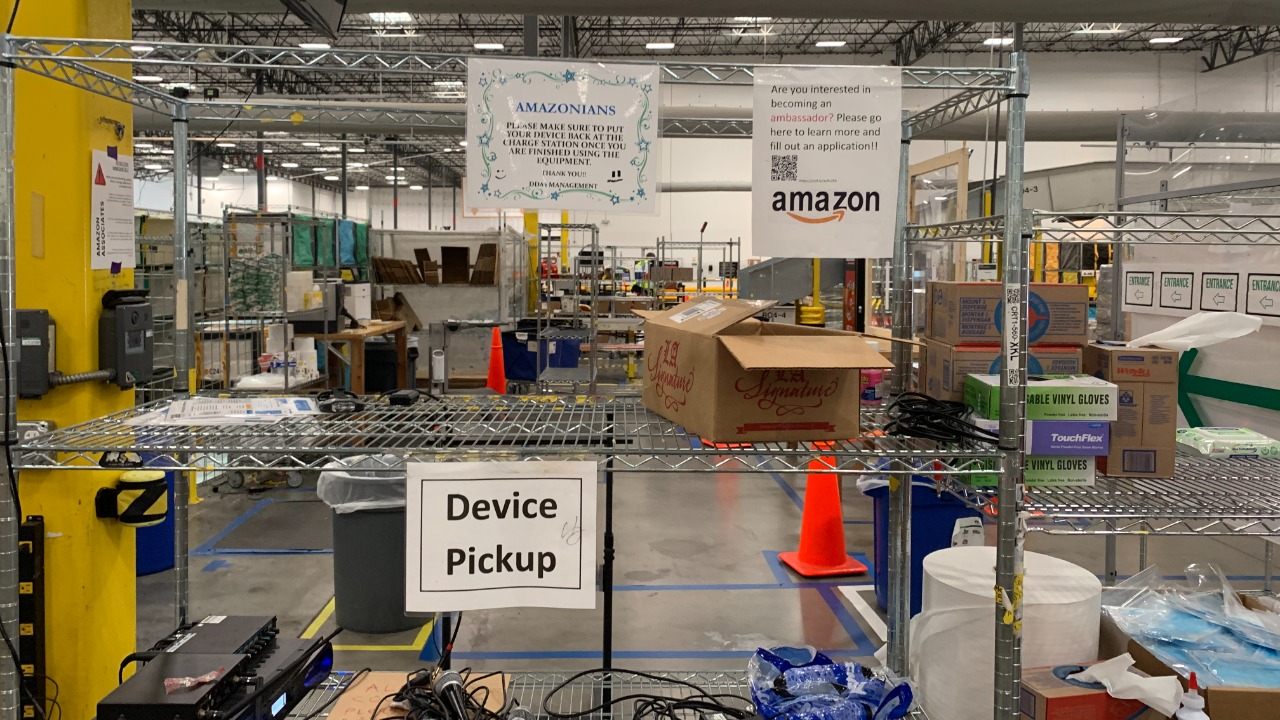
To understand what is really at stake, it helps to look closely at the tasks these machines are taking over. In Amazon fulfillment centers, robots now glide under shelving units to bring entire racks of products to stationary workers, lift heavy pallets, and shuttle packages between zones, turning what used to be miles of daily walking into a more stationary, screen guided workflow for humans, as shown in the detailed tour of Amazon Robotics systems. The machines do not yet handle the fine motor work of picking up a single lipstick or paperback from a bin with the reliability of a human hand, but they increasingly handle everything around that moment.
That division of labor has already changed the skills Amazon looks for in frontline hires. Instead of prioritizing sheer physical stamina, the company now needs workers who can manage complex workflows, troubleshoot jams, and collaborate with software driven systems, a shift that outside observers have traced in analyses of How Amazon Robotics Changed the Landscape of Fulfillment. The result is a workplace where the most punishing tasks are increasingly mechanized, but the pace of work and the expectation to keep up with the machines can feel more intense.
Buffett’s long view: robots as the next productivity wave
Warren Buffett has been unusually consistent in arguing that robots and artificial intelligence should be seen as the next chapter in a long history of productivity improvements rather than as a unique threat. Years ago, he and Bill Gates both described it as “crazy” to view job stealing robots as inherently bad, pointing out that if one person could push a button and produce all the goods and services society needs, the challenge would be distribution, not production, a thought experiment he laid out alongside Warren Buffett and Bill Gates. In that framing, Amazon’s robots are simply the latest in a line of technologies that free people from drudgery and open space for new kinds of work.
Buffett has also been clear that the transition will not be painless. He has warned that artificial intelligence could lead to significantly less employment at some firms and that the gains from higher productivity will not automatically flow to displaced workers, a concern he raised while discussing how AI might affect well known companies like Geico in remarks captured in Global. His optimism is conditional, rooted in the belief that policy makers can design systems that share the benefits of automation rather than allowing a small group of shareholders to capture them all.
Why Buffett tells Americans not to fear automation
When Buffett tells Americans not to fear automation, he is not denying that specific jobs will disappear, he is arguing that the overall pie will grow if society manages the transition well. He has repeatedly said that rising productivity has historically raised living standards, even when it has wiped out entire categories of work, and that the same pattern can hold in the age of AI and warehouse robots if governments and companies invest in retraining and social safety nets, a case laid out in coverage that explains why Here he is not afraid.
At the same time, Buffett has called AI “good for society but enormously disruptive,” a phrase that captures his belief that the technology’s upside is real but that the adjustment period could be brutal for specific communities and industries. His long time partner Charlie Munger has echoed that view, arguing that the world will adjust well to increased productivity, a sentiment that appears in the discussion of how Charlie Munger and Buffett see AI as both beneficial and destabilizing. For warehouse workers watching robots roll in, that nuance matters, it is an invitation to demand policies that cushion the disruption rather than a blanket reassurance that everything will work out on its own.
How critics see Amazon’s robot strategy
Not everyone shares Buffett’s confidence that the market and policy makers will rise to the challenge, especially when it comes to Amazon’s specific automation plans. Labor advocates and left leaning analysts argue that the company’s deployment of its one millionth robot is already reshaping the workforce in ways that concentrate power and profits at the top while leaving frontline workers with fewer options and more surveillance, a concern explored in a critical look at how Earlier this year Amazon highlighted robots working alongside inventory stowers and order pickers in glossy videos.
Those critics point out that even if robots technically “work alongside” humans, they also set the pace and structure of the job, from how fast items must be scanned to how tightly breaks are scheduled. They worry that internal Amazon documents about replacing 600,000 human workers with robots by 2033, described as Internal Amazon planning, signal a future in which the company uses automation not just to improve safety but to weaken labor’s bargaining power and keep wages in check.
The policy question Buffett keeps raising
Where Buffett aligns with some of those critics is in his insistence that technology alone will not determine the outcome, policy will. He has said that as AI and automation create “roadkill” in the labor market, governments will need to design systems that take care of people who lose out in the transition, whether through wage insurance, retraining, or more ambitious social programs, a point he made explicitly when he argued that society must address the plight of displaced domestic workers in remarks captured by Jun. In that sense, the debate over Amazon’s robots is really a debate over whether the United States is prepared to make those choices.
For now, the policy response lags far behind the technology curve. While Amazon refines generative AI foundation models to orchestrate its logistics network and continues to scale its robotic fleets, there is little sign of a comprehensive national strategy to help warehouse workers transition into new roles or to ensure that the gains from automation show up in their paychecks. Buffett’s message to Americans not to fear automation is best read not as a prediction that everything will be fine, but as a challenge to build the institutions that can turn a warehouse full of robots into a broader story of shared prosperity.
More From TheDailyOverview

Grant Mercer covers market dynamics, business trends, and the economic forces driving growth across industries. His analysis connects macro movements with real-world implications for investors, entrepreneurs, and professionals. Through his work at The Daily Overview, Grant helps readers understand how markets function and where opportunities may emerge.