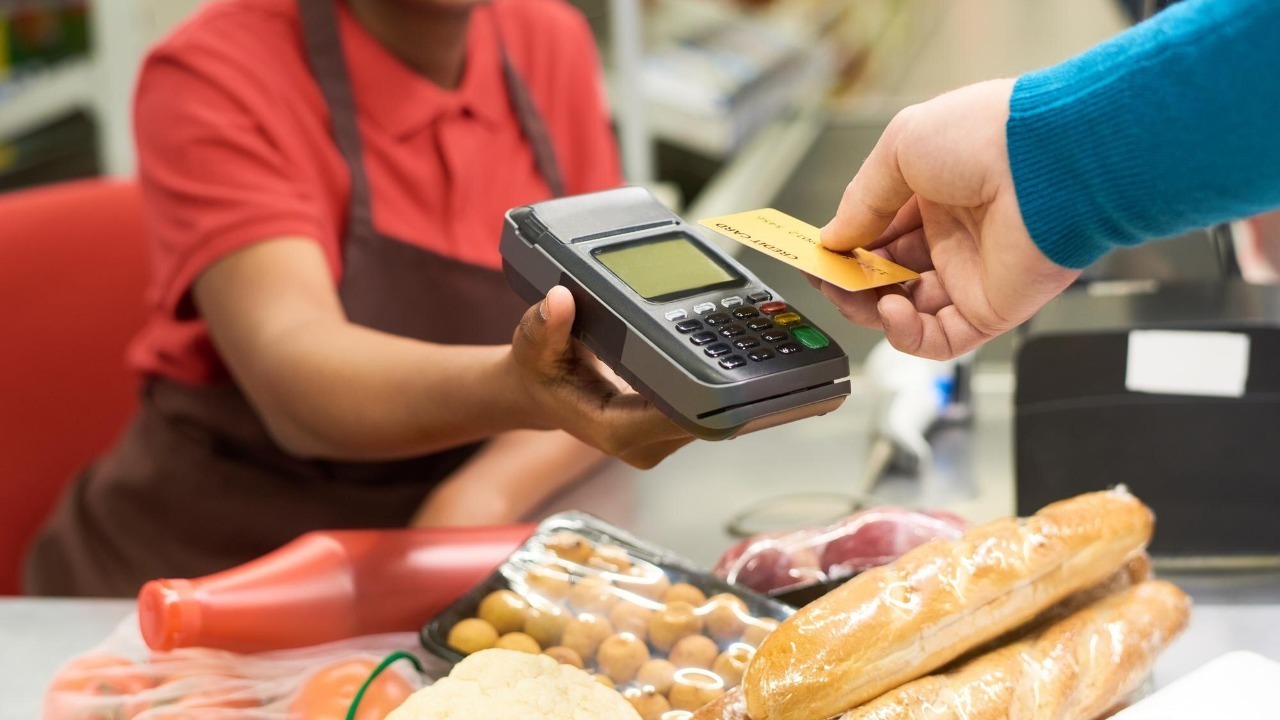
U.S. consumers devoted a record-low share of their disposable income to food in 2024, yet grocery bills and restaurant tabs still feel like a financial burden for millions of households. The disconnect between that historic low and the persistent sting at checkout has several explanations, from stubborn restaurant inflation to hidden costs baked into the shift away from cash. Understanding why wallets still hurt requires looking beyond the headline number and into the mechanics of how Americans actually pay for what they eat.
A Record Low That Masks Uneven Relief
In 2024, American consumers spent an average of 10.4 percent of disposable income on food, continuing a long downward trend. That figure covers both groceries and dining out, and it has been falling for decades as incomes have grown faster than food costs. Higher-earning households feel this most clearly: as incomes rise, families spend more total dollars on food, but that spending represents a shrinking slice of after-tax income, a pattern detailed by the USDA’s food expenditure data.
The problem is that a national average smooths over sharp differences. Lower-income households still devote a much larger portion of every paycheck to feeding their families, which means even modest price increases hit harder. The record-low share is real, but it describes an economy-wide ratio, not the lived experience of a family earning $35,000 a year and watching egg prices fluctuate. When the denominator (income) grows while the numerator (food cost) rises more slowly, the percentage drops, but that does not necessarily mean the dollar amount on a receipt has gone down, especially for families whose paychecks have not kept pace with the aggregate gains.
Restaurant Bills Outpace Grocery Shelves
The split between eating at home and eating out tells a sharper story. For the 12 months ending in January 2026, prices for food at home rose 2.1 percent year over year, while food away from home climbed 4.0 percent, according to the consumer price index. That gap matters because Americans have been steadily shifting their food dollars toward restaurants, takeout, and delivery. USDA figures indicate that money spent on food away from home has exceeded spending on food at home in multiple recent years, a structural change that amplifies the impact of restaurant-specific inflation on household budgets.
Labor costs, commercial rents, and tipping norms all feed into restaurant prices in ways that do not apply to a bag of rice at the supermarket. So even when grocery inflation cools, the category where Americans increasingly choose to spend, dining out, keeps climbing at a faster clip. A 4.0 percent annual increase may sound modest in isolation, but layered on top of cumulative price gains since 2020, it helps explain why a casual dinner for two can feel noticeably more expensive than it did just a few years ago. With food competing fiercely with housing and transportation for room in the family budget, the restaurant premium can turn what looks like manageable inflation on paper into real strain at the table.
Wages Are Rising, but So Is Everything Else
Real purchasing power has improved, though not by enough to erase the sting. Real average hourly earnings grew 1.2 percent year over year from January 2025 to January 2026, while real weekly earnings rose 1.9 percent, according to the Bureau of Labor Statistics. Those gains mean workers are technically outpacing overall inflation, which should ease pressure on food budgets. Yet cumulative price levels remain elevated after several years of above-trend inflation, and categories like shelter continue to absorb large portions of household income, leaving less flexibility elsewhere.
The result is a psychological and mathematical mismatch. A worker whose real wages are up in a single year may still be behind on a three- or four-year basis if prices jumped sharply in 2022 and 2023. The Consumer Expenditure Survey underscores how food, housing, and transportation crowd each other within a fixed paycheck, with rent or mortgage payments often taking precedence. When shelter costs remain elevated, even a modest food bill can feel like the straw that tips a monthly budget from comfortable to tight. Real wage growth is welcome, but it has not yet fully offset the cumulative price reset that households experienced during the post-pandemic inflation surge.
The Hidden Toll of Going Cashless
A less visible force is also shaping what Americans pay for food: the cost of the payment itself. Card purchase volume in the United States reached $11.903 trillion in 2024, and merchants paid $187.20 billion in processing fees on those transactions, roughly $1.57 per $100 spent. Those fees do not appear as a line item on a consumer’s receipt, but they are routinely folded into the prices that restaurants and grocery stores charge everyone, whether they pay with a card, a phone, or cash. For food businesses that often operate on thin margins, there is little choice but to bake payment costs into menu prices and shelf tags.
For the roughly 4.2 percent of U.S. households that remain unbanked (about 5.6 million families) and the 14.2 percent classified as underbanked, roughly 19.0 million, the cashless shift creates an additional layer of disadvantage. These groups, identified in the FDIC’s national household banking survey, are more likely to rely on cash, prepaid cards, or high-fee financial services. When merchants raise prices to cover card processing costs, cash-paying customers effectively subsidize the rewards and conveniences enjoyed by card users. At the same time, unbanked shoppers may face surcharges at certain stores, higher fees at check-cashing outlets, or limited access to online grocery discounts, compounding the sense that food is taking a larger bite out of their income than headline statistics suggest.
Why “Cheaper on Paper” Still Feels Expensive
Putting these threads together helps explain the disconnect between the record-low share of income spent on food and the persistent feeling of strain. The headline ratio captures an aggregate economy in which incomes have risen faster than food costs overall, but it obscures how that progress is distributed. Higher earners, who devote a smaller share of each dollar to food, pull the average down, while lower-income households continue to juggle grocery lists against rent, utilities, and transportation. At the same time, a growing share of food dollars flows to restaurants, where inflation has been hotter and where service charges and tipping expectations have crept higher.
Layered on top of that is the quiet but substantial cost of processing payments in a largely cashless system, a cost that businesses spread across all customers. Even as real wages inch ahead of inflation on annual comparisons, many families are still catching up from earlier price spikes, particularly in housing. The result is an environment in which official statistics can point to progress, more income relative to food spending, while lived experience reflects the cumulative impact of restaurant premiums, payment fees, and stubbornly high fixed costs. For households, the math is simple: if the rent check and the card bill keep growing faster than the paycheck, a record-low national food share offers little comfort when it is time to pay for dinner.
More From The Daily Overview
*This article was researched with the help of AI, with human editors creating the final content.

Cole Whitaker focuses on the fundamentals of money management, helping readers make smarter decisions around income, spending, saving, and long-term financial stability. His writing emphasizes clarity, discipline, and practical systems that work in real life. At The Daily Overview, Cole breaks down personal finance topics into straightforward guidance readers can apply immediately.

