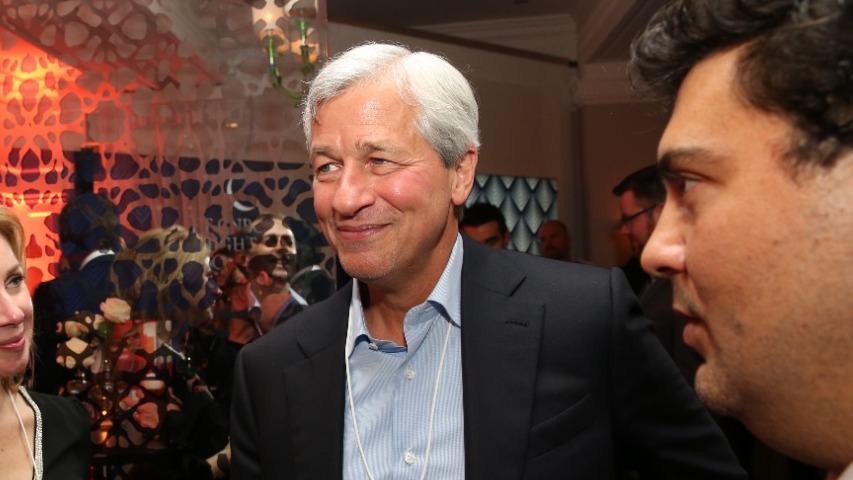
Jamie Dimon is putting his considerable clout behind a blunt warning to President Donald Trump: turn the Federal Reserve into a political weapon and borrowing costs will climb, not fall. The longtime JPMorgan Chase chief is arguing that efforts to pressure, investigate, or sideline Jerome Powell will rattle markets, push up long‑term yields, and ultimately hit the very voters Trump says he wants to help.
At stake is more than a Beltway turf fight. Dimon is effectively telling the White House that a revenge campaign against the central bank and a populist cap on credit card rates risk detonating the foundations of the bond market and consumer finance, with consequences that would show up in mortgage quotes, car loans, and small‑business credit lines across the country.
Dimon’s core warning: meddle with the Fed, get higher rates
Dimon’s central argument is deceptively simple: if politicians start leaning on the Federal Reserve, investors will demand a higher premium to lend money to the United States. He has told clients and colleagues that any move to interfere with the central bank’s independence would likely push market interest rates higher, even if the Fed itself tried to hold its policy rate steady, a concern echoed in recent briefings. In practice, that means 30‑year mortgage costs, corporate bond yields, and state and local borrowing could all jump as investors price in more inflation risk and political chaos.
That logic underpins Dimon’s public defense of Jerome Powell, who is facing a Justice Department probe that many on Wall Street view as politically motivated. In interviews highlighted by Alexander Saeedy, Dimon has stressed that undermining Powell to score short‑term political points could backfire by eroding confidence in the Fed’s inflation‑fighting credibility. If investors start to doubt that the central bank will be allowed to do its job, they will not wait for official rate hikes; they will simply demand higher returns now, driving up borrowing costs across the economy.
Backing Powell and blasting the DOJ probe
Dimon has not limited himself to abstract lectures about central bank theory. He has explicitly backed Powell as Fed chair and criticized the Justice Department’s investigation as a dangerous escalation. In one televised exchange, he said that “everyone we know believes in Fed independence,” a pointed message that the financial community, from big banks to asset managers, sees the probe as a threat to the institutional guardrails that keep monetary policy insulated from day‑to‑day politics, a stance detailed in his support for Powell. By tying his defense of Powell to a broader principle, Dimon is signaling that this is not about one man’s job but about the rules of the game.
His language about the investigation has grown sharper as the controversy has deepened. Dimon has warned that the DOJ’s move to open a criminal inquiry into Powell could “stoke inflation” by intimidating the Fed at a moment when markets are still on edge about price pressures, a concern he laid out when he slammed the probe. In that same conversation, the 36‑year Wall Street veteran, as described by James Franey, framed the investigation as part of a broader pattern of political score‑settling that risks turning monetary policy into a partisan battlefield. For a banking system that depends on predictable rules and credible institutions, that is not a theoretical worry; it is a direct threat to how capital is priced.
Trump fires back, accusing Dimon of wanting higher rates
President Trump has responded with characteristic aggression, casting Dimon as an out‑of‑touch banker who benefits from higher borrowing costs. After Dimon’s latest warnings, Trump told reporters that “we should have lower [interest] rates” and suggested that “Jamie Dimon probably wants higher rates, maybe he makes more money that way,” a jab captured in his latest counterattack. The president’s argument is that Wall Street profits from elevated interest margins, while ordinary Americans are squeezed by expensive mortgages and credit cards, so any banker defending the Fed must be defending a rigged system.
Trump has also brushed aside Dimon’s specific concern that the DOJ probe into Powell could push rates higher, publicly dismissing the JPMorgan boss as “wrong” for warning against the investigation. In coverage of his remarks, Trump is quoted insisting that the Fed has made mistakes and that more pressure, not less, is needed to bring rates down, a view he reiterated when he lashed out at. That framing flips Dimon’s warning on its head: where the banker sees political interference as a trigger for higher inflation and yields, the president portrays it as a necessary corrective to an unelected technocracy that has kept money too tight for too long.
A broader clash over Fed independence and “revenge” politics
Behind the personal barbs lies a deeper clash over how much power the White House should wield over the central bank. Dimon has been unusually blunt in describing the administration’s posture as a kind of “revenge plot” against the Fed, warning that efforts to punish Powell for past rate decisions will ultimately “blow up” on Trump by driving up the very borrowing costs he wants to cut, a theme explored in reporting on America’s top banker. In Dimon’s telling, the Fed’s independence is not a technocratic nicety but a hard‑won safeguard that keeps inflation expectations anchored and prevents presidents of either party from juicing the economy before elections.
Other reporting underscores how far this confrontation has escalated. Dimon has criticized the Trump administration’s attacks on the Federal Reserve as a direct assault on central bank independence, warning that turning Powell into a political punching bag will unsettle global investors who rely on the Fed as a steady hand, a concern detailed in his comments on central bank independence. When the chief executive of the largest U.S. bank, often dubbed “America’s banker,” publicly tells a sitting president that he is “shooting himself in the foot,” as he did when warning that President Trump’s own tactics could raise mortgage rates, it signals that the financial establishment sees the current strategy not just as unorthodox, but as actively self‑defeating.
Credit card caps, bond markets, and the risk to everyday borrowers
The fight over the Fed is colliding with another Trump initiative that has Wall Street on edge: a proposed one‑year cap on credit card interest rates. In a post on Truth Social, the president called for “Credit Card Interest Rates of 10%,” arguing that such a cap would save households billions, a pledge that set off alarm bells among big banks and card issuers, as described in coverage of his Truth Social proposal. Dimon and other executives have warned that an abrupt ceiling at that level would force lenders to pull back from riskier borrowers, cut rewards programs, and tighten credit just as consumers are already feeling the pinch from higher prices.
Dimon has linked that concern to a broader plea not to “shake the foundation of the bond market” with sudden, politically driven changes to how credit is priced. In remarks reported by one major outlet, he cautioned that aggressive attacks on both the Fed and the credit card industry could “cause interest rates to actually get pushed up,” a warning echoed in Wall Street’s broader pushback against the administration’s agenda, as detailed in analysis of Wall Street warnings. The average interest rate on credit cards in November stood at 20.97%, according to the Federal Reserve’s consumer credit report, a figure cited by critics who say a sudden plunge to 10% would blow a hole in bank balance sheets and prompt a sharp pullback in lending, as noted in data on the 20.97% rate.
More From TheDailyOverview

Alex is the strategic mind behind The Daily Overview, guiding its mission to uncover the forces shaping modern wealth. With a background in market analysis and a track record of building digital-first businesses, he leads the publication with a focus on clarity, depth, and forward-looking insight. Alex oversees editorial direction, growth strategy, and the development of new content verticals that help readers identify opportunity in an ever-evolving financial landscape. His leadership emphasizes disciplined thinking, high standards, and a commitment to making sophisticated financial ideas accessible to a broad audience.

