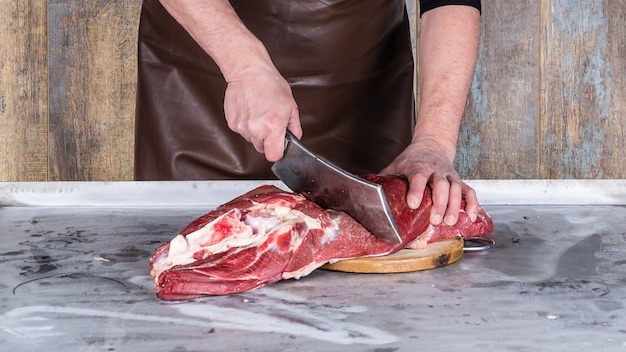
America’s meat habit quietly runs through a single corporate giant that now hauls in more than $50 Billion a year in sales, yet many shoppers could not pick its name out of a lineup. The company sits behind drive‑thru chicken sandwiches, supermarket burger packs, and frozen nuggets, turning the country’s appetite into one of the largest food businesses on the planet. To understand how that happened, I need to unpack both the scale of the industry and the particular empire that turned everyday cravings into a $50 Billion machine.
That story starts with Americans’ deep attachment to animal protein, stretches through decades of consolidation in meatpacking, and lands in a present where one firm dominates beef, chicken, and pork in the United States. Along the way, it has reshaped rural economies, squeezed suppliers, and drawn scrutiny from regulators and advocates who see both economic power and risk concentrated in a single name.
Americans’ meat obsession and the $50 Billion question
Any search for America’s biggest meat processor begins with the simple fact that Americans love meat, and they buy it in staggering quantities. From fast‑food chicken sandwiches to premium steaks, the country’s diet is built around animal protein, and that demand underwrites a supply chain that runs from feedlots and chicken houses to industrial slaughter lines and refrigerated trucks. Industry analysts point out that the largest player in this chain now generates more than $50 Billion in annual revenue, a figure that would place it among the biggest food companies in the world.
That scale is easy to miss because the brand is often invisible at the point of sale, tucked behind restaurant menus and private‑label supermarket packaging. Yet the same corporate parent that processes chicken for quick‑service chains also fills grocery meat cases with beef and pork, capturing a dominant share of the domestic market. Consumer surveys routinely show that many shoppers cannot name the company even as they buy its products several times a week, which is why the question “Do You Know Which?” still lands with some surprise when people learn that a single processor is responsible for such a large slice of the meat they eat.
Inside the U.S. meat, beef and poultry hierarchy
To see how one firm reached that position, I look first at the broader structure of the Meat, Beef & Poultry Processing industry in the United States. Market research on the sector’s Biggest players shows a short list of companies controlling the bulk of revenue, with a clear leader at the top. That leader is Tyson Foods, which has built a vertically integrated network spanning chicken, beef, and pork, and which now sits as the largest Meat, Beef, Poultry Processing Company in the country by sales.
Tyson’s dominance is not just a matter of size but of product mix. The company processes enormous volumes of chicken, which has become the default protein for many households, while also running some of the largest beef and pork operations in the country. Industry tables that rank each Company by revenue consistently place Tyson Foods ahead of domestic rivals, confirming that when people talk about America’s Largest Meat Processing Company, they are effectively talking about Tyson’s reach from farm to plate.
Tyson Foods’ $54.44 billion meat empire
Once I name Tyson Foods as the mystery giant, the revenue numbers come into sharper focus. Financial data show that Tyson’s annual revenue recently totaled $54.44 billion, with year‑over‑year growth of 2.12%. That figure comfortably clears the $50 Billion threshold highlighted in consumer‑facing explainers and underscores just how central Tyson has become to the American food system. When analysts describe Tyson Foods as the largest meat processing company in the U.S., they are pointing directly at this revenue base and the breadth of its operations.
Company statements on recent Fiscal performance highlight not only headline sales but also liquidity targets and free cash flow expectations, signaling a business that is planning years ahead on the assumption that Americans’ appetite for meat will remain robust. In detailed SEGMENT RESULTS and Fourth Quarter Highlights, Tyson lays out how each protein category contributes to the whole, reinforcing the picture of a diversified meat conglomerate rather than a single‑product brand.
From Arkansas chicken houses to national dominance
The path to that $54.44 billion footprint runs through Springdale, Arkansas, where the company’s roots are still part of its corporate mythology. Archival photos show John Tyson standing inside a chicken house in the Springdale, Arkansas area, a reminder that Tyson Foods began as a regional poultry operation before expanding aggressively into beef and pork. Over decades, the company used acquisitions, contract farming, and processing plant investments to transform itself from a local chicken business into the largest meat producer in the USA.
That growth strategy has had ripple effects across rural America. Contract growers who raise birds for Tyson often depend on the company for financing, feed, and flock placement, while communities that host processing plants rely on Tyson for jobs and tax revenue. The company’s evolution from those early Arkansas chicken houses to a national powerhouse illustrates how a single corporate player can come to dominate not just supermarket shelves but also the economic life of entire regions.
Global rivals and the JBS challenge
Tyson’s supremacy inside the United States does not mean it is the largest meat company on the planet, and that distinction matters for understanding competitive pressure. A Brazil‑based multinational, JBS, has spent years buying up rivals and expanding its global footprint, including snapping up Pilgrim’s Pride in a deal that turned Pilgrim’s Pride into part of its empire. Reporting on that acquisition describes JBS as the biggest producer of meat in the world, ahead of Tyson, which reframes Tyson’s $54.44 billion as part of a larger global contest for protein dominance.
Financial snapshots of JBS show a company with its own vast revenue base and a complex capital structure, tracked through metrics such as Price history, Operating margin, EPS, and Dividends Shares. For Tyson, competing with a Brazil‑based rival that has leveraged international acquisitions to become the world’s largest meat producer adds pressure to keep expanding and to manage costs aggressively. That global rivalry helps explain why Tyson continues to invest heavily in efficiency and scale, even as it already dominates the U.S. market.
More From TheDailyOverview
*This article was researched with the help of AI, with human editors creating the final content.

Grant Mercer covers market dynamics, business trends, and the economic forces driving growth across industries. His analysis connects macro movements with real-world implications for investors, entrepreneurs, and professionals. Through his work at The Daily Overview, Grant helps readers understand how markets function and where opportunities may emerge.

