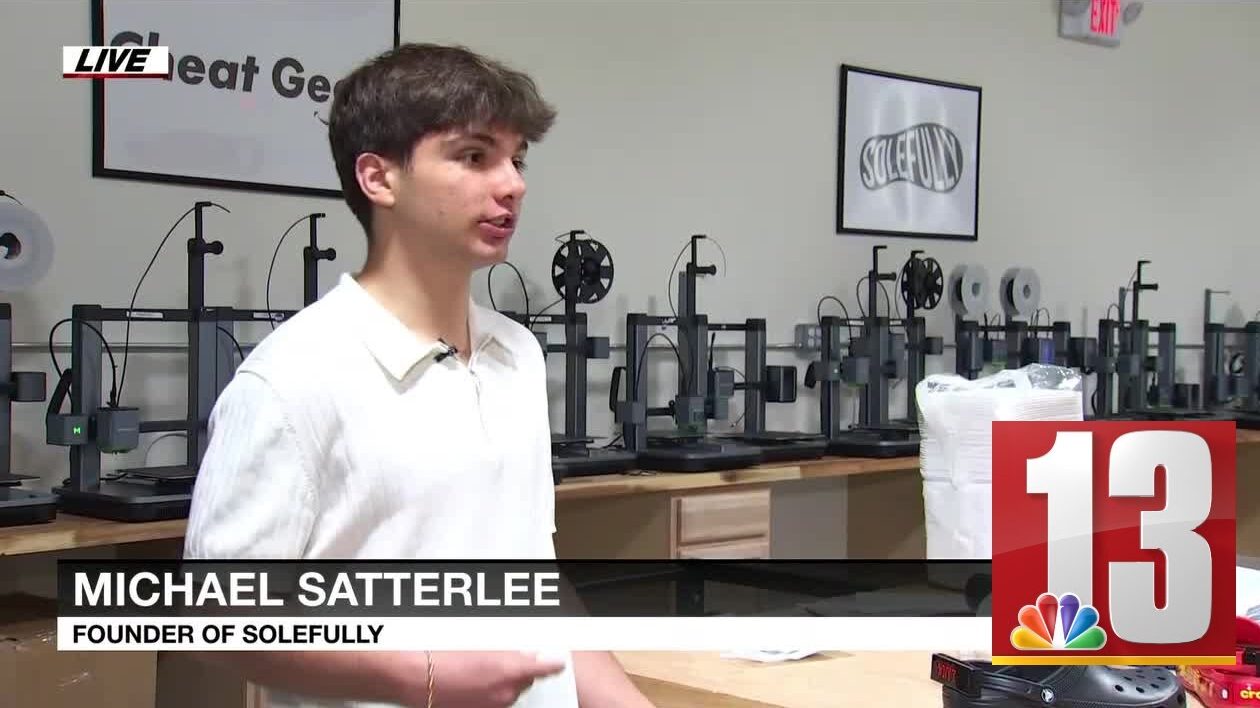
At an age when most teenagers are still figuring out what to study, Michael Satterlee has already turned a 3D-printing side project into a business that brings in $300,000 a month. His signature product, a tactical reload can holder that clips onto a car cup holder and flips a drink into easy reach, has become the kind of viral hit that usually belongs to venture-backed startups, not high school classrooms. The real story, though, is not just the gadget, but the idea engine behind it and how he keeps finding the next thing people did not know they wanted.
From classroom curiosity to a tactical hit
The path to that tactical reload can holder started in a place that feels almost mundane: a school lesson. Michael Satterlee first encountered 3D printing in class, then decided the technology was too promising to leave in the lab, so he bought his own printer and began experimenting at home. After Satterlee learned how to 3D print in class, he did not chase abstract art pieces or generic trinkets, he researched product ideas that could solve specific annoyances in everyday life, a pattern that would later underpin his entire approach to physical products and is highlighted in the Key Takeaways about his early side hustle.
That focus on practical problems eventually produced the tactical reload can holder, a 3D-printed accessory that lets drivers stash a can sideways and then swing it upright when they want a sip. The design is simple enough to understand in a few seconds of video, which is exactly how it spread, as clips of the device in action racked up views and turned curiosity into orders. Satterlee, who learned about 3D printing in school and then refined his designs at home, credits that combination of classroom exposure and self-directed tinkering for giving him the confidence to build a product that could be manufactured at scale, a progression detailed in reporting that tracks how Satterlee, who learned about 3D printing in class, turned that knowledge into a commercial hit.
The $300,000-a-month flywheel
Once the tactical reload can holder caught on, the numbers escalated quickly, and with them the pressure to keep delivering. At 18, Satterlee now brings in $300,000 a month from his 3D-printed reload can holders, a figure that would be impressive for a seasoned founder, let alone someone barely out of high school. That revenue is not just a vanity metric, it is proof that a niche, highly visual product can sustain a serious operation when it is paired with a tight feedback loop between social media, manufacturing and customer response, as described in coverage of how an 18-year-old brings in $300,000 a month with this single idea.
Behind that headline figure sits an e-commerce engine that has grown far beyond a bedroom setup. Satterlee’s viral video did more than generate likes, it funneled viewers straight into Cruise Cup, his online store that now sells a variety of 3D-printed accessories built around the same ethos of playful utility. The viral clip, which showcased the tactical reload can holder in a car console, helped turn Cruise Cup into a recognizable brand and is credited with driving a surge of orders that can be seen in a screenshot of his Shopify dashboard, a moment captured in reporting on how Satterlee’s viral video powered the quick rise of Cruise Cup.
Scaling from a childhood home to a 50-printer factory
Rapid demand forced Satterlee to confront a problem that many young makers never reach: how to scale production without losing control of quality or speed. What began as a few printers humming in a bedroom soon spilled into every available corner of his family’s house, until the business effectively took over his childhood home in Clifton Park, New York. The operation grew so large that it outgrew that space entirely, a shift described in accounts of how Satterlee’s company has outgrown his childhood home in Clifton Park, New York as printers, inventory and packing stations multiplied.
To keep up, he built what is essentially a small-scale factory of consumer-grade machines, reportedly running around 50 3D printers in parallel to churn out parts. That fleet is not just about volume, it is part of what Satterlee describes as an algorithm for success, a system that blends printer capacity, product testing and social media response into a repeatable process. In community discussions, he is described as a 17-year-old who has already secured an algorithm for success with his 3D-printing business, a phrase that captures how he treats each new design as a data point in a larger experiment, as highlighted in a thread that links to a profile of Open, Michael Satterlee and his 50-printer setup.
The idea engine: research, algorithms and customer obsession
The most striking part of Satterlee’s story is not just that he found one winning product, but that he has built a repeatable way to spot the next one. He talks about his process in almost mathematical terms, describing how he studies what people complain about in their cars, kitchens and daily routines, then runs those pain points through a mental filter of what 3D printing can solve quickly and cheaply. That is where his algorithm comes in, a research method that blends trend-watching, customer comments and rapid prototyping into a cycle that can spin up new designs in days rather than months, a mindset that early profiles of algorithm driven product development have emphasized.
Customer feedback sits at the center of that engine. Satterlee has said that the key is to pay attention to your customers, not just in formal surveys but in the offhand comments they leave on videos and product pages. When someone mentions that a can rattles in a cup holder or that a console is too cluttered, he treats it as a design brief, sketching and printing variations until the complaints turn into compliments. That approach, where Satterlee listens closely to what buyers say and then iterates his 3D-printed designs accordingly, is highlighted in reporting that notes how Satterlee, who learned about 3D printing in class, built his business by staying obsessed with what customers actually want.
Beyond one viral product: building Cruise Cup as a brand
For any young entrepreneur, the risk of being a one-hit wonder is real, especially when the first breakout product is as distinctive as a tactical reload can holder. Satterlee’s answer has been to treat Cruise Cup not as a single-product shop, but as a platform for a family of clever, 3D-printed accessories that share a common design language. Cruise Cup now sells a variety of 3D-printed items that extend the same playful, tactical aesthetic into other parts of the car and daily carry, a shift that reporting on Cruise Cup notes as part of the company’s quick evolution from a single viral clip to a broader catalog.
That brand-building effort is also informed by Satterlee’s earlier experiments outside the car accessory niche. Before the tactical reload can holder took off, he had already dabbled in other product lines, including a clog accessory company called Solefully, which gave him a crash course in what makes a small, visual product shareable and easy to ship. Those lessons now feed back into Cruise Cup, where each new design is evaluated not just for function, but for how it will look in a five-second video or a still photo on a product page, a connection that surfaces in coverage of how his reload can holders and earlier ventures like Solefully fit into a broader strategy.
What other founders can learn from an 18-year-old
For aspiring founders, especially those still in school, Satterlee’s trajectory offers a blueprint that is both specific and replicable. He did not wait for perfect conditions or industrial equipment, he started with a single consumer 3D printer, a classroom skill and a willingness to test ideas in public. The fact that his side hustle was already making $20,000 a month when he was 17 underscores how quickly a focused, problem-solving product can scale when it is paired with disciplined execution, a point underscored in profiles that explain how After Satterlee learned 3D printing, he turned it into a serious income stream.
The deeper lesson is that his success is not a lottery win, but the result of a deliberate system for generating and testing ideas. By treating social media as a live focus group, using 3D printers as rapid prototyping tools and building an algorithmic approach to research that starts with real complaints, Satterlee has created an engine that can keep producing new products long after the initial viral wave fades. For other entrepreneurs, the takeaway is clear: the next breakout idea may not come from a boardroom or a lab, but from the comments section, a classroom and a willingness to let a few plastic prototypes fail on the way to something people cannot stop sharing.
More From TheDailyOverview

Cole Whitaker focuses on the fundamentals of money management, helping readers make smarter decisions around income, spending, saving, and long-term financial stability. His writing emphasizes clarity, discipline, and practical systems that work in real life. At The Daily Overview, Cole breaks down personal finance topics into straightforward guidance readers can apply immediately.
