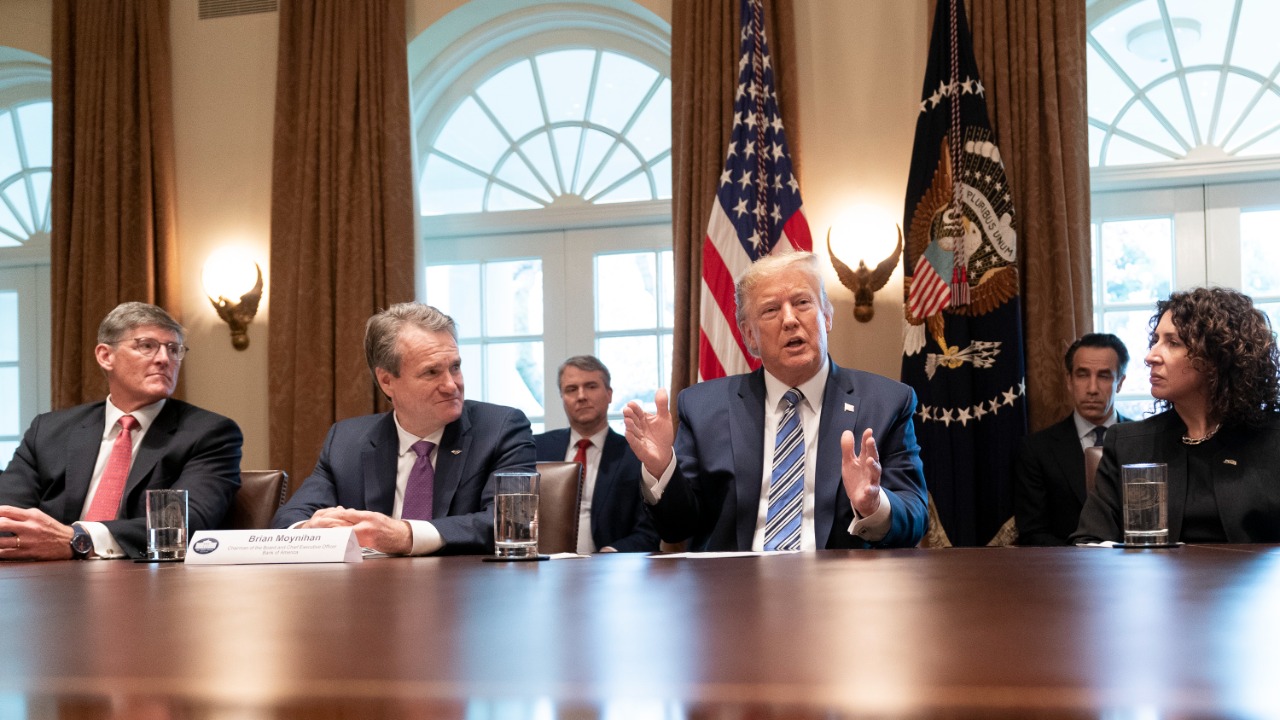
Financial markets can tolerate a lot of uncertainty, but they have far less patience for political meddling in central banking. When a big bank chief warns that investors will “punish” Americans if the Federal Reserve bends to the White House, he is really describing a confidence game that underpins every mortgage rate, credit card bill, and small business loan in the country. The message is blunt: if the Fed looks captured, the cost of money will rise for everyone.
At the center of the latest warning is Bank of America Chairman and CEO Brian Moynihan, who has been unusually direct about the risks if President Donald Trump tries to steer the Federal Reserve’s decisions or its leadership. His argument is not about institutional etiquette, it is about the price that households and companies will pay if investors start to doubt that the Fed will put inflation and financial stability ahead of politics.
The CEO’s warning and what “punishment” really means
When a Wall Street veteran like Brian Moynihan talks about markets “punishing” people, he is not invoking some abstract moral judgment, he is describing how fast capital can flee when trust erodes. In his recent comments, the Bank of America CEO framed Federal Reserve independence as a hard line, saying that if investors believe the central bank is taking orders from the White House, they will demand higher returns to hold U.S. assets, which translates into higher borrowing costs for American consumers and businesses. That is the core of his warning: political pressure on the Fed would be felt in everything from 30‑year fixed mortgages to auto loans on a 2025 Ford F‑150.
Moynihan’s concern is rooted in the Fed’s role as the central bank that sets benchmark interest rates and anchors expectations for inflation. In his televised appearance, he stressed that the institution must remain independent even as President Donald Trump weighs whether to keep or replace Federal Reserve chair Jerome Powell, because any perception that the president is dictating policy would shake confidence in the Fed’s commitment to price stability. His argument, captured in a detailed discussion of Fed independence, is that markets are watching not just the level of rates, but the integrity of the process that produces them.
Trump, Powell, and the temptation to lean on the Fed
The political backdrop to Moynihan’s warning is President Donald Trump’s open interest in reshaping the Federal Reserve. As the president considers whether to nominate a new chair to replace Jerome Powell, he also faces the temptation to lean on the central bank for looser policy that might juice growth or stock prices in the short term. Any such effort, Moynihan argues, would be read by investors as an attempt to subordinate the Fed’s mandate to the electoral calendar, a move that could backfire quickly in the bond and currency markets.
In a clip shared from his appearance on Face The Nation, the Bank of America chairman underscored that the independence of the Federal Reserve, and of Jerome Powell personally, is “paramount” to maintaining a stable banking system and predictable interest rates. He framed the choice facing President Donald Trump not just as a personnel decision, but as a signal to global investors about whether the United States still respects the firewall between politics and monetary policy, a point that was highlighted in a video of his remarks on the Federal Reserve.
How markets would react if the Fed looks captured
From my perspective, the most important part of Moynihan’s warning is not the headline phrase about punishment, but the mechanism behind it. If traders conclude that President Donald Trump is steering the Federal Reserve toward artificially low rates, they will worry that inflation will run hotter in the future, and they will demand higher yields on U.S. Treasurys to compensate. That repricing would ripple through to corporate bonds, municipal debt, and consumer credit, lifting the cost of capital across the economy and potentially knocking stock valuations lower as discount rates rise.
Reporting on Moynihan’s comments has emphasized that any direct effort by President Donald Trump to influence the Federal Reserve could have “harmful effects” on the stock market and the broader economy, particularly if it undermines confidence in Jerome Powell’s willingness to tighten policy when needed. The warning is that markets would not wait for inflation data to confirm their fears, they would move preemptively, selling risk assets and pushing up yields the moment they sense that the central bank is no longer acting independently, a dynamic spelled out in coverage of how the market will punish political interference.
Why independence matters for everyday Americans
It is easy to treat debates about Federal Reserve independence as an inside‑baseball fight among elites, but the stakes land squarely on household balance sheets. If investors lose faith in the Fed and push long‑term rates higher, a family shopping for a $400,000 home could see their monthly payment jump by hundreds of dollars, while a small manufacturer rolling over a line of credit might face sharply higher interest costs that force layoffs or delayed expansion. Moynihan’s point is that the “punishment” would not be confined to Wall Street traders, it would be felt in Main Street budgets.
In his interview, the Bank of America CEO also pointed to the importance of keeping the Fed’s rate decisions anchored in data rather than political pressure, noting that the central bank’s target range for interest rates, which he referenced as between 3.5 percent and 3.75 percent, reflects a judgment about inflation and growth rather than a desire to please any administration. That distinction matters because it reassures lenders and borrowers that the path of rates is tied to economic fundamentals, a theme that came through clearly in his comments on the Fed’s target range.
The media fight over how the warning is framed
There is also a parallel battle over how Moynihan’s warning, and the broader debate about Federal Reserve independence, is presented to the public. Supporters of President Donald Trump have accused some outlets of editing interviews in ways that underplay concerns about political pressure or overstate the risk of interference, turning what should be a sober discussion of monetary policy into another front in the media wars. That tension surfaced in coverage that criticized how a Face The Nation interview with Secretary Nome was cut for time, with critics arguing that key context about the administration’s stance on the Fed was left on the cutting room floor.
One segment that circulated widely urged viewers to “Watch” how CBS News handled Secretary Nome’s appearance on Face the Nation, suggesting that the editing shaped perceptions of the administration’s approach to institutions like the Federal Reserve more than the raw transcript would have. The clip, shared as a short reel highlighting Secretary Nome’s interview, became a proxy fight over whether the media is fairly conveying the stakes of Trump’s relationship with the Fed or amplifying partisan narratives. That dispute matters because public understanding of central bank independence is filtered through these media frames, which can either reinforce Moynihan’s warning about market discipline or drown it out in the broader noise of political combat.
Signals, speeches, and the road ahead for the Fed
Looking ahead, the key variable is not just what President Donald Trump ultimately decides about Jerome Powell’s future, but how he talks about that decision and about the Federal Reserve more broadly. Markets parse every speech, social media post, and off‑the‑cuff remark for clues about whether the White House respects the Fed’s autonomy or expects it to deliver politically convenient outcomes. A single comment suggesting that rate cuts are owed to the administration, rather than earned by economic data, can move futures markets and shift expectations for the path of policy.
That is why Moynihan’s warning has resonated beyond the usual policy circles. In a widely shared interview clip, he framed the issue in plain language, explaining that if the Fed is seen as an arm of the executive branch, investors will adjust their behavior in ways that raise costs for everyone, from tech startups seeking venture debt to households carrying balances on variable‑rate credit cards. His remarks, captured in a video of his full conversation, amount to a plea for restraint: let the Federal Reserve do its job, or be prepared for markets to reprice the risk of lending to a country that no longer treats its central bank as independent.
More From TheDailyOverview

Grant Mercer covers market dynamics, business trends, and the economic forces driving growth across industries. His analysis connects macro movements with real-world implications for investors, entrepreneurs, and professionals. Through his work at The Daily Overview, Grant helps readers understand how markets function and where opportunities may emerge.

