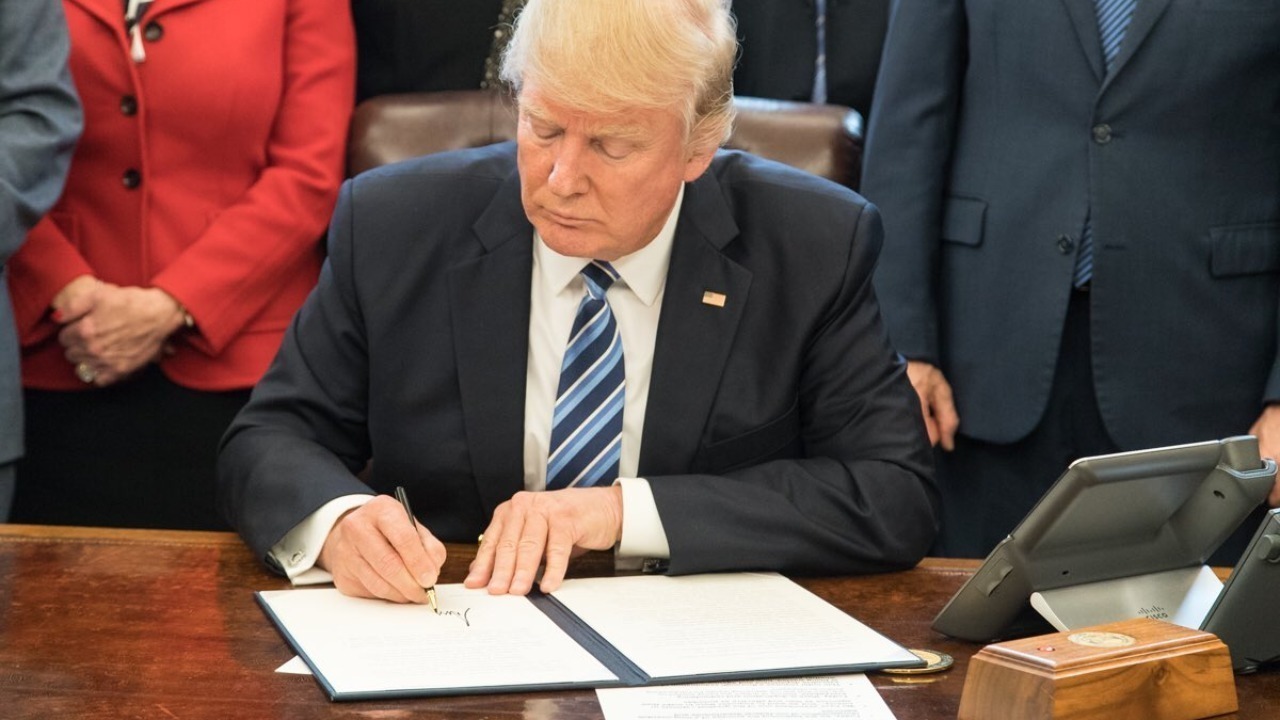
President Donald Trump is promising to turn his trade war into a cash dividend, pitching $2,000 “tariff checks” that he says could land in Americans’ mailboxes by the middle of 2026. The idea has electrified some voters who remember earlier stimulus rounds, but it has also triggered a sharp backlash from Republican lawmakers who see a costly new entitlement wrapped in populist packaging. I want to unpack how this proposal is supposed to work, why the GOP is balking, and what it would actually take for those checks to arrive.
At its core, the plan tries to convert tariff revenue into a direct payment, a kind of “warrior dividend” for households that Trump argues have shouldered the costs of his trade fights. The White House has floated a target of mid‑2026 for the first $2,000 payments, but the path from podium promise to real money runs straight through Congress, skeptical budget hawks, and some unforgiving math.
Trump’s $2,000 tariff dividend, in plain English
Trump has been selling the concept as a simple trade: the government collects more money at the border, then sends a $2,000 check to eligible Americans as a reward for enduring higher prices tied to tariffs. In his framing, tariffs on imports from rivals like China would generate a dedicated pool of cash that can be rebated to “middle and lower income” households, turning a controversial trade tool into a visible benefit. In public remarks and campaign‑style events, he has repeatedly described the payments as a “tariff dividend,” a phrase meant to suggest that ordinary families, not just corporations or the Treasury, should share in the proceeds.
Behind the slogan, the structure is still hazy. Reporting on the Tariff Dividend Check concept notes that President Trump pitched the $2,000 benefit as targeted to “middle and lower income” people, but he has not locked in income thresholds, phase‑outs, or whether dependents would qualify for partial amounts. A separate breakdown of the Stimulus angle underscores that the administration is still describing the plan in broad strokes, promising $2,000 checks tied to tariff revenue while leaving the fine print for later negotiations.
Mid‑2026 timing and the White House sales pitch
The calendar is central to Trump’s message. He has told supporters that the first $2,000 payments could arrive in the middle of 2026, a timeline that conveniently places the windfall after the next budget cycle but before the political focus fully shifts again. In a televised segment, White House advisor Kevin Hassett said Trump would make a formal proposal to Congress in 2026, framing the checks as a way to share the spoils of a tougher trade posture. That pitch is designed to reassure voters who are still feeling the sting of inflation that help is on the horizon, even if it is tied to a policy many economists say already raises consumer prices.
According to one detailed explainer, the administration has floated mid‑to‑late 2026 as the realistic window for any $2,000 tariff payments, stressing that the program would depend on sustained tariff collections and legislative approval. A separate report on how He has suggested the payments could arrive by the middle of 2026 notes that Trump and the White House have promoted that date even as key design details remain unsettled. In a separate interview, National Economic Council Director Kevin Hassett said Sunday that the administration expects the US Supreme Cour to ultimately uphold its broader tariff strategy, and he described $2,000 rebate checks as “likely” if the legal and legislative pieces fall into place.
Republican resistance and the inflation argument
For all the enthusiasm at Trump rallies, the idea has landed with a thud among many Republican lawmakers on Capitol Hill. Senior figures in the party have warned that mailing out $2,000 checks funded by tariffs would look and feel like another round of stimulus, potentially undermining the GOP’s brand as fiscal hawks. Some have privately complained that the plan resembles the pandemic‑era relief they once criticized as excessive, only this time wrapped in tariff rhetoric instead of emergency aid. That skepticism has hardened into open resistance as budget committees run the numbers and see a large new obligation layered on top of existing deficits.
One detailed account notes that Republican lawmakers are resisting President Donald Trump’s proposal to send $2,000 checks, arguing that he cannot move forward without legislative approval and warning that the plan blurs the line between conservative tax policy and direct cash transfers. Another report describes how GOP lawmakers push back on $2K tariff checks, citing inflation and national debt risks as their main objections. A separate analysis from Nov warns that the program could cost up to $606.8 billion, nearly double the combined 2025 and 2026 projected new tariff revenue, and cautions that such a gap means the checks would have to be financed with borrowing, a scenario critics say could fuel more inflation and undercut the very households the plan is meant to help.
How the checks would actually move through Congress
Even if Trump can keep Republican voters excited about the idea, the constitutional plumbing is unforgiving: only Congress can authorize new spending on this scale. White House aides have acknowledged that reality, with Kevin Hassett telling CBS that Trump will bring a formal proposal to Congress in 2026 rather than trying to route the money around lawmakers. That means the plan will have to survive committee markups, floor debates, and the usual horse‑trading over offsets, all while deficit hawks and moderates weigh whether a one‑time $2,000 payment is worth the long‑term budget impact. In practice, the tariff dividend would likely be folded into a broader tax or budget package rather than moving as a standalone bill.
One detailed breakdown of the legislative path notes that Trump’s team expects to present the idea as part of a larger economic agenda, with He will make a proposal to Congress in 2026, according to the White House and Kevin Hassett’s comments to CBS News. Another report on Trump accounts and child care suggests that the payments could come through a new budget bill that clears the Republican‑run Senate in a simple majority vote, potentially using reconciliation rules to avoid a filibuster. That analysis notes that the Republican, Senate could structure the program over a much longer period, stretching out the fiscal hit even if the first checks are branded as a 2026 dividend.
Who would qualify, and how much is really at stake
Eligibility is the biggest unanswered question hanging over the proposal. Trump has repeatedly invoked “middle and lower income” families when describing the $2,000 checks, but he has not specified whether that means the same income thresholds used for prior stimulus rounds or a new set of cutoffs. Some internal discussions have reportedly floated tying eligibility to tax filing status, with full payments for adults under a certain adjusted gross income and partial amounts for those slightly above it. Without those details, it is impossible to say how many households would actually see the full $2,000 or whether the benefit would phase out quickly for upper‑middle‑class earners.
A detailed explainer titled Proposal Explained, Who, Eligible and When It Might Arrive walks through several scenarios, all anchored on the same $2,000 headline figure but with different income caps and family structures. Another analysis on What Trump, Tariff Payout Could Look Like, Your State uses state‑by‑state data to estimate how much money would flow into local economies if every eligible adult received the full amount, highlighting that the impact would be especially pronounced in lower‑income states where $2,000 represents a larger share of annual earnings. Those projections underscore why the stakes are so high: the program could reshape household budgets and local spending patterns, but only if Congress signs off on a structure that matches Trump’s rhetoric.
What Trump and his aides are promising publicly
Trump has not been shy about putting his own political capital behind the idea. At rallies and in interviews, he has framed the $2,000 checks as a personal promise, telling supporters that he will deliver the money as a reward for backing his tough‑on‑China stance. In one televised town hall, he described the payments as a way to “pay down debt” for families who have taken on higher costs, even as he also talked about using tariff revenue to reduce the national debt and address what he calls unfair trade practices by past administrations. That dual message, promising both household relief and macro‑level fiscal responsibility, has become a staple of his economic pitch.
Coverage of his latest comments captures the tone: one report notes that Will, Here, Trump, President Donald Trump reiterated his plan to distribute $2,000 tariff checks in the middle of 2026, telling an audience that the money would come directly from countries that “have taken advantage” of the United States. Another piece on whether Will AmericansPresident Trump says he will send $2,000 stimulus‑style tariff checks and that his administration is confident the plan is a sure thing, even as outside analysts describe it as far from guaranteed.
Inside the GOP’s economic critique
Republican resistance is not just about optics, it is about arithmetic. Budget analysts aligned with the party have warned that the cost of sending $2,000 to every eligible adult could quickly outstrip the tariff revenue Trump is counting on, forcing the government to borrow heavily or cut other programs. That is where the $606.8 billion estimate comes in: if the program were broad‑based, it could cost up to $606.8 billion, nearly double the combined 2025 and 2026 projected new tariff revenue. For lawmakers who spent the last decade railing against deficits, that kind of mismatch is hard to swallow, especially when inflation remains a top concern for voters.
A detailed critique from Nov lays out four reasons the checks might never materialize, starting with the sheer price tag and moving through concerns that the policy could backfire by encouraging more imports to generate revenue for future dividends. That analysis warns that $606.8 billion in potential costs would require either deep cuts elsewhere or a willingness to expand the deficit, both of which divide the GOP. Another report on GOP concerns highlights that Republican lawmakers are already bracing for attacks if they back a plan that could be blamed for any renewed inflation, especially after spending years criticizing earlier stimulus rounds for similar reasons.
Voters’ hopes, doubts and the Tennessee test case
While Washington argues over spreadsheets, voters are trying to decide whether to believe the promise. In swing states and economically stressed regions, the idea of a $2,000 check arriving in 2026 has obvious appeal, particularly for renters, student‑loan borrowers, and families juggling child care costs. Some see it as a chance to catch up on bills or finally replace an aging car, the way earlier stimulus checks helped people pay down credit cards or put a down payment on a used 2015 Honda Civic. Others, burned by past political pledges that never materialized, are more skeptical, treating the tariff dividend as a campaign talking point rather than a firm commitment.
Coverage focused on Tennessee captures that split. One report asks Should Tennesseans
What happens next if the plan moves forward
From here, the story will be written in budget drafts and committee hearings rather than rally speeches. If Trump follows through on his pledge, the White House will send a detailed proposal to Congress in 2026 spelling out who qualifies for the $2,000 checks, how the money will be distributed, and what other programs or revenues will be tapped to make the math work. Lawmakers will then decide whether to embrace the idea as a centerpiece of the next economic package, scale it back to a smaller benefit, or strip it out entirely in favor of more traditional tax cuts or deficit reduction. The outcome will depend not just on Republican unity but also on how much pressure voters apply once they realize that the checks are not automatic.
Trump’s own messaging suggests he is prepared to keep pushing. In a video clip circulating online, recorded in Nov, he talks up the tariff dividend as a way to deliver “thousands of dollars for individuals of moderate income middle income” while also pledging to “pay down debt,” a balancing act that will be hard to achieve in practice. That clip, shared from a Nov appearance, underscores how central the $2,000 figure has become to his economic brand. Another detailed explainer on whether $2,000 tariff checks will really go out in 2026 notes that opinions are mixed, with some analysts calling the plan aspirational and others warning that the longer Congress waits to act, the harder it will be to hit Trump’s mid‑2026 target. For now, the only certainty is that the promise of tariff‑funded checks has opened a new front in the GOP’s internal fight over what conservative economic policy should look like in the Trump era.
More From TheDailyOverview

Grant Mercer covers market dynamics, business trends, and the economic forces driving growth across industries. His analysis connects macro movements with real-world implications for investors, entrepreneurs, and professionals. Through his work at The Daily Overview, Grant helps readers understand how markets function and where opportunities may emerge.

