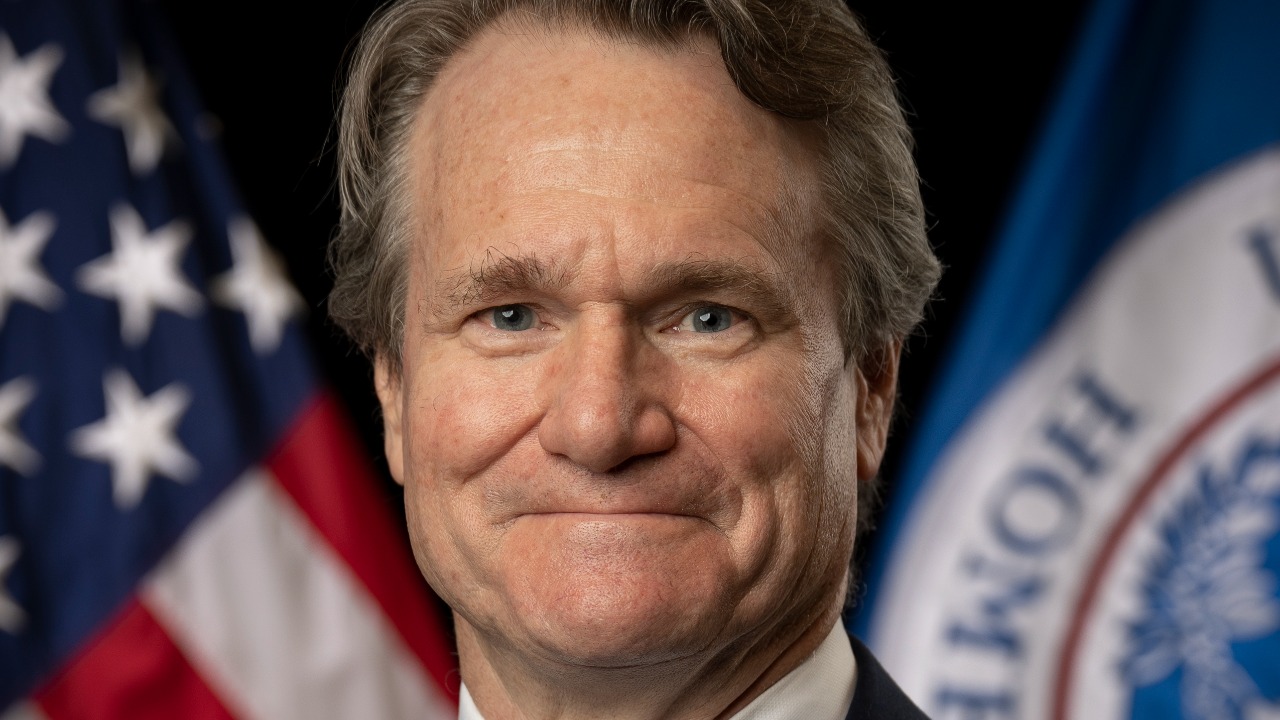
Financial markets can live with high interest rates, geopolitical shocks and even messy politics, but they struggle when they lose faith in the referees. That is the warning Bank of America chief executive Brian Moynihan has been pressing, as he argues that investors will not hesitate to punish the United States if the Federal Reserve is seen as a political arm rather than an independent central bank. His message is blunt: tamper with the Fed’s autonomy and the cost of money, and of America’s credibility, will rise fast.
At a moment when inflation, growth and election-year politics are colliding, Moynihan is trying to shift the debate from short term rate moves to the long term rules of the game. He is effectively telling Wall Street and Washington that the real systemic risk is not whether the next move is a cut or a hike, but whether the Fed is still trusted to make that call on economic grounds alone.
Why Brian Moynihan is sounding the alarm
When the head of a bank as large as Bank of America warns that markets will “punish people” if the Fed loses its independence, he is speaking from the vantage point of someone who watches funding costs and investor sentiment in real time. As Bank of America CEO, Brian Moynihan has framed Fed autonomy as a core asset of the United States, arguing that the central bank’s ability to set policy without day to day political interference underpins confidence in the dollar, in Treasury debt and in the broader financial system. In his view, the risk is not abstract: if investors start to suspect that interest rates are being set to please elected officials rather than to stabilize prices and employment, they will demand higher yields or shift capital elsewhere.
Moynihan sharpened that point in a recent television appearance, where he said plainly that the market “will punish people if we do not have an independent Fed,” tying the warning directly to how traders would react if they saw political pressure shaping decisions by Chair Jerome Powell and his colleagues. In that same conversation, the Bank of America CEO stressed that the Fed’s current policy rate, which he described in a range between 3.5% and 3.75%, only works as an anchor for expectations if investors believe it reflects the central bank’s own judgment rather than the wishes of the White House or Congress, a concern he raised while speaking with Face The Nati.
Big-bank chiefs close ranks around Fed independence
Moynihan is not making this case alone, and that collective stance matters. Earlier this year, a group of top Wall Street leaders publicly lined up behind the same message, underscoring that Fed independence is not a niche concern but a shared priority across the largest institutions in global finance. Goldman Sachs chief executive David Solomon, Bank of America’s Brian Moynihan and Citigroup chief executive Jane Fraser joined JPMorgan Chase’s Jamie Dimon in warning that undermining the central bank’s autonomy would damage its credibility and, by extension, hurt U.S. competitiveness in global capital markets.
That joint front from Goldman Sachs, Bank of America, Citigroup and JPMorgan Chase is striking because these firms often compete fiercely on trading, investment banking and consumer finance, yet they are aligned on the institutional value of a politically insulated Fed. Their argument is straightforward: if the Federal Reserve is perceived as an extension of the administration in power, whether under President Donald Trump or any successor, then foreign and domestic investors will start to question the reliability of U.S. monetary policy. By stressing that point together, Solomon, Moynihan and Fraser signaled that the stakes go beyond partisan fights, a message captured in their coordinated call for an independent Fed.
“Preserve it”: why autonomy matters for rates and credibility
For Moynihan, the case for an arm’s length central bank is rooted in both history and current policy. He has argued that Fed independence is “important to the U.S.” and that the country “should preserve it,” framing the institution as a kind of economic infrastructure that supports everything from mortgage markets to corporate bond issuance. In his telling, the credibility the Fed built by fighting inflation and acting aggressively in crises is a key reason global investors still treat U.S. assets as a safe harbor, and that credibility depends on the perception that rate decisions are made by technocrats, not campaign strategists.
That perspective also shapes how Moynihan talks about the path of interest rates. He has pointed to the Fed’s own projections of limited cuts in December and more in 2026 as an example of a central bank trying to communicate a steady, data driven path rather than a politically convenient one. By highlighting that the Federal Reserve is signaling only modest easing this year and a more meaningful shift in 2026, he is effectively arguing that markets can price in a slow, predictable adjustment as long as they trust the process. His call to “preserve” that trust is grounded in the view that once investors doubt the Fed’s independence, even a carefully telegraphed path of rate cuts in December, more in 2026 will not be enough to reassure them.
No quick cuts: how policy uncertainty feeds market nerves
Moynihan’s warning about market punishment is also tied to his outlook that interest rates are likely to stay higher for longer than many borrowers would like. Bank of America economists, whose views he has echoed, project that the Federal Reserve is unlikely to cut rates before 2026, a stance that runs counter to hopes for rapid easing. As Bank of America CEO Moynihan has put it, the absence of near term cuts reflects both the Fed’s focus on fully taming inflation and the uncertainty created by political debate over the central bank’s role.
That forecast of no cuts before 2026 is not just a macroeconomic call, it is a signal about how fragile expectations can become if investors start to suspect that political pressure might force the Fed to move faster or slower than the data justify. If markets believe that the central bank is holding the line despite political noise, they may accept a longer period of elevated borrowing costs. If they think the Fed could be leaned on to juice growth ahead of an election, they will demand a higher risk premium. Moynihan’s emphasis on a distant horizon for easing, reflected in Bank of America’s projection that Fed rate cuts are unlikely before 2026, is therefore part of the same argument: stability depends on a central bank that can resist short term political demands.
What “market punishment” could look like in practice
When Moynihan talks about markets punishing a loss of Fed independence, he is not speaking in metaphors. In practical terms, that punishment would likely show up first in the Treasury market, where investors might demand higher yields on U.S. government debt if they feared that inflation would be tolerated for political reasons. A spike in yields on 10 year Treasurys, for example, would quickly filter into higher mortgage rates for a 2025 Toyota Camry buyer or a small business owner rolling over a line of credit, amplifying the very economic pain politicians might have hoped to avoid by leaning on the Fed.
The damage would not stop at government bonds. A perception that the Federal Reserve is no longer an independent guardian of price stability could weaken the dollar, raise funding costs for banks like Bank of America, Goldman Sachs and Citigroup, and push global investors toward other currencies or assets. For a multinational that relies on dollar funding, or for a pension fund that holds large amounts of U.S. corporate debt, that shift would translate into real losses. Moynihan’s warning is therefore less about defending an institution for its own sake and more about protecting the plumbing of global finance, where confidence in an independent Fed is one of the few constants that still anchors an increasingly volatile world.
More From TheDailyOverview

Grant Mercer covers market dynamics, business trends, and the economic forces driving growth across industries. His analysis connects macro movements with real-world implications for investors, entrepreneurs, and professionals. Through his work at The Daily Overview, Grant helps readers understand how markets function and where opportunities may emerge.

