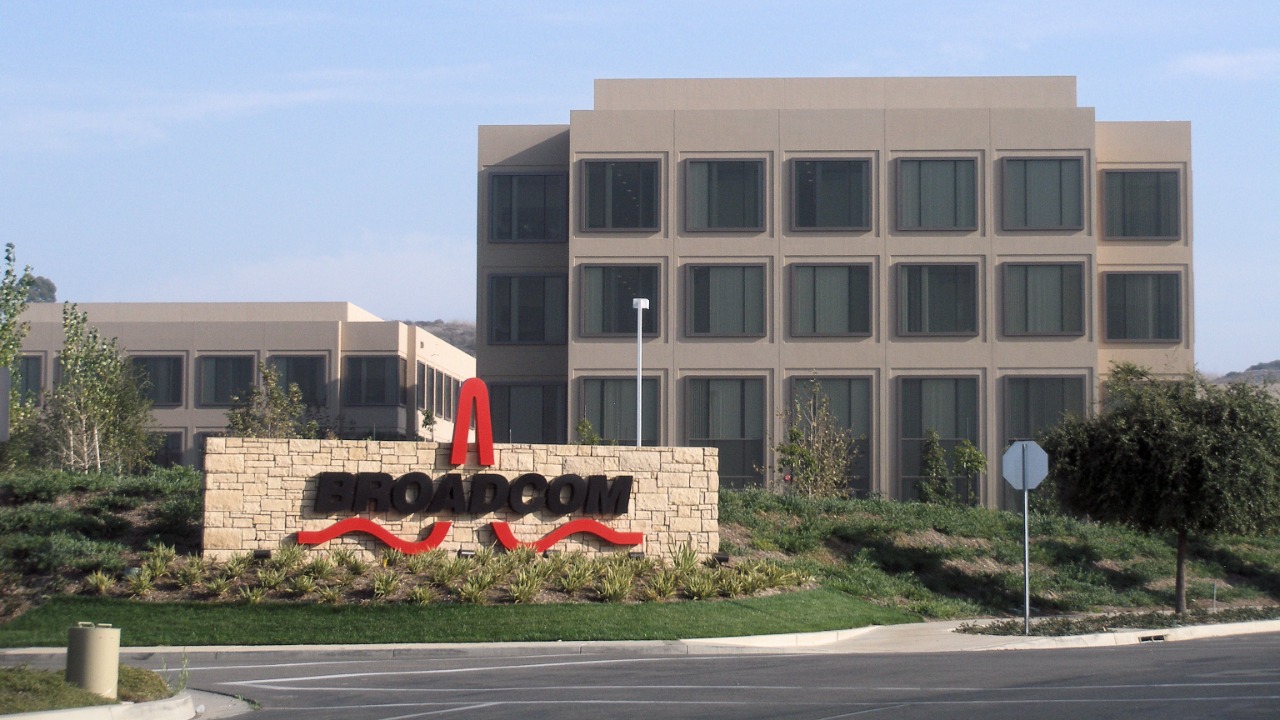
Broadcom delivered a blockbuster fiscal fourth-quarter earnings report powered by surging AI chip demand, but a warning about near-term margin pressure triggered a sharp selloff in its shares and sent tremors across the broader tech sector. The results forced Wall Street analysts to revisit their models, with Bank of America among those reassessing its outlook for the chipmaker. The tension between explosive revenue growth and rising costs tied to AI infrastructure spending now sits at the center of a wider debate about how long the AI trade can sustain sky-high valuations.
AI Chip Revenue Surges, but Costs Follow
Broadcom’s fourth-quarter fiscal 2025 results told two stories at once. On the growth side, the numbers were striking: according to the company’s own earnings release, quarterly revenue hit $18.015 billion, a 28% increase from the same period a year earlier. AI semiconductor revenue grew 74% year over year, reflecting the enormous capital flowing into custom silicon for data center buildouts. Adjusted EBITDA came in at 68% of revenue, a figure that on its own signals a highly profitable operation and underscores how central AI has become to Broadcom’s growth narrative.
The other side of the ledger drew far more attention from traders. Broadcom flagged that quarterly gross margins would dip as AI-related production costs climb, a disclosure that, as news reports noted, sent shares lower in the sessions following the report. For a company that has long been prized for its margin discipline, even a modest decline raised questions about whether the economics of AI chip manufacturing can match the revenue trajectory. The gap between top-line acceleration and bottom-line pressure became the dominant talking point on earnings calls and analyst notes alike, shifting focus from pure growth to the sustainability of Broadcom’s cost structure.
Guidance That Raised the Stakes
Broadcom’s forward-looking numbers added fuel to the debate. The company guided for first-quarter fiscal 2026 revenue of $19.1 billion, with AI semiconductor revenue expected to double year over year to $8.2 billion, according to its own guidance commentary. That projection implies AI chips will account for a rapidly growing share of total sales, making the margin dynamics around that segment even more consequential for the company’s overall profitability profile. The faster AI becomes the core of Broadcom’s business, the more any erosion in its economics will ripple through the consolidated results.
The guidance essentially dared the market to decide what matters more: the speed of AI revenue growth or the cost of chasing it. Bank of America was among the firms that moved quickly to revise its forecast in response, recalibrating expectations for a company whose AI ambitions now carry meaningful margin risk. For investors who had treated Broadcom as a relatively safe way to play the AI infrastructure boom, the earnings release introduced a new variable that complicates the thesis. Growth alone no longer tells the full story when the cost structure is shifting beneath it, and that realization is forcing money managers to rethink how they value AI-heavy chipmakers.
Tech Stocks Feel the Ripple Effect
Broadcom’s results did not stay contained to a single stock. U.S. tech shares broadly declined as the margin commentary fed into a wider anxiety about AI-driven valuations. The Nasdaq and S&P 500 both experienced notable moves, with investors pulling back from names that had rallied hard on AI optimism. Coverage from the financial press highlighted how the selloff in tech stocks reflected a growing unease that the AI trade may be entering a phase where execution risk, not just revenue potential, determines winners and losers.
What made the reaction significant was the speed at which it spread beyond Broadcom itself. The company’s margin warning acted as a stress test for the entire AI investment thesis. If one of the best-positioned custom chip suppliers is flagging cost headwinds, the implication is that similar pressures could surface across the supply chain, from foundries to networking equipment makers. That logic drove a broader reassessment of how much premium the market should assign to companies whose AI revenue is growing fast but whose cost structures remain in flux, and it raised the prospect that AI hardware names could see more volatile trading as each new quarter brings fresh data on profitability.
The Unbundling of the AI Trade
For much of the past two years, the market treated AI-exposed companies as a relatively uniform group, rewarding anything with a plausible link to accelerated computing or model training. Broadcom’s earnings may mark the beginning of a more selective phase. The distinction between companies that can grow AI revenue while maintaining margins and those that cannot is becoming a primary filter for institutional capital allocation. Bank of America’s decision to revise its Broadcom forecast signals that even bullish analysts are no longer willing to model AI growth without accounting for the cost side of the equation, a shift that could compress valuation multiples for firms seen as structurally disadvantaged on manufacturing or scale.
This shift matters beyond Wall Street models. If the largest AI chip suppliers are absorbing higher production costs, those expenses will eventually flow through to the hyperscale cloud providers and enterprise buyers funding the buildout. The question is whether end demand for AI compute is strong enough to absorb price increases, or whether margin compression at the component level will force a slowdown in infrastructure spending. Broadcom’s results suggest the industry is entering a period where revenue growth and profitability may pull in opposite directions, and investors will need to pick which signal to follow. In that environment, stock selection within the AI theme is likely to hinge on granular assessments of cost curves, manufacturing partnerships, and pricing power rather than broad exposure to the trend.
What Broadcom’s Bet Reveals About AI Economics
The conventional wisdom around AI infrastructure has been straightforward: demand is insatiable, supply is constrained, and pricing power belongs to the chipmakers. Broadcom’s margin disclosure challenges the third leg of that argument. Even with AI semiconductor revenue growing 74% and guidance calling for it to double, the company acknowledged that the cost of serving that demand is rising faster than many had assumed. That admission carries weight precisely because Broadcom has historically been one of the most disciplined operators in the semiconductor industry, building its reputation on high-margin franchises in networking, storage, and connectivity.
One critique of the current AI valuation framework is that it treats revenue acceleration as a proxy for long-term profitability. Broadcom’s results expose the flaw in that assumption. Custom AI chips require heavy upfront investment in design, packaging, and advanced manufacturing processes, often tailored to a small number of hyperscale customers. As the complexity of these chips increases with each generation, the cost curve does not flatten as neatly as it does for more mature product lines, and the bargaining power of large buyers can limit how much of that cost can be passed through in pricing. The market’s reaction to Broadcom’s earnings suggests that investors are starting to price in this reality, even if the headline revenue numbers remain impressive.
For the broader semiconductor sector, the episode underscores that AI is not a simple cure-all for margin pressure elsewhere in the portfolio. Companies that rushed to position themselves as AI beneficiaries will now be judged on whether they can translate design wins into durable returns on capital, not just into higher sales. Broadcom’s willingness to lean into AI, even at the expense of near-term gross margin, shows that management teams may prioritize strategic share gains and ecosystem relevance over short-term profitability. The trade-off is that shareholders must tolerate more earnings volatility as the industry works through the true cost of building and deploying ever more powerful AI systems.
Ultimately, Broadcom’s quarter reads less like an outlier and more like an early case study in the economics of scaled AI hardware. The company is capturing extraordinary demand and guiding to even faster growth, yet it is simultaneously warning that the path to monetizing that demand is narrower than many assumed. How Broadcom, its customers, and its competitors navigate that tension will help define the next phase of the AI cycle, one in which the winners are likely to be those that can innovate not only in silicon performance, but also in the efficiency and profitability of the infrastructure that makes AI possible.
More From The Daily Overview
*This article was researched with the help of AI, with human editors creating the final content.

Grant Mercer covers market dynamics, business trends, and the economic forces driving growth across industries. His analysis connects macro movements with real-world implications for investors, entrepreneurs, and professionals. Through his work at The Daily Overview, Grant helps readers understand how markets function and where opportunities may emerge.

