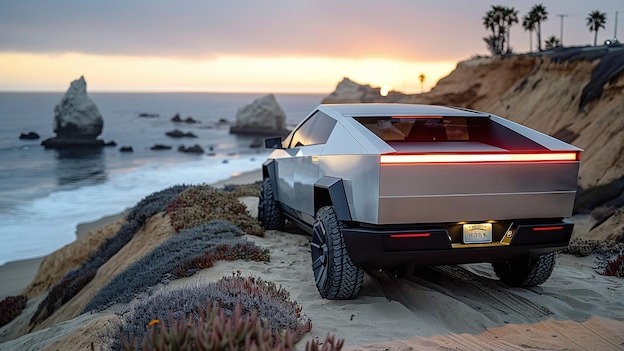
California has staked its climate reputation on aggressive electric vehicle mandates, generous subsidies and a willingness to pick winners in the market. The idea is simple: move fast, back bold technology and let scale drive down costs for everyone. Yet as Tesla’s Cybertruck stumbles, the state’s strategy of concentrating political capital and public support around a handful of marquee projects looks less like smart risk-taking and more like a bet that could smother the broader EV ecosystem.
The headline figure of a $165 million “gamble” on Tesla’s truck program is, based on available sources, unverified. What is clear, however, is that California has built a policy architecture that effectively channels outsized benefits to Tesla’s most eye-catching products, from preferential consumer incentives to regulatory credits. If that scaffolding props up a struggling luxury truck instead of accelerating affordable EVs, the state’s approach could end up slowing innovation rather than speeding it up.
Cybertruck’s slump exposes the risk of halo bets
The Cybertruck was supposed to be the rolling billboard for the EV future, a stainless-steel symbol that electrification could be outrageous, fast and profitable. Instead, the truck has quickly become a case study in how hype can outrun demand. Sales of Tesla’s electric Cybertruck fell 48% in 2025, dropping to 20,237 units from 38,965 the year before, according to recent sales data. That is a brutal reversal for a product that was marketed as a category-defining breakthrough.
Those numbers matter for public policy because California has treated vehicles like the Cybertruck as proof points that its aggressive EV push is working. When a flagship model loses nearly half its volume in a year, it undercuts the narrative that consumer appetite for high-end electric trucks is inexhaustible. It also suggests that the marginal public dollar or regulatory favor directed toward such halo products may not be buying much real-world decarbonization, especially compared with investments in smaller, cheaper EVs that could replace millions of gasoline commuters instead of a niche slice of luxury truck buyers.
Model cancellations signal a pivot away from affordability
If the Cybertruck’s sales slide raises questions about demand, Tesla’s own product decisions raise sharper questions about who benefits from the current incentive structure. Earlier in the rollout, Tesla introduced a rear-wheel-drive Cybertruck that was positioned as the least expensive way into the lineup. By Sep, that entry point was gone. Tesla canceled the least expensive Cybertruck model after selling it for just six months, pulling the rear-wheel-drive configuration and leaving higher priced versions as the de facto standard, according to industry reporting.
That move was not a one-off adjustment. In a separate update, also in Sep, Tesla again confirmed that it had canceled the rear-wheel-drive version of the Cybertruck roughly six months after adding it to the lineup, leaving the more expensive all-wheel-drive and Cyberbeast models in its wake, as detailed in follow-up coverage. When the most prominent EV maker repeatedly trims its lower-cost options, it is a signal that the current mix of subsidies, mandates and consumer incentives is not pushing the market toward mass affordability. Instead, it is rewarding companies for chasing high-margin, high-priced vehicles that only a fraction of drivers can realistically buy.
How concentrated support can crowd out real innovation
California’s EV policy has always mixed broad-based tools, like statewide rebates, with more targeted support for specific manufacturers and projects. Even without a verified $165 million line item for Cybertruck production, the state’s rules around zero-emission credits, access to carpool lanes and local permitting have functioned as a kind of soft subsidy for Tesla’s most visible models. When regulators and lawmakers repeatedly spotlight one company’s truck as the emblem of progress, they tilt investor attention, infrastructure planning and even consumer imagination toward that single product class.
The opportunity cost is hard to see because it shows up in what never gets built. Startups working on compact urban EVs, modular battery-swapping systems or low-cost delivery vans do not have the same political halo as a stainless-steel pickup. Yet those are precisely the segments that could deliver the fastest emissions cuts per public dollar, especially for lower income drivers who are locked out of today’s premium EV market. When capital and policy oxygen are drawn toward a faltering flagship, smaller players can struggle to raise funds, secure fleet contracts or get their own pilot programs in front of city and state agencies.
The Solyndra shadow and the danger of repeating old mistakes
Critics often reach for Solyndra as a cautionary tale, and the comparison is imperfect but instructive. In that case, federal loans concentrated risk in a single solar manufacturer that ultimately collapsed under market pressure, souring public opinion on clean energy subsidies for years. California is not repeating that exact script with Tesla, which remains a profitable and dominant automaker, but the structural resemblance is there. When a government effectively brands one company’s product as the avatar of its climate strategy, any stumble by that product can be weaponized by opponents of the broader transition.
The Cybertruck’s 48% sales drop and the quiet disappearance of its least expensive variants give skeptics ammunition to argue that EVs are a fad for wealthy early adopters rather than a durable, mass-market solution. That narrative is misleading, given the steady growth of more conventional electric sedans and crossovers, but perception often drives politics. If voters come to associate California’s EV push with a polarizing, low-volume luxury truck that cannot hold its sales, they may be less willing to support the next round of charging investments, grid upgrades or transit electrification bonds that actually deliver the bulk of emissions reductions.
What a healthier innovation strategy would look like
The lesson here is not that California should abandon risk-taking or stop working with Tesla. It is that the state needs to rebalance its portfolio away from symbolic bets and toward a more diversified, systems-level approach. That would mean tying the richest incentives to clear affordability and volume metrics, so that a company earns more support for selling 100,000 modestly priced EVs than for moving 20,000 high-margin trucks. It would also mean designing grant programs that explicitly reserve space for smaller manufacturers, community-based mobility projects and non-car solutions like e-bikes and shared shuttles.
Two predictions follow from the current trajectory. First, if policymakers keep structuring incentives in ways that favor premium models, I expect more automakers to follow Tesla’s lead in canceling their cheapest trims once the marketing value has been extracted, leaving a thinner ladder into EV ownership. Second, if California instead shifts toward performance-based, technology-neutral support that rewards emissions cuts per dollar and per household, the next wave of innovation is likely to come from less glamorous segments: compact crossovers, work vans and fleet vehicles that quietly electrify daily life. The Cybertruck’s struggles are a warning flare that halo products make for great photos but fragile policy foundations. The real test of California’s climate leadership will be whether it can move beyond the spectacle and build an EV market that works for everyone, not just for the drivers who can afford a stainless-steel statement piece.
More From The Daily Overview
*This article was researched with the help of AI, with human editors creating the final content.

Grant Mercer covers market dynamics, business trends, and the economic forces driving growth across industries. His analysis connects macro movements with real-world implications for investors, entrepreneurs, and professionals. Through his work at The Daily Overview, Grant helps readers understand how markets function and where opportunities may emerge.

