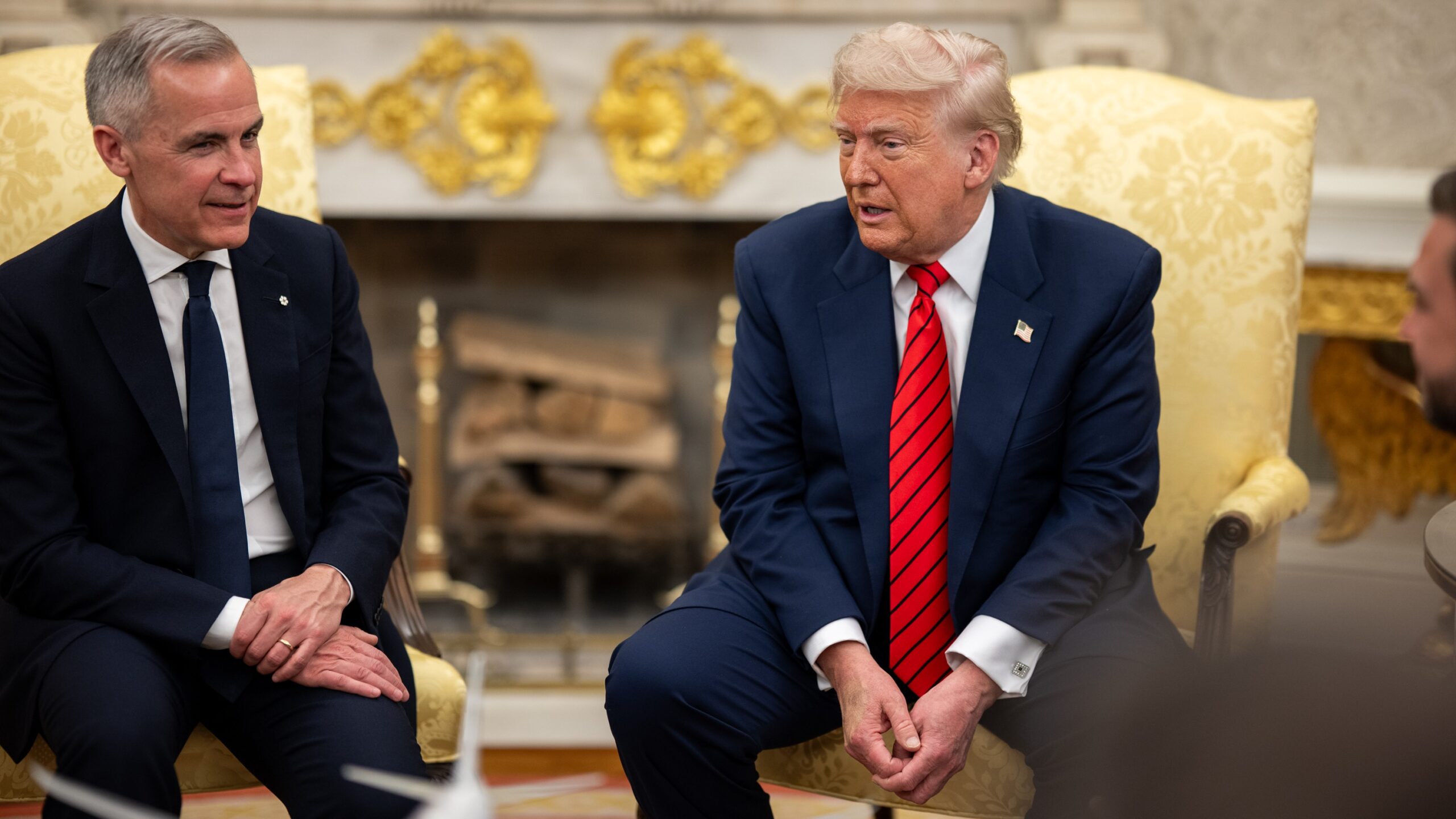
The clash between Prime Minister Mark Carney and President Donald Trump has escalated from a war of words at Davos into a full‑blown diplomatic feud. At its center is Carney’s blunt retort that “Canada doesn’t live because of the US,” a line that crystallizes a deeper argument over sovereignty, economic power and the future of the Western alliance. I see a dispute that began as a personal spat hardening into a test of how far Canada is willing to push back against a U.S. president who openly questions the value of traditional partners.
The confrontation is unfolding as Carney tries to position Canada as a champion of rules‑based cooperation while Trump doubles down on a transactional, America‑first approach. Their competing visions are colliding in public speeches, formal letters and symbolic snubs, with both leaders using the feud to rally domestic audiences. The result is a rare moment when the usually cautious cross‑border relationship is being argued in front of the world.
Davos clash: Carney’s warning shot at the World Economic Forum
The feud effectively ignited when Prime Minister Mark Carney used a high‑profile address at the World Economic Forum in Davos to warn that the global order is at risk of a “rupture.” In that speech, delivered as the newly installed Prime Minister of Canada, Carney argued that the world faces a choice between fragmentation and a “more cooperative, resilient world,” and he cast Canada as a country determined to defend open markets and democratic norms against rising economic nationalism. His remarks, framed as a sober assessment of systemic risk, were also a clear critique of leaders who weaponize tariffs and alliances for short‑term leverage, a category that plainly includes President Donald Trump, even when Carney did not name him directly in Davos itself, according to the World Economic Forum.
Carney’s warning about a looming “rupture” in the world order landed with particular force because it came from a leader whose career has been built on technocratic credibility. The Right Honourable Mark Carney, now Prime Minister of Canada, previously served as a central banker and is described by his own office as the country’s 24th Prime Minister and the Leader of a government that wants “the strongest economy in the G7.” When such a figure warns that the international system is at risk of breaking, it is not easily dismissed as routine rhetoric. Trump, who was also a presence around Davos and has long bristled at elite economic forums, took the speech as a direct affront, setting the stage for a personal and political counterattack.
Trump’s Board of Peace snub and the 46‑word rupture
President Trump’s first major response was to turn a symbolic invitation into a weapon. Earlier this year, his administration had extended an offer for Canada to participate in a new advisory body branded as a Board of Peace, a project Trump has touted as a way to showcase his personal diplomacy. After Carney’s Davos broadside, Trump rescinded Canada’s invite, framing the move as a consequence of the Prime Minister’s criticism and signaling that access to his initiatives depends on personal deference. In a formal communication, Trump’s team used language that began, “Please let this Letter serve to represent that the Board of Peace is withdrawing its invitation to you regarding Canada’s joining,” a phrasing that underscored how the Board of Peace itself had become a stage for the feud rather than a neutral forum.
Trump then amplified the snub in public, with coverage of his decision noting that President Trump acted on a Friday and that the letter revoking the invitation was part of a broader pattern of using access as leverage. One account of the episode highlighted that the notice was delivered in a tightly worded message and cited the figure 46 in connection with the political context, while also stressing that Trump reserved the right to revisit the decision “at any time” if his conditions were met, according to reporting linked to Ryan Mancini. The message was unmistakable: in Trump’s view, Canada’s place at his table is contingent, and Carney’s willingness to challenge him in global forums carries a price.
“Canada doesn’t live because of the US”: Carney’s sharpest line yet
If Davos was Carney’s warning shot, his return to Canada produced the line that defined the feud. Upon arriving back home, Carney addressed a cabinet retreat in Quebec City and directly referenced Trump’s claim that “Canada lives because of the United States.” In front of his ministers, he rejected that framing outright, declaring that “Canada doesn’t live because of the US” and insisting that the country’s prosperity and security rest on its own choices and values. Reports of the event describe how Carney, speaking in Quebec City, tied that assertion to a broader argument that staying true to Canada’s principles is essential to maintaining its sovereignty, as reflected in coverage of Carney at the retreat.
That phrase, “Canada doesn’t live because of the US,” quickly became shorthand for a more assertive posture toward Washington. One detailed account of the exchange noted that Carney’s rebuttal came after Trump had suggested Canada owed its existence and prosperity to American protection, a claim the Prime Minister treated as both historically inaccurate and politically dangerous. In the same setting, Carney emphasized that Canada’s freedoms endure because Canadians choose to defend them, not because they are granted by any foreign power, a point echoed in reporting that described how Prime Minister Mark Carney, for the second time in a week, took aim at Donald Trump during the cabinet meeting.
Domestic politics: Carney’s mandate, Trudeau’s shadow and Trump’s attacks
To understand why Carney chose such direct language, I have to look at his domestic position. The Right Honourable Mark Carney is not only the Prime Minister of Canada but also the political successor to Trudeau, a figure whose tenure reshaped the country’s progressive brand. Trudeau, identified in one profile as Justin Trudeau of the Liberal Party of Ca and described as a leader whose internal party battles culminated before he was no longer in office, left behind both a legacy and a set of expectations about how a Canadian Prime Minister should handle U.S. presidents, according to a background note on Justin Trudeau. Carney, as the new Leader of a Liberal government, must show that he can defend Canadian interests at least as forcefully, if not more so, than his predecessor.
On the other side of the border, President Donald Trump has seized on Carney’s Davos speech as fresh material for his long‑running campaign against what he calls globalist elites. In one video segment, U.S President Donald Trump renewed attacks on Canadian Prime Minister Mark Carney after the fiery Davos remarks, tying his criticism to disputes over trade and tariffs and using the moment to energize his base. That same coverage noted that the confrontation coincided with soaring approval for Carney above 50 percent at home, suggesting that the Prime Minister’s willingness to stand up to Trump is resonating with Canadian voters, as reflected in the clip featuring Canadian Prime Minister. In that sense, both leaders are using the feud to fortify their political narratives: Trump as the scourge of international critics, Carney as the defender of Canadian autonomy.
From rupture talk to restraint: where the feud goes next
For all the sharp words, Carney has also tried to show that he can calibrate his response. After a week of escalating tension, he shifted tone and responded with more restraint to Donald Trump’s goading, signaling that he did not want the dispute to spiral into a permanent breakdown in relations. One account of this phase notes that Mark Carney quietly ended a week of foreign policy tension by emphasizing coexistence and partnership, even as he maintained his critique of Trump’s approach. In that telling, Carney went on to call for a model of cooperation that exemplifies “coexistence” and partnership, a choice that suggests he is trying to balance firmness with a pragmatic recognition of Canada’s deep ties to the United States, as described in coverage of Mark Carney.
More From TheDailyOverview
*This article was researched with the help of AI, with human editors creating the final content.

Grant Mercer covers market dynamics, business trends, and the economic forces driving growth across industries. His analysis connects macro movements with real-world implications for investors, entrepreneurs, and professionals. Through his work at The Daily Overview, Grant helps readers understand how markets function and where opportunities may emerge.

