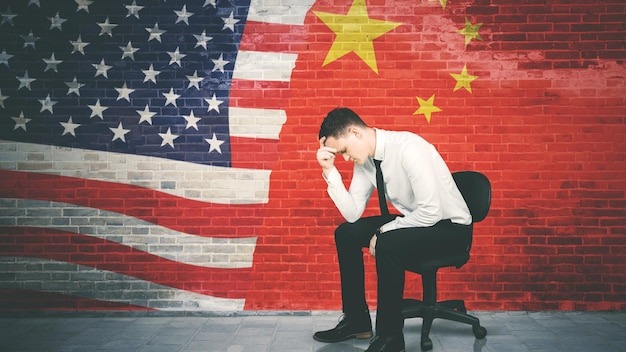
Chinese regulators are quietly telling the country’s biggest lenders to pull back from U.S. government bonds, just as global investors are rediscovering their anxiety about American debt. The guidance has collided with a record-breaking rush into gold and renewed geopolitical tension, feeding a narrative that Beijing is preparing a stealthy exit from Washington’s IOUs. The more interesting story, though, is not a sudden fire sale, but a long, strategic repositioning that is starting to collide with market psychology.
China’s holdings of U.S. Treasuries have already fallen to roughly a 17‑year low of about $1.2 trillion, a retreat that began during President Donald Trump’s first term and has continued into his current one. What is new is the explicit warning from regulators about “shock swings” and sanction risk, and the way that warning is rippling through portfolios from Shanghai to New York. The question now is whether this slow-motion shift marks the early stages of a new, more fragmented global financial order.
Beijing’s quiet instructions and the sanction shadow
The latest signal from Beijing is not a public decree but a behind-the-scenes nudge. Chinese regulators have advised major financial institutions to limit their exposure to U.S. Treasuries, framing the move as a response to concentration risk and the possibility of disruptive market moves. The guidance, delivered to large banks and other lenders, comes with an explicit warning about potential “shock swings” in the value of their holdings, and it lands just weeks before a planned visit by President Donald Trump to meet Xi Jinping, a timing that underscores the political sensitivity of the shift. According to one detailed account, regulators have effectively asked Chinese lenders to be ready to dump Treasuries if volatility spikes.
Behind the risk-management language sits a more strategic concern: sanctions. Analysts who follow Chinese policy closely argue that the push to curb U.S. Treasury exposure is driven in part by fear that Washington could one day weaponize the dollar system against Beijing in the way it has against Moscow. One assessment of the situation describes how China’s government has been encouraging banks and institutions to reduce their holdings of U.S. debt to limit that vulnerability. In that reading, the latest guidance is less a panic move and more the next step in a multi‑year effort to make China’s financial system less exposed to a single foreign sovereign.
A long retreat from U.S. debt, not a sudden stampede
It is tempting to frame the current moment as a dramatic pivot, but the numbers tell a slower story. China has been trimming its U.S. bond portfolio for years, steadily selling down its position since the early phase of President Donald Trump’s first term. By October of last year, official data showed that China has continued U.S. government bonds to their lowest level in 17 years, with holdings around US$1.2 trillion and the country slipping to third place among foreign creditors. That is not the profile of a sudden seller, it is the profile of a patient one.
Recent commentary on China’s “long retreat” from Treasuries emphasizes that this is a structural adjustment rather than a market tantrum. Analysts note that China’s long retreat U.S. debt has unfolded over several years, with officials gradually reallocating reserves and signaling a desire to accelerate de‑dollarization. That context matters for investors who see every headline as a trigger for an immediate crash in Treasuries. The more realistic risk is not a single “dump” that breaks the market overnight, but a persistent seller that quietly reshapes who finances America’s deficits.
Markets flinch: Treasuries wobble, gold explodes higher
Even a gradual seller can rattle nerves when the world’s second‑largest economy is involved. The latest reports that Chinese banks were urged to curb their U.S. bond exposure initially pushed Treasury prices lower, as traders tried to gauge whether Beijing might accelerate its selling. Yet the move was modest. One strategist, Kathleen Brooks, research director at XTB, noted that the initial reaction was limited and argued that if China was truly unloading aggressively, yields would be rising far more sharply. That distinction between signaling and actual flow is crucial for anyone trying to separate noise from risk.
Where the market’s anxiety has been far more visible is in gold. In a historic start to the trading week, gold futures surged to a record $5,050 per ounce, a move explicitly linked to Chinese regulators’ push for U.S. debt divestment and to investors’ desire for a hedge against geopolitical and fiscal instability. For ordinary savers, that price spike is the clearest sign yet that professional money managers are treating the combination of U.S. deficits, political risk and Chinese selling as a cocktail worth insuring against. If Treasuries are the world’s seatbelt, gold has become the airbag.
China is selling, but America still finds buyers
One of the most underappreciated dynamics in the current debate is that while China is stepping back, other investors are stepping in. Recent data on cross‑border flows show that China is “selling”, but the rest of the world is still buying, with European and Japanese institutions, as well as private asset managers, continuing to treat Treasuries as the ultimate safe asset. These buyers operate on different horizons and are often driven by regulatory or liability‑matching needs that make U.S. bonds hard to replace, even if yields are volatile and politics are noisy.
That is why the Trump administration’s concern about Chinese selling coexists with a relatively stable market for U.S. debt. Reports note that The Trump administration is unlikely to welcome news that Chinese banks have been urged to limit their Treasury purchases, especially given the scale of U.S. borrowing needs. Yet the same reporting highlights that other “nervy buyers” are still stepping up, including investors in BRIC economies who see Treasuries as a relative haven compared with their own domestic markets. The dominant assumption that China’s exit would automatically break the Treasury market looks too simplistic. The more nuanced risk is that Washington becomes increasingly dependent on a more fragmented, and potentially more fickle, investor base.
From de‑dollarization to a tri‑polar financial order?
For Beijing, reducing exposure to U.S. debt is part of a broader strategy to chip away at dollar dominance. Officials and analysts describe a deliberate effort to accelerate de‑dollarization by cutting Treasury holdings and building up alternative assets, including gold and potentially more exposure to currencies within the BRICS bloc. One detailed analysis argues that China may quietly be preparing to sell even more U.S. Treasuries as part of this shift, echoing the pattern seen during President Donald Trump’s earlier tariff battles. If that pattern holds, I expect the next phase to involve not just selling, but a more visible effort to promote non‑dollar settlement in trade and finance.
At the same time, there are signs that China’s retreat from Treasuries is feeding into a new macro tailwind for digital assets. Analysts who track both crypto and sovereign debt argue that the combination of de‑dollarization rhetoric and record gold prices is encouraging some investors to treat cryptocurrencies as a parallel hedge. One report explicitly frames China’s strategy as a potential boost for crypto markets, noting that dollar dominance is than it once was. My own read is that we are inching toward a tri‑polar system in which U.S. Treasuries, gold and a basket of alternative assets, including crypto and BRICS‑linked instruments, share the role that Treasuries once played alone. That shift will not happen overnight, but the direction of travel is becoming harder to ignore.
More From The Daily Overview
*This article was researched with the help of AI, with human editors creating the final content.

Grant Mercer covers market dynamics, business trends, and the economic forces driving growth across industries. His analysis connects macro movements with real-world implications for investors, entrepreneurs, and professionals. Through his work at The Daily Overview, Grant helps readers understand how markets function and where opportunities may emerge.

