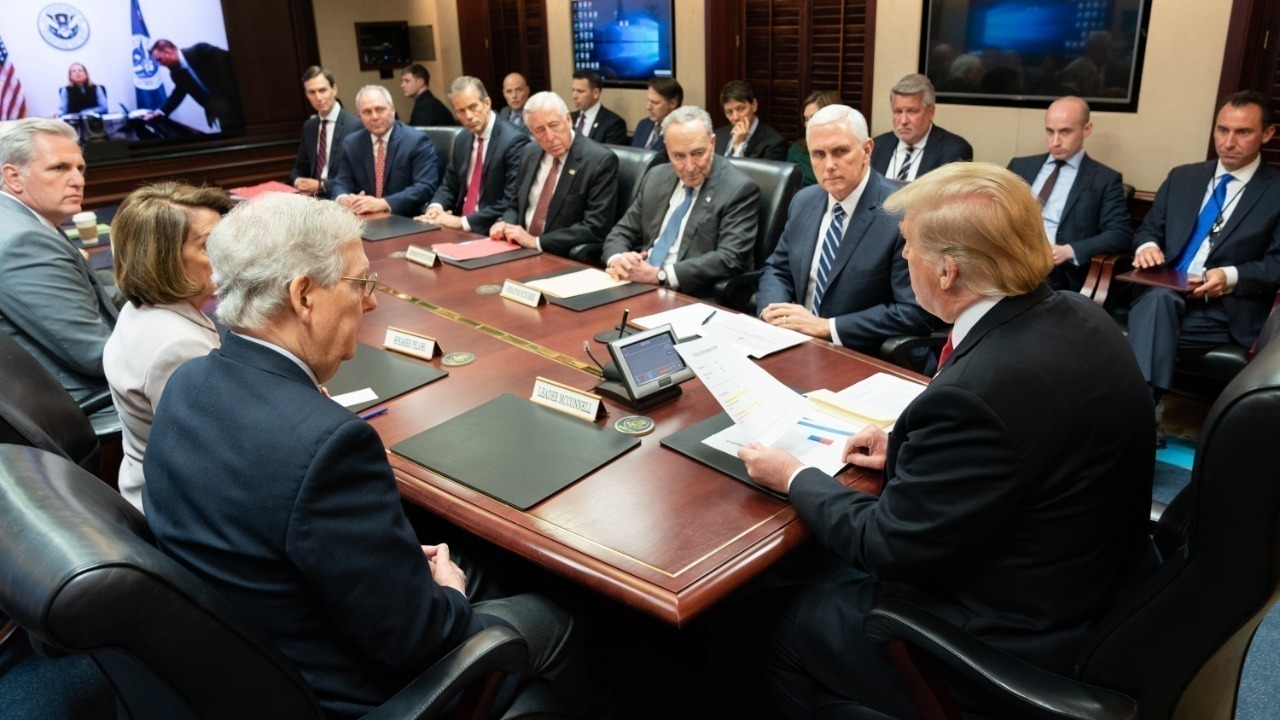
With days left before key agencies run out of money, Congress has finally put a sprawling funding package on the table that is designed to keep the government open and avoid another grinding shutdown. The deal, assembled at the last possible moment, reflects a fragile bipartisan truce that trades modest spending growth for policy concessions on immigration, defense and domestic programs. I see it as a stress test of whether Washington has learned anything from its recent budget crises or is simply buying time until the next one.
At stake is not just whether federal workers get paid or national parks stay open, but whether lawmakers can prove they are capable of basic governance in an election year. The new agreement is structured to cover the remaining agencies that have been limping along on temporary extensions, and it lands against a backdrop of public fatigue with brinkmanship and memories of the last prolonged funding lapse still fresh.
The deal that finally materialized
After weeks of stalemate, Negotiators in both chambers of Congress have now agreed on a comprehensive package that funds every remaining federal agency with only a less than 1% increase in overall discretionary spending. That relatively flat topline reflects a political reality I have seen harden over the past year, in which both parties accept that large new spending surges are off the table but still want to protect their core priorities inside the caps. The agreement, described by Eric Katz, is the product of a small circle of senior appropriators who have been trading line items and policy riders almost to the last hour.
To get there, lawmakers released final measures that bundle multiple appropriations bills into a single package, the kind of “minibus” approach that has become standard when deadlines loom. Jan leaders in both parties framed these final measures as the only realistic way to avert a partial shutdown, given how little floor time remains and how many agencies still need full-year funding. The fact that Lawmakers waited until the brink to roll out the text underscores how much of the modern budget process has migrated from open committee work to closed-door leadership talks.
What is funded and what is left out
On the spending side, the centerpiece is a roughly $1.2 trillion bundle that covers a wide swath of domestic and infrastructure accounts, including Transportation and Housing and Urban Development. On the whole, the bundle of four bills is designed to keep the lights on in Washington, D.C., while also signaling that Congress is not walking away from long term investments in roads, transit and affordable housing. I read the structure of this package, described in detail in On the reporting, as an attempt to reassure local governments and contractors that the federal spigot will not suddenly shut off midyear.
Another major pillar is the national security portion of the deal, where House and Senate appropriators have settled on a $838.7 billion defense topline for fiscal 2026 in a bipartisan agreement. That figure boosts the Pentagon budget by $8 billion while largely bypassing a last minute $28 billion munitions request, a choice that reflects both concern about long term readiness and skepticism about giving the department too much flexibility at once. The defense bill sits alongside a broader package that includes the Defense, Labor, HHS, Education and Transportation accounts, as described in a detailed breakdown of the Defense and domestic mix.
ICE, immigration and the progressive revolt
The most explosive policy fight inside the new package centers on immigration enforcement, particularly funding and restraints for ICE. The legislation would fund key agencies before a Jan. 30 deadline to avert a shutdown, but it pointedly excludes the restraints on ICE that some Democrats had demanded after a high profile enforcement incident involving a woman in Minneapolis. That omission has already triggered a brewing revolt among progressive lawmakers who argue that the deal gives too much ground on detention and deportation policy in order to secure Republican votes, a tension captured in reporting on the looming ICE clash.
From my vantage point, this fight is less about raw dollars than about the direction of immigration policy under President Donald Trump, who has made aggressive enforcement a centerpiece of his agenda. Progressive critics see any increase in detention capacity or removal operations as a step backward, while conservatives argue that anything short of full funding for ICE undermines border security. The resulting standoff has turned a must pass funding bill into a proxy battle over the administration’s broader approach to immigration, even as party leaders insist that the immediate priority is simply to keep the government open.
Deadlines, shutdown scars and political risk
The urgency behind the new agreement is rooted in a calendar that has been unforgiving from the start of the fiscal year. A detailed tracker of Upcoming Congressional Fiscal Policy Deadlines shows how a series of staggered cutoffs, including a Date for expiring funding at the end of December 2025 and additional Issue points in Jan, forced lawmakers into repeated short term extensions. Those temporary measures, known as continuing resolutions, kept agencies running but also created a sense of rolling crisis that has now culminated in this last minute push, a pattern that was flagged earlier this year in a Upcoming Congressional Fiscal analysis.
Public patience for this cycle is thin, in part because the country still remembers the record 43-day shutdown that ended when President Donald Trump signed a government funding bill on a Wednesday in WASHINGTON. That episode magnified partisan divisions, disrupted paychecks for hundreds of thousands of federal workers and even led to longer lines at some food banks, as detailed in contemporaneous coverage of the 43-day impasse. I see that history hanging over the current talks, as both parties weigh the electoral cost of being blamed for another lapse in basic services.
Why this keeps happening
Even if this deal passes and the immediate crisis is averted, the structural problems that keep pushing Congress to the brink remain unresolved. Earlier this month, a Mirror Explains analysis laid out how government funding has been running on autopilot through stopgap measures because lawmakers have not completed the regular appropriations process on time. That explainer noted that each continuing resolution simply extends prior year spending levels and policies, which means that big fights get punted into the next deadline rather than truly settled, a dynamic that has now produced yet another high stakes showdown in Mirror Explains fashion.
There is also a deeper tug of war over how much flexibility to give the executive branch, especially on national security. Congressional negotiators largely back the Pentagon’s acquisition overhaul but are wary of the Department of Defense push for additional budget flexibility, a skepticism that surfaced in recent appropriations language critiquing how some pilot programs have been managed. That caution is detailed in a report on how Congressional leaders are pushing back on parts of the Pentagon agenda, and it helps explain why even relatively small shifts in defense accounts can become flashpoints that slow the entire funding process.
More From The Daily Overview
*This article was researched with the help of AI, with human editors creating the final content.

Grant Mercer covers market dynamics, business trends, and the economic forces driving growth across industries. His analysis connects macro movements with real-world implications for investors, entrepreneurs, and professionals. Through his work at The Daily Overview, Grant helps readers understand how markets function and where opportunities may emerge.

