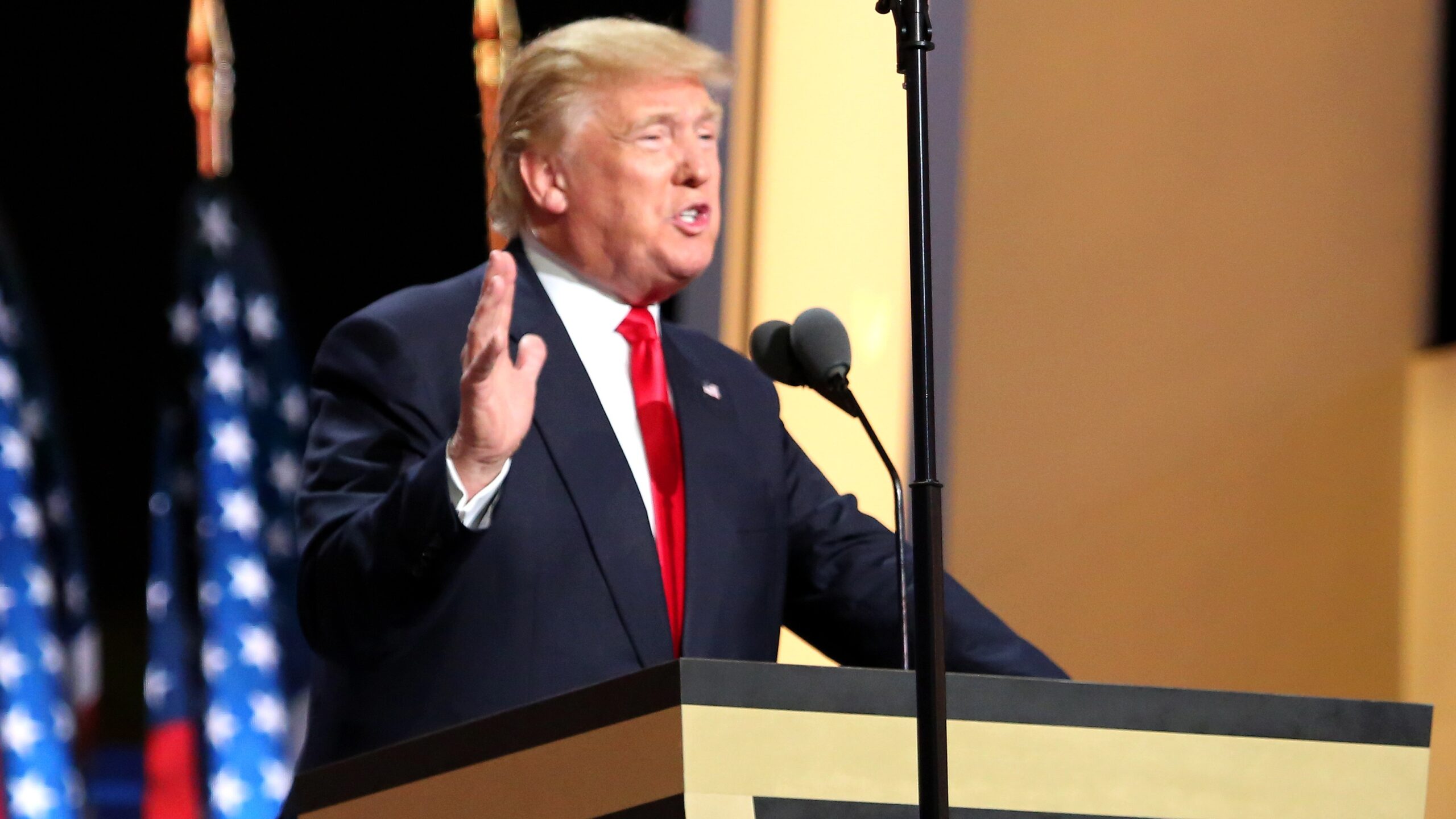
President Donald Trump is selling a story of American resurgence, telling voters the country is entering a new “golden age” even as key indicators flash warning signs. Conservative economists and Republican strategists are increasingly describing a far darker outlook, arguing that the current mix of high spending, trade disruption, and political turmoil is leaving the United States weaker while global capital and influence drift elsewhere. The gap between that optimistic rhetoric and the emerging data is where the economic debate, and the next election, is now being fought.
From investor flight into gold to sliding public confidence, the evidence suggests an economy that looks less like a triumphant boom and more like a fragile high-wire act. I see a pattern in which short term political gains are being prioritized over long term stability, with the rest of the world adjusting to a future that relies less on U.S. demand, U.S. assets, and U.S. leadership.
Trump’s ‘golden age’ message collides with public doubt
Trump has framed his second term as a historic economic breakthrough, with his allies amplifying his claim that the nation is entering a “golden age” of growth and prosperity. Yet the public mood is moving in the opposite direction, with a recent poll showing that Just 37% of respondents approve of Trump’s handling of the economy, down from 42%, a sharp drop for a president who has staked his political identity on business acumen. When a leader insists that “down is up” while confidence erodes, it signals not only a communications problem but a deeper credibility gap that can itself weigh on investment and hiring.
That skepticism is not confined to partisan opponents. Research on voter attitudes finds that Economic expectations for 2026 are not bright and that Most Americans believe tariffs will continue to push up prices, a dynamic that is already eroding real incomes and consumer optimism. In one detailed analysis, the public was found to be particularly pessimistic about inflation and trade, with support for Trump’s stewardship falling sharply among key groups, including a double digit slide among Hispanics, trends documented in a study of how the economy weakened support for President Trump in 2025. When a president’s signature issue turns into a liability, it reshapes both domestic politics and how foreign governments price in U.S. stability.
Conservative economists warn of a ‘least conservative’ boom
Behind the political noise, some of the sharpest criticism of Trump’s approach is coming from within the economic right. One prominent conservative economist, Jan Wolfers, has described Trump’s current mix of tax cuts, high deficits, and aggressive trade policy as the “least conservative” economy in a lifetime, warning that the result could be a generation of missed opportunities and lost growth. In Wolfers’s view, the combination of heavy borrowing and policy volatility risks leaving “our kids” poorer, with Our children feeling it in a set of lost opportunities as capital is diverted from productive investment into servicing debt and hedging against policy shocks, concerns laid out in detail in a recent analysis.
Those warnings are echoed in a separate assessment where Jan Wolfers again argues that Trump’s economic experiment could leave the next generation facing slower growth than peers in Europe and Asia, reversing decades in which U.S. living standards reliably outpaced much of the developed world. In that account, Wolfers compares the potential long term drag from Trump’s policies to the structural damage caused by Brexit, suggesting that by around 2024–25 the United States could already be locked into a lower growth path, a scenario he outlines in a detailed forecast. For conservatives who traditionally prize fiscal restraint and predictable rules, this is not a golden age but a high risk gamble that could leave the United States less competitive just as rivals accelerate investment in technology and infrastructure.
Investors hedge against America as gold and silver surge
Financial markets are often the first place where global doubts about a country’s direction show up, and in Trump’s America the signal is increasingly clear. As political fights over tariffs, deficits, and central bank independence have intensified, investors have been shifting money out of U.S. assets and into traditional safe havens, triggering what one detailed report describes as a gold rush as investors flee the United States. Spot gold prices have climbed steadily from 2022 to 2026, with the chart of Spot prices in U.S. dollars showing a pronounced spike in recent weeks as traders brace for more volatility, a pattern documented in a close look at gold markets.
Silver has been on even more of a tear, particularly in the past few weeks, with Its price having surged as investors look for alternatives to dollar denominated assets and U.S. equities. By the time officials in Washington began to acknowledge the market jitters, the damage had been done, with capital already reallocated to jurisdictions seen as more predictable and less exposed to Trump’s trade brinkmanship. For a country that has long relied on the dollar’s reserve status and deep capital markets as strategic advantages, a sustained move into gold and Silver is more than a market story, it is a sign that parts of the world are quietly preparing for a future in which U.S. policy risk is a permanent feature rather than a temporary shock.
Republican fractures and the politics of austerity
Inside Trump’s own party, the economic debate is turning into a power struggle over what it means to be a conservative in an era of populist spending and culture war priorities. President Donald Trump and Republicans in Congress are beginning to put forward a new budget blueprint that leans heavily on cuts to domestic programs, even as they defend tax reductions and other costly priorities that have widened the deficit. Reporting on the internal fight describes how some Republicans see the plan as a necessary correction, while others fear it will deepen voter backlash in 2026, a tension laid out in a detailed account of the emerging strategy.
The split is particularly stark in battleground states, where lawmakers are being asked to defend reductions in services while explaining why Trump’s earlier promises of painless prosperity have not materialized. In one closely watched exchange, Jade Lozada and Violet Jira of NOTUS reported that Jan budget discussions have exposed rifts between President Donald Trump and Republicans and rank and file members of Congress who worry that deep cuts will be politically toxic and economically counterproductive. That dynamic is captured in a focused report on GOP fractures, which notes that some conservatives now privately describe the outlook as grim, warning that the party risks owning both the pain of austerity and the instability created by Trump’s earlier policies.
Voters, layoffs and a world moving on
Trump has signaled that he wants to refocus voters’ attention on the economy, betting that a message of resilience and growth can override concerns about inflation and instability. Yet detailed reporting on his “run it hot” strategy suggests that this approach could work only at a steep cost to Americans, with higher prices and greater inequality baked into the model. One analysis notes that Jan efforts to keep growth elevated through stimulus and pressure on the Federal Reserve have already eroded purchasing power for many Americans, and warns that pushing voters to judge him on this record may backfire as more households feel squeezed, a risk explored in depth in a recent piece on Trump’s economic messaging.
More From TheDailyOverview
*This article was researched with the help of AI, with human editors creating the final content.

Grant Mercer covers market dynamics, business trends, and the economic forces driving growth across industries. His analysis connects macro movements with real-world implications for investors, entrepreneurs, and professionals. Through his work at The Daily Overview, Grant helps readers understand how markets function and where opportunities may emerge.

