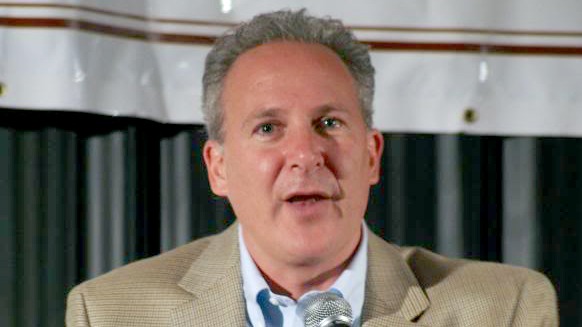
Peter Schiff is once again sounding the alarm on the United States economy, arguing that the next downturn will be so severe that the 2008 meltdown will look mild by comparison. At the same time, he is doubling down on a familiar solution, telling investors that gold, which he describes as having “no ceiling” on its price, is the one asset he trusts as the dollar weakens. I see his latest warnings as a window into a broader debate over debt, inflation and the future of money in President Donald Trump’s economy.
Schiff’s “Sunday school picnic” warning for the US economy
Peter Schiff has never been shy about pessimism, but his current outlook is stark even by his standards. He argues that the United States is “headed for an economic crisis” that will be worse than the Great Recession, saying the 2008 collapse will look like a “Sunday school picnic” once the next phase of the debt and inflation problem hits. In his view, years of ultra-loose policy, surging federal deficits and a reliance on cheap credit have left the system fragile, and he frames the coming shock as the inevitable result of ignoring those imbalances, a point he has pressed in recent Peter Schiff interviews.
That message has been sharpened by his role as Chief economist at Euro Pacific Asset Management, where he has warned that the United States is nearing a full-blown “financial crisis” under President Trump’s watch. He argues that inflation pressures, higher interest costs on the national debt and a slowing real economy are converging, and he insists that when markets finally reprice risk, the fallout will make the last housing bust look tame, a comparison he has repeated while saying the next downturn will not resemble a “Sunday school picnic” in Chief commentary.
From dollar crisis fears to a “no ceiling” asset
Schiff’s crash call is rooted in a specific fear, that the United States is edging closer to a dollar crisis as investors lose confidence in the currency’s purchasing power. Speaking on the Randi Hipper Show, he said the economy is “getting closer” to that tipping point and described gold and silver as the assets already signaling trouble. In his telling, persistent inflation and the need to refinance government debt at higher rates will eventually force policymakers into a choice between painful austerity and even more money creation, and he expects they will choose the printing press.
That is why he keeps returning to the idea that there is “no ceiling” on the price of gold, because in his words there is “no floor” to the value of the dollar. He has even traced that conviction back to his youth, recalling that he put his own Bar Mitzvah money into gold and never lost faith in the metal’s role as real money. In a separate discussion of his long-term stance, he argued that his optimistic view on gold stems directly from skepticism about the fiat system and the belief that paper currencies can be devalued without limit, a point he made while outlining why he sees no upper bound on the metal’s price in a detailed Schiff analysis.
Why gold is Schiff’s hedge of choice
Gold sits at the center of Schiff’s strategy because he sees it as the antithesis of the policies he blames for the looming crisis. Unlike paper currency, the metal cannot be printed at will by central banks, and he argues that this scarcity is what has allowed it to serve as a hedge against inflation across multiple cycles. In his recent interviews, he has emphasized that Gold has historically preserved purchasing power when currencies were debased, and he believes the same dynamic will play out if the dollar weakens further.
His conviction is not just theoretical. He has said explicitly, “I did put my Bar Mitzvah money into gold,” using that anecdote to underline how long he has trusted the asset. He has also highlighted that gold’s potential is not limited to bullion, pointing to the way miners and related companies can amplify moves in the underlying price, a theme he returned to when he said that the metal’s role as a store of value has been recognized for generations and that recent market action has again highlighted that potential.
From miners “going ballistic” to tokenized gold backlash
Schiff’s bullishness extends beyond the metal itself to the companies that dig it out of the ground. During the latest round of interviews, he was asked about specific precious-metals mining stocks and replied that “these stocks are going to go ballistic” if his inflation and dollar thesis plays out. He sees miners as leveraged plays on the gold price, arguing that rising bullion can translate into outsized gains for producers once their fixed costs are covered, a view he shared while discussing how During the interview he singled out two names he believes could benefit.
At the same time, his push into digital representations of gold has drawn fire from within the crypto world. When he backed a tokenized gold product, Binance co-founder and former Binance CEO Changpeng Zhao dismissed it as a “trust me bro” asset, questioning whether investors could really verify the backing reserves. That criticism underscored a tension in Schiff’s approach, he champions physical gold as the antidote to fiat risk, yet some of the vehicles designed to make owning it easier rely on the same kind of intermediaries and trust structures that crypto advocates say they want to avoid.
Gold versus Bitcoin in Schiff’s crisis playbook
Schiff’s enthusiasm for gold is matched only by his hostility toward Bitcoin, which he sees as the first casualty when the easy-money era ends. In a recent warning, he predicted an “imminent Bitcoin crash” and said the United States is headed for an “economic crisis” that will expose the token as a speculative bubble rather than a safe haven. He argued that once liquidity tightens and risk appetite fades, the market is likely to get a sharp Bitcoin selloff, and he likened the trading environment to a “casino” where prices are driven more by speculation than fundamentals.
That contrast is central to his broader message. Where Bitcoin advocates see digital scarcity, Schiff insists that only a tangible asset with a long monetary history can anchor portfolios in a crisis, and he points to the way gold and silver have behaved as the economy edges closer to what he calls a dollar problem. Speaking again on the Speaking segment of the Randi Hipper Show, he described the recent moves in precious metals as an early warning sign that investors are quietly repositioning for trouble. In his framework, that shift is exactly what he expects to accelerate if his prediction of a downturn that makes 2008 look like a “Sunday school picnic” proves correct, a scenario he has tied directly to the policy mix in President Trump’s economy.
More From TheDailyOverview
*This article was researched with the help of AI, with human editors creating the final content.

Grant Mercer covers market dynamics, business trends, and the economic forces driving growth across industries. His analysis connects macro movements with real-world implications for investors, entrepreneurs, and professionals. Through his work at The Daily Overview, Grant helps readers understand how markets function and where opportunities may emerge.

