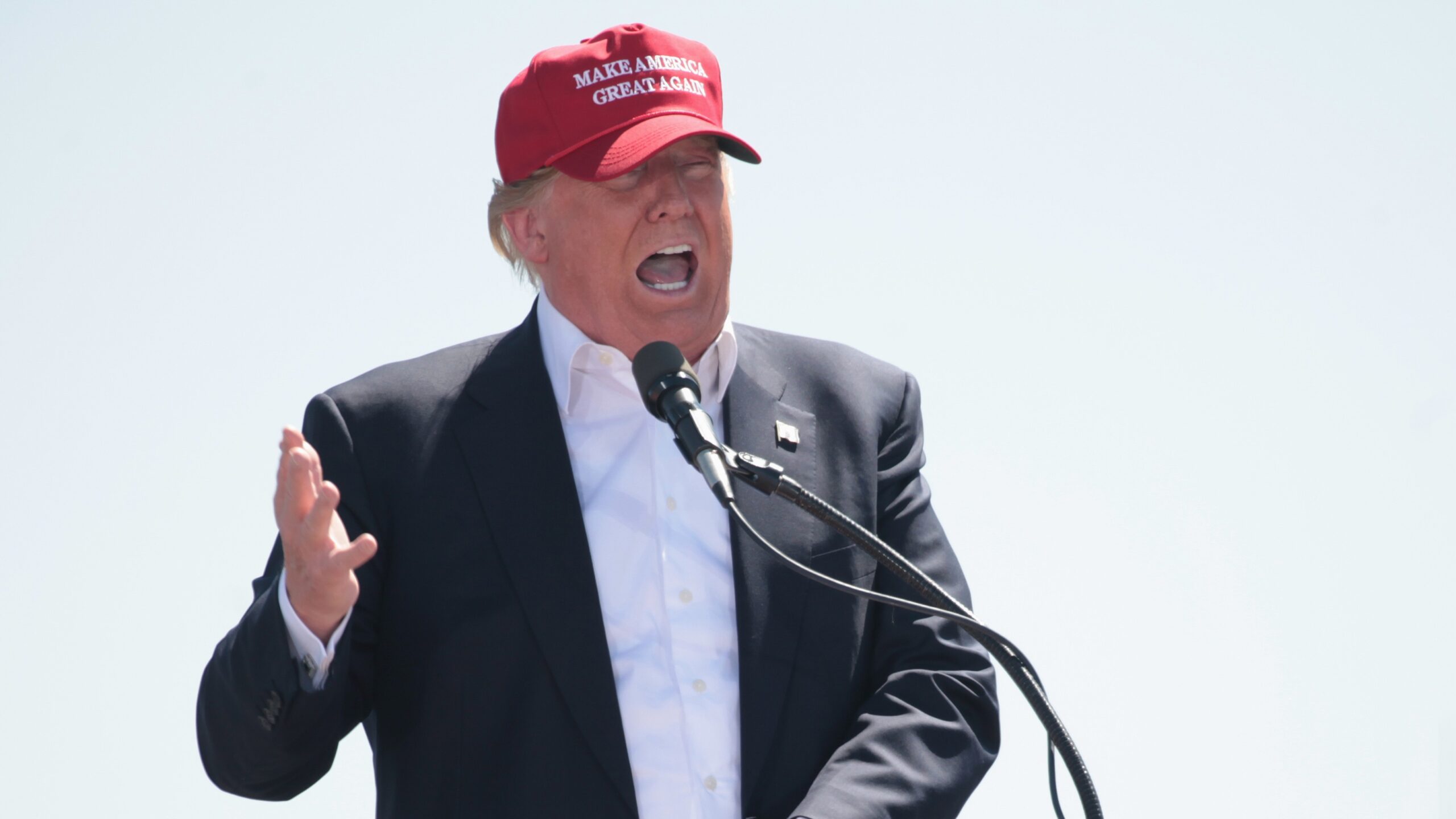
The political movement that carried President Trump back into the White House is starting to show visible strain. Polls, ideological disputes and new rival brands on the right all point to a MAGA universe that is less unified than it once was, and those fissures could matter as the 2026 midterms approach. The question is not whether Trump still commands intense loyalty, but whether the cracks in that loyalty are now deep enough to threaten his grip on power.
The myth and reality of a MAGA crack‑up
For months, commentators have predicted a dramatic break between Trump and his most devoted followers, often seizing on foreign policy flashpoints such as Venezuela as proof that the movement is splintering. The idea that a dispute over how to handle Venezuela would finally rupture MAGA has a certain surface plausibility, since foreign entanglements cut against the movement’s populist instincts. Yet detailed reporting on conservative media and grassroots activism shows that, in many corners of the right, Trump still “reigns supreme,” and talk of an imminent mass defection is described as wildly overstated.
Survey data reinforces that caution. A survey of The Republicans conducted with YouGov found that those who explicitly identify with MAGA remain more supportive of Mr Trump’s approach than non‑MAGA Republicans, even when they express skepticism about specific decisions. Another analysis of conservative politics argues that the theory of a MAGA rupture is “completely contradicted” by what is happening in the places where the movement is strongest, and notes that internal support still reaches 74 percent among core activists. In other words, the base is not collapsing, but it is becoming more complicated, and that complexity is where Trump’s vulnerability lies.
Ideological drift inside “America First”
At the heart of the tension is a debate over what MAGA actually means in 2026. One influential conservative thinker argues that “MAGA” and “America First” once functioned as interchangeable labels for a revolt against a dominant Progressive orthodoxy, but that the coalition has since drifted from those first principles. That drift shows up in disputes over foreign policy, trade and the role of big business, where some activists accuse the administration of reverting to conventional Republican instincts. The more MAGA looks like a rebranded establishment, the harder it becomes to keep anti‑establishment voters in line.
The split is especially sharp on questions of Israel and antisemitism. A feature on the right’s internal debate cites a Manhattan Institute survey of Republicans that found a clear divide between longstanding party voters and newer populist entrants, with the latter more critical of the Jewish state. That ideological rift exploded into public view around a high‑profile meeting involving Tucker Carlson, which critics said normalized antisemitic rhetoric, and it has fed a broader argument over whether “America First” is being hijacked by fringe elements or whether Trump himself has failed to police the boundaries of his own movement.
Personal rifts and visible defections
Ideological disputes are no longer confined to think‑tank essays or cable monologues, they are now producing personal ruptures between Trump and figures who once embodied MAGA loyalty. One report describes how the movement “recently witnessed a public split” between Trump and Georgia Republican Marjorie, a lawmaker who built her brand on unflinching support for the president before leaving office amid controversy. The same account links that break to a broader “MAGA rift over antisemitism,” suggesting that what began as a tactical disagreement has hardened into a moral and cultural divide for some activists.
Other longtime allies are also edging away. A widely shared video segment on “cracks between Trump and MAGA” highlights a very public disagreement with Senator Ron Johnson, who has criticized aspects of the administration’s agenda despite years as a reliable partner. Another televised discussion, featuring reporter Michael Schnell, relays warnings from Republicans Burgess that they are “beginning to see fractures” in the base and that “a hundred perhaps more” House Republicans could eventually vote against key Trump priorities. These are not yet mass defections, but they are unmistakable signals to grassroots conservatives that questioning the president is no longer taboo inside his own party.
Economic anxiety and the erosion of trust
Even where loyalty to Trump remains strong, economic frustration is gnawing at the foundations of MAGA. A national poll conducted for CNN finds that Trump “retains his base but has little support beyond it,” and that his overall job approval rating now stands at 39%. Another analysis by William A. Galston Senior Fellow, who holds the Ezra K. Zilkha Chair in Gove at the Center for Effective in Governance Studies, concludes that the economy weakened support for President Trump in 2025 and may do so again in the 2026 midterms and beyond. When kitchen‑table issues sour, even the most emotionally charged political brands can lose some of their shine.
Grassroots polling captures that discontent in granular detail. A New Poll shared by Indivisible notes that MAGA Identification Among Republicans Drops to 50%, framing it as “Signaling Potential GOP Fractures Ahead of” the Midterms. A separate NBC News Decision Desk Poll powered by SurveyMonkey finds that Trump’s MAGA base is still behind him but that cracks are showing ahead of 2026, with the NBC respondents voicing particular concern about inflation and wages. A local write‑up of the same poll notes that Respondents’ concerns were apparent in everyday spending decisions like grocery shopping and holiday budgets, a reminder that loyalty to Trump is being tested not in rallies but in supermarket aisles.
New brands on the right and the limits of Trump’s reach
As MAGA grapples with internal strain, rival projects on the right are trying to capture pieces of its coalition. One of the most striking is The Make America Healthy Again initiative, known as MAHA, which has been championed by Robert F. Kennedy Jr. and has quickly become a wild card for the GOP. Reporting by Nathaniel Weixel notes that The Make America Healthy Again movement is drawing interest from vaccine‑skeptical conservatives and wellness‑oriented independents, with MAHA support among Republicans far outpacing its modest 29 percent backing among Independents. That asymmetry suggests MAHA is competing directly with MAGA for the same pool of anti‑establishment voters.
Party strategists are leaning into that competition. A separate report explains that Republicans are counting on a MAHA bounce to avert midterm losses, promoting the MAHA agenda as a way to reconnect with suburban voters who soured on Trump’s pandemic rhetoric. Yet that strategy carries risk: if MAHA becomes a parallel identity rather than a sub‑brand of MAGA, it could further dilute Trump’s hold on the right. A CNN analysis of the president’s standing already finds that Trump retains his base but has little support beyond it, and repeats that his approval is stuck at 39%, a ceiling that leaves little margin for splinter movements.
More From TheDailyOverview

Grant Mercer covers market dynamics, business trends, and the economic forces driving growth across industries. His analysis connects macro movements with real-world implications for investors, entrepreneurs, and professionals. Through his work at The Daily Overview, Grant helps readers understand how markets function and where opportunities may emerge.