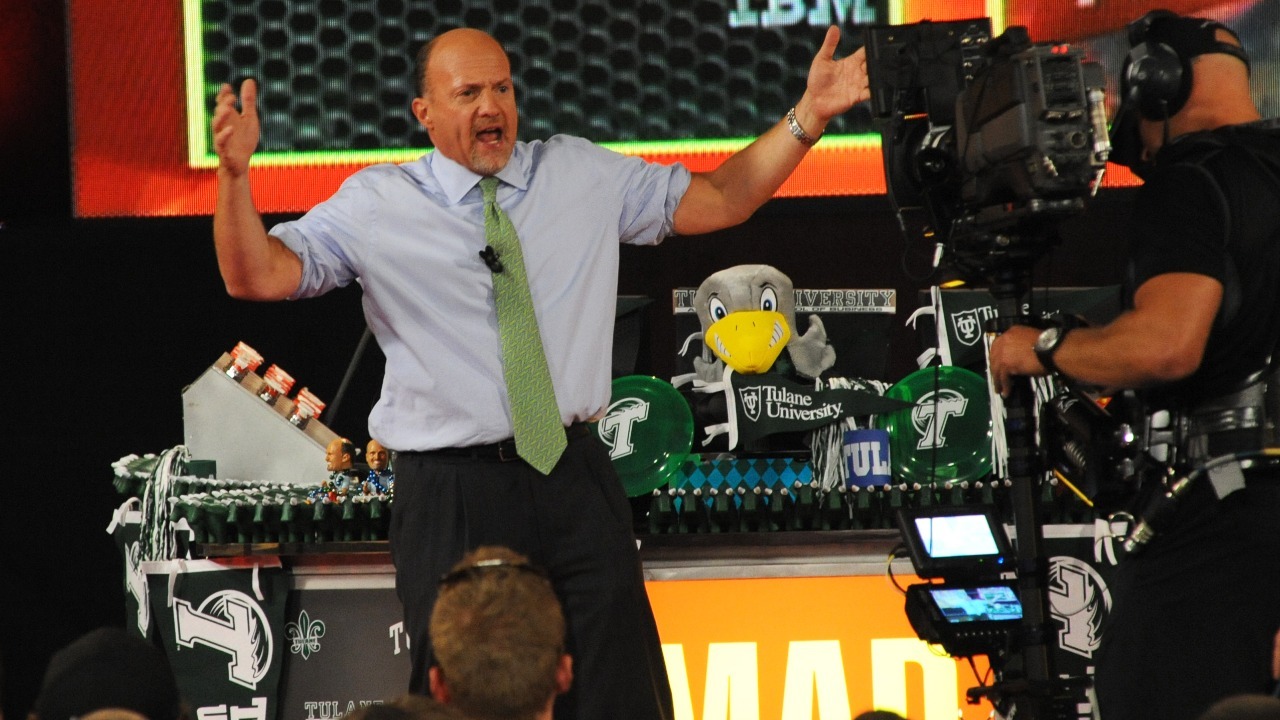
Jim Cramer is waving investors away from the market’s two most beloved tech names, Apple and Nvidia, not because their businesses have suddenly broken, but because the tape has. His warning is about timing and positioning as Wall Street heads into a pivotal earnings stretch, with money quietly slipping out of the mega-cap darlings and into overlooked corners of the market. I see his message less as a verdict on the companies themselves and more as a blunt reminder that even the strongest stories can be the wrong trade when leadership is rotating.
Why Cramer is telling traders to stand down on Apple and Nvidia
Cramer’s core argument is that Apple and Nvidia have lost their near-term grip on the market’s imagination just as earnings season approaches, and that makes them dangerous trading vehicles right now. He points to a pattern in which money is rotating away from the most crowded winners into stocks that have been ignored, a classic pre-earnings shuffle that often leaves former leaders flat or choppy even when the broader indexes look healthy. In his view, Apple and Nvidia are no longer the automatic go-to names for fast money, which means traders counting on quick upside could find themselves stuck in dead money or whipsawed by sharp intraday reversals.
That caution is rooted in recent price action. Cramer notes that both Apple and Nvidia have struggled to gain traction as investors reposition around an employment report he describes as “basically uneventful,” a backdrop that tends to favor rotation rather than momentum breakouts. He argues that when the macro data fail to deliver a clear new narrative, capital often drifts toward cheaper or under-owned stocks instead of doubling down on the same mega-cap leaders. In that environment, he believes trying to trade Apple and Nvidia into earnings is a low-odds bet, especially after prior rallies have already pulled forward a lot of good news.
The rotation playbook: from crowded leaders to overlooked stocks
What Cramer is really flagging is a classic rotation phase, where the market quietly shifts its focus from the most popular names to those that have lagged. He sees money moving out of Apple and Nvidia and into sectors and individual stocks that have not been the center of attention, a process that can last for weeks as portfolio managers rebalance risk and valuation. For traders who are used to riding the same handful of tech giants, that shift can feel like the ground moving under their feet, because the usual leaders stop responding to good news while forgotten names suddenly start to run.
In his analysis, the catalyst for this rotation is not a crisis but the absence of one. When the employment data come in without major surprises, there is no urgent reason to chase defensive mega-caps or to pay peak multiples for the most crowded trades. Instead, investors look for relative bargains and fresh stories, which is why Cramer is steering attention toward “overlooked stocks” ahead of earnings. He argues that this is the moment when under-owned industrials, financials, or smaller tech names can quietly outperform while the giants like Apple and Nvidia mark time or even slip as money is pulled out to fund new positions.
Apple and Nvidia’s recent stumbles and why they matter
Cramer’s warning is sharpened by the fact that both Apple and Nvidia have already shown signs of vulnerability. He highlights that these two stocks, which once seemed unstoppable, have recently failed to hold rallies and have been knocked down by bouts of selling that arrive with little warning. For Apple, that has meant sharp pullbacks after periods of optimism about iPhone demand or new product cycles, while Nvidia has seen its own swings as investors debate how much artificial intelligence growth is already priced into the shares. Those reversals are a reminder that even market favorites can become fragile when expectations are stretched.
He stresses that this fragility is particularly dangerous heading into earnings season, when every tick of guidance and every comment on demand can trigger algorithmic reactions. In his view, traders who try to game short-term moves in Apple and Nvidia are now facing asymmetric risk: limited upside because the stocks are already widely owned and heavily analyzed, and significant downside if results or commentary fall even slightly short of lofty hopes. That is why he folds both Apple and Nvidia into a broader list of leaders that have “failed to gain traction” and have been “knocked down” before, arguing that the recent tape action should be taken as a serious warning sign rather than dismissed as noise.
How Cramer wants investors to think about timing and risk
Although his language sounds harsh, Cramer is not telling long-term investors to abandon Apple and Nvidia as businesses. His focus is on trading behavior, and he is explicit that his concern is about the near-term setup rather than the multi-year prospects of these companies. He wants traders to recognize that buying strength in former leaders right before earnings, in the middle of a rotation, is a very different proposition from accumulating shares on weakness with a long horizon. In other words, he is drawing a line between owning Apple and Nvidia as core holdings and trying to flip them for quick gains in a market that is no longer rewarding that strategy.
From a risk-management perspective, his advice is to step back and let the rotation play out instead of fighting it. He suggests that when leadership is in flux and the macro data are not providing a clear trend, the best move can be to avoid the most crowded trades and look for better risk-reward elsewhere. That might mean focusing on companies with improving fundamentals that have not yet been fully recognized, or on sectors that benefit from the same economic backdrop without carrying the same valuation and sentiment baggage. By reframing Apple and Nvidia as “do not trade” names for now, he is effectively telling investors to wait for a cleaner entry point rather than forcing a trade into a messy tape.
Where the “overlooked” opportunity may lie instead
Cramer’s emphasis on overlooked stocks is not just a throwaway line, it is the other half of his red alert. If money is rotating out of Apple and Nvidia, it has to be going somewhere, and he believes that “somewhere” is a set of names that have been ignored while the market obsessed over a handful of mega-cap winners. He points to this shift as a chance for investors to broaden their horizons, arguing that the next leg of performance may come from companies that have solid earnings prospects but have not yet been bid up to extreme valuations. In his framework, the opportunity is not in chasing yesterday’s winners, but in identifying tomorrow’s.
That is why he ties his caution on Apple and Nvidia directly to the broader pattern of capital moving into under-owned areas ahead of earnings. He sees the current environment, shaped by an uneventful employment report and a market searching for new leadership, as a window in which disciplined investors can reposition. By stepping away from trading Apple and Nvidia and instead scanning for mispriced earnings stories, he believes traders can avoid the chop in the former leaders and potentially capture the upside in the new ones. His message is blunt: respect the rotation, skip the crowded trades for now, and let the market’s shift in focus guide where you deploy fresh capital.
Jim Cramer’s stance has been distilled into a simple directive not to trade Apple and Nvidia as money rotates into overlooked stocks ahead of earnings season, a view he has laid out in detail in his recent market commentary. He underscores that when an employment report is “basically uneventful,” it often sets the stage for leaders to struggle and for capital to seek new homes, a dynamic he applies directly to Apple and Nvidia as he urges traders to let the rotation run its course before stepping back into the trade.
More From The Daily Overview

Elias Broderick specializes in residential and commercial real estate, with a focus on market cycles, property fundamentals, and investment strategy. His writing translates complex housing and development trends into clear insights for both new and experienced investors. At The Daily Overview, Elias explores how real estate fits into long-term wealth planning.

