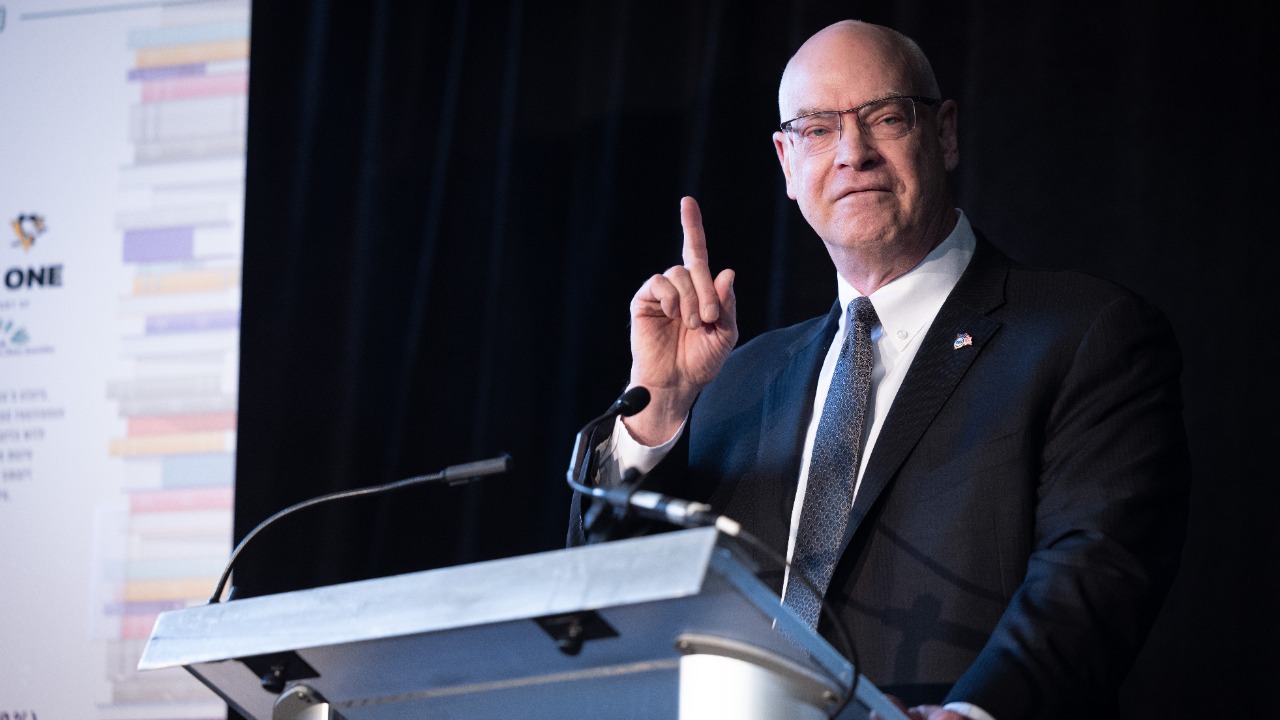
U.S. Steel’s chief executive is trying to reassure workers, investors and Washington that the company still calls its own shots, even after President Donald Trump secured an unprecedented “golden share” in the storied manufacturer. In a recent television interview, Steel CEO David Burritt argued that the special government stake does not give the White House day‑to‑day control over strategy, even as it allows Trump to veto some of the most sensitive decisions. The tension between that message and the legal reality of the golden share is now at the center of a high‑stakes experiment in industrial policy.
How a Japanese takeover created an American ‘golden share’
The golden share was born out of the politically fraught sale of U.S. Steel to Japan’s Nippon Steel, a deal that turned a century‑old American icon into part of a foreign‑owned group while promising to keep its identity rooted in the United States. To win approval from the Trump administration, Nippon Steel agreed that the federal government would receive a special equity stake in the combined Steel business, a structure that gives Washington veto rights over certain major corporate moves. Burritt has insisted that, despite the change in ownership, the company is “absolutely” still an American enterprise, a point he underscored while discussing the Nippon Steel acquisition in an interview that highlighted the role of Trump in shaping the terms.
Regulators treated the takeover as a national security case, routing it through the Committee on Foreign Investment in the United States, or CFIUS, which reviews foreign deals involving critical industries. After a protracted process, the President cleared the acquisition by Nippon Steel of Steel, but only subject to a novel set of conditions that included the golden share and strict oversight of plant closures and technology transfers. Legal analysts later described these CFIUS Actions as a template for how the White House might use ownership tools to shape future cross‑border mergers, a point reinforced when a separate summary of M&A in 2025 flagged the Nippon Steel of Steel deal as a turning point.
What the golden share actually lets Trump do
In practice, the golden share gives the U.S. government a narrow but potent set of rights over Steel’s most consequential decisions. According to deal summaries, the special stake allows federal officials to veto changes to the company’s headquarters, the locations of its factories and offices, and other moves that could affect domestic production capacity. One detailed account of the Steel Golden Share noted that, in return for allowing Nippon Steel to buy U.S. Steel, Trump required that the United States receive several powers over the combined group’s governance, including a say over the locations of offices and factories, a structure that was later highlighted as one of the most disruptive deals of his current term in a broader review of Trump‑era transactions.
Corporate lawyers who dissected the merger agreement between Nippon Steel Corp and United States Steel Corp noted that the parties issued a press release describing a bespoke governance structure that reserved certain “major decisions of the company” to a special class of oversight. That framework, laid out in a June announcement of the finalized merger, underscored that the golden share would sit alongside the ordinary shareholder base and board of directors, rather than replacing them, but it still carved out a list of strategic moves that could not proceed without government consent. The same analysis of Highlights cited the figure 202 in describing the number of pages in the underlying documentation, a reminder of how intricate the governance terms have become.
Burritt’s message: still an American company, still in charge
Against that backdrop, Burritt has been at pains to argue that the golden share is a guardrail, not a steering wheel. In a sit‑down with a national evening news program, he described Steel as “absolutely” still an American company after the Nippon Steel acquisition, stressing that its leadership, workforce and core operations remain rooted in the United States even as ownership shifted to Japan. He framed the government’s special stake as part of a broader partnership with Washington, one that he said would help secure long‑term investment and jobs rather than micromanage the business, a point he made while discussing how Nippon Steel and Trump negotiated the final terms.
In an extended conversation with CBS Evening News anchor Tony Dokoupil, Steel CEO David Burritt went further, outlining plans to invest $14 billion in new and upgraded facilities and arguing that such a capital program would not be possible if the company were constantly waiting on political sign‑off. He portrayed the golden share as a backstop for extreme scenarios, such as an attempt to offshore critical production, rather than a tool for day‑to‑day interference in pricing, hiring or product strategy. That message was reinforced in a separate clip shared on social media, where Burritt again emphasized that Steel remains an American company at its core, even as he acknowledged that the President holds a unique stake in the business, a moment captured in a short Jan reel.
In that longer broadcast, Burritt’s comments were framed by questions about how much practical power the White House now wields over the company’s footprint, including specific plants in places like Granite City in Illinois. He responded by stressing that management still makes operational calls, while the government’s role is limited to a defined set of strategic vetoes, a distinction that was echoed in a separate write‑up of the Evening News interview. That balancing act, between asserting corporate autonomy and acknowledging a powerful new shareholder, is central to his argument that the golden share cannot stop Steel from doing what it wants within the bounds of its long‑term commitments.
When the golden share bites: Granite City and beyond
The limits of that autonomy became clear when the Trump administration used the golden share to block Steel’s plan to shut down production at a plant in Illinois. According to a report citing a person familiar with the matter, Reuters described how the Trump administration invoked the special stake to stop the company from idling operations at the Granite City facility, a move that would have cut jobs in a politically sensitive region. The intervention showed that, while Burritt may see the golden share as a rarely used safeguard, the White House is prepared to wield it aggressively when it believes local employment or national capacity is at risk, a point underscored in coverage of how Illinois became a test case.
International observers have also taken note of how the golden share has reshaped the global steel landscape. One detailed account in a Japanese business outlet described how the move, which created the world’s second‑largest steelmaker, was approved by President Donald Trump only after concessions made by Nippon Steel on issues such as plant closures and domestic investment. That same report highlighted how the golden share was later used by Trump officials to block U.S. Steel from shutting the Granite City plant in Illinois, illustrating the concrete power that the special stake confers on the federal government and the degree to which President Donald Trump is willing to intervene in corporate restructuring.
A template for future deals, or a one‑off experiment?
For now, the Steel golden share remains a singular arrangement, but it is already influencing how lawyers, investors and foreign buyers think about politically sensitive takeovers. A legal analysis of the Nippon Steel Corp and United States Steel Corp merger noted that the parties issued a press release on June 18 describing a complex governance framework that could serve as a model for future deals in sectors like semiconductors, defense and critical minerals. That same document, which summarized key Highlights of the agreement, emphasized that the golden share sits alongside other protective measures, such as commitments to maintain certain levels of domestic production and to consult with U.S. authorities on major decisions of the company, a structure that was further detailed in a separate breakdown of the merger agreement.
More From The Daily Overview

Grant Mercer covers market dynamics, business trends, and the economic forces driving growth across industries. His analysis connects macro movements with real-world implications for investors, entrepreneurs, and professionals. Through his work at The Daily Overview, Grant helps readers understand how markets function and where opportunities may emerge.

