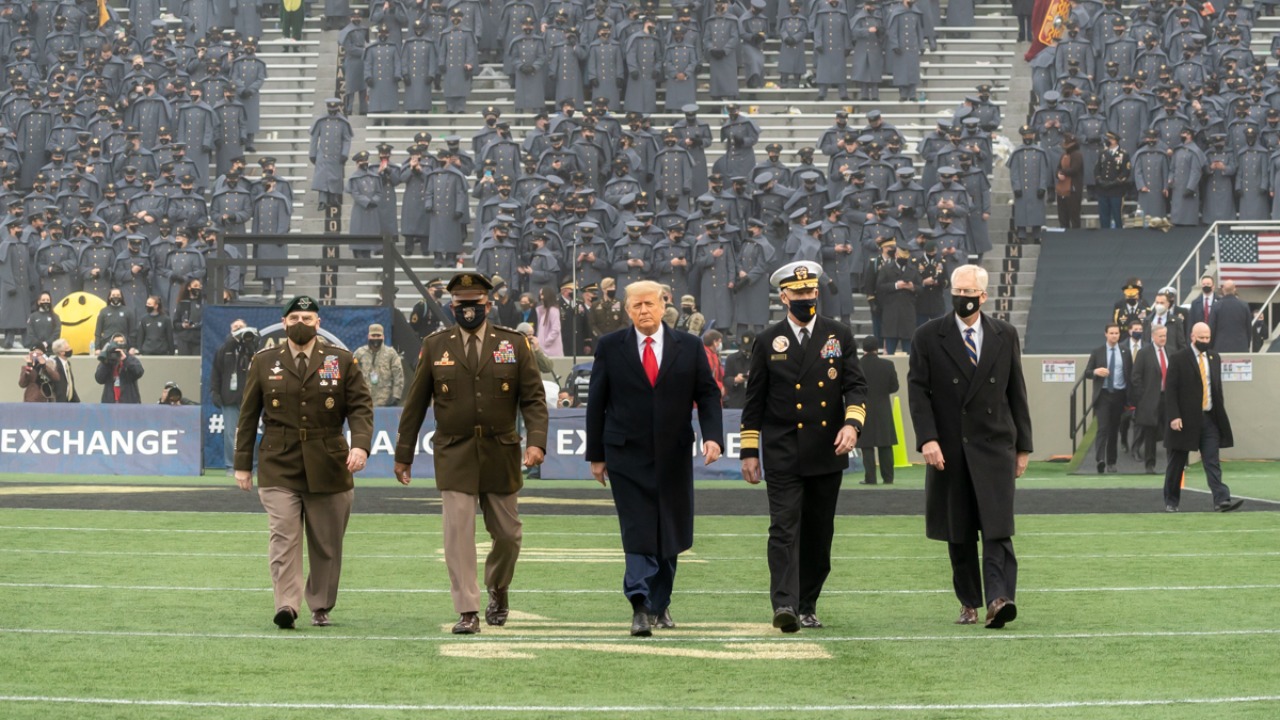
Defense shares are suddenly back at the center of Wall Street’s story, as President Donald Trump’s push for a massive Pentagon buildup sends money flooding into the sector. After a volatile stretch triggered by new scrutiny of contractors, the market is now betting that a proposed $500 Billion expansion of military funding will outweigh the political risk and reset the earnings outlook for the industry.
Investors are trying to price in what a dramatically larger war budget, paired with tougher rules on how contractors operate, means for giants like Lockheed Martin Corp LMT and Northrop Grumman Corp NOC as well as their smaller peers. I see a market that is not just reacting to headlines, but rapidly repricing long term cash flows in light of Trump’s stated determination to boost spending “for the Good of our Country.”
Trump’s $500 Billion ambition and a 50% spending leap
The core catalyst for the rally is Trump’s call to add an extra $500 Billion to the Pentagon’s resources, a figure that would reshape the scale of U.S. war planning and procurement. In his push to expand what some analysts describe as a Department of War style posture, Trump has framed the buildup as essential for deterrence and industrial strength, arguing that the Good of Country requires a far larger and more resilient arsenal than the one funded under prior budgets, a case that has electrified traders who specialize in military names.
On top of that headline figure, Trump has also floated a target to lift annual military outlays by 50% to roughly $1.5 trillion a year, a level that would lock in a structurally higher revenue base for prime contractors and their supply chains. When he signaled that he wants to boost spending by that 50% margin to $1.5 trillion, Defense stocks jumped as investors tried to front run the potential surge in orders and margins that such a budget would imply.
From executive order shock to “Euphoria” in defense names
The path to this rally has not been smooth, and I see the recent price action as a case study in how policy risk can whipsaw a sector before settling into a new trend. Earlier this week, President Donald Trump signed an executive order that rattled the industry by tightening expectations on contractors and initially sent shares of major defense firms sharply lower, as traders tried to gauge what The EO would mean for compliance costs and contract structures.
That initial sell off quickly reversed once Trump followed the order with his budget push and public praise for certain companies, turning fear into what some analysts have described as outright Euphoria in U.S. defense stocks. One detailed breakdown of the move framed it as “Euphoria in U.S. defense stocks” tied to the prospect of an additional $500 for a Department of War style expansion, noting that Yesterday, Donald Trump delivered the comments that flipped sentiment from anxiety to enthusiasm almost overnight.
Big winners: Lockheed, Northrop and the broader complex
In market terms, the clearest winners so far are the largest Pentagon suppliers, which tend to move first when Washington signals a step change in spending. Lockheed Martin Corp LMT, listed on the NYSE, saw its Close marked at 518.44, up 21.57 points or 4.34%, on heavy Volume of 3,909,573 shares, with traders also noting its 52 week range that stretches down to 410.11 as a reminder of how much room there is for a full re rating if orders ramp as expected.
Northrop Grumman Corp NOC, also on the NYSE, has been swept up in the same wave, with its Close recorded at 590.79, a gain of 13.78 points or 2.39%, on Volume of 3,480,197 shares, and a 52 week range that reaches as low as 426.24, underscoring how sharply sentiment has turned in favor of the sector’s blue chips. I see those price and volume spikes, captured in real time by tools such as Google Finance, as evidence that institutional money is rotating back into defense after months of caution about policy risk.
Policy risk: The EO, new scrutiny and contractor behavior
Even as the budget story drives prices higher, I think it would be a mistake to ignore the parallel shift in how Washington intends to police the industry. Legal analysts who have parsed The EO argue that it signals a potentially significant shift in the government’s expectations for the defense industrial base, with a clear message that contractors will be expected to align more tightly with new priorities on issues ranging from supply chain resilience to domestic production.
That tougher stance is already visible in how Trump has publicly singled out specific firms, including RTX and its role as RTX Corp, which he has described as the contractor most reluctant to implement certain U.S. Depar directives, a criticism that carries real weight when paired with a promise of hundreds of billions in new orders. One detailed market note pointed out that Earlier, Trump had also pointed to RTX Corp by name, reinforcing the idea that access to the coming budget windfall may depend on how closely companies align with the administration’s industrial and strategic agenda.
What the surge says about investor expectations
Looking across the tape, I read the sector’s reaction as a bet that higher topline spending will more than offset any drag from new rules or political scrutiny. One detailed breakdown of the rally noted that Defense company stocks rose sharply after President Donald Trump called for a significant increase in the United States military budget, with investors also cheering the prospect of contractors buying back their own stock as cash flows expand, a dynamic that tends to magnify earnings per share and support higher valuations.
Intraday market coverage has highlighted how Defense stocks recover after Trump signals his intent to boost military spending, with names like Lockheed Martin (LMT) popping in premarket trading as traders position for a multi year upcycle in weapons production and support services. In one session recap, analysts pointed out that Defense stocks recover quickly from policy scares once Trump reiterates his spending goals, a pattern that suggests the budget narrative is overpowering short term regulatory worries.
At the same time, the sector’s roller coaster over the past several sessions is a reminder that policy driven trades can cut both ways, especially when a single administration is reshaping both the size of the budget and the rules of the game. One account of the volatility described how shares of major defense firms first tanked, then soared, as traders tried to interpret what President Donald Trump’s declarations and executive actions would mean for each company’s margins and contract pipeline, with shares of major defense firms ultimately gunning higher once the scale of the proposed budget became clear.
Why the $500 Billion push could reshape the sector
Stepping back from the day to day moves, I see Trump’s $500 Billion push as a structural story that could redefine how investors value defense stocks for years. A detailed analysis of the rally noted that Defense stocks rocketed early in the session as traders digested Trump’s determination to deliver a Tariff Funded Budget Hike of $500 Billion, framed explicitly as a decision he had “determined that, for the Good of our Country,” he needed to pursue, a formulation that signals both political commitment and a willingness to use trade tools to pay for the expansion.
Another market note captured the mood with the phrase Euphoria in U.S. defense stocks and asked whether an additional $500B for a Department of War style posture was now on the table, arguing that the combination of higher topline spending and more aggressive industrial policy could usher in a new era for the sector’s earnings power. In that context, the latest session, in which Defense Stocks Surge On Trump and his Billion Budget Hike Push, looks less like a one day pop and more like the market’s first serious attempt to price in what a sustained, politically backed rearmament cycle might mean for balance sheets, buybacks and long term shareholder returns.
More From The Daily Overview

Grant Mercer covers market dynamics, business trends, and the economic forces driving growth across industries. His analysis connects macro movements with real-world implications for investors, entrepreneurs, and professionals. Through his work at The Daily Overview, Grant helps readers understand how markets function and where opportunities may emerge.