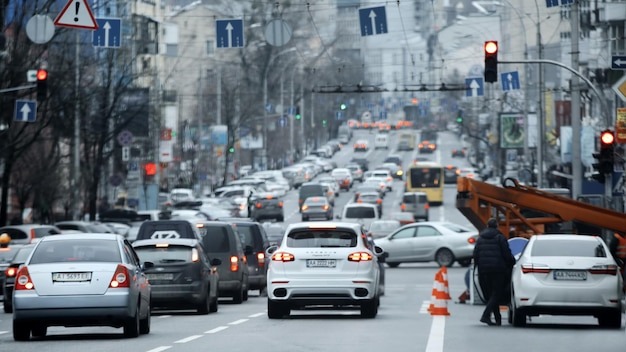
California is charging ahead with a plan to bill drivers for every mile they travel, and the effort is drawing fierce opposition from Republican lawmakers who see it as a new tax on motorists already squeezed by high fuel costs. Under a Democratic-backed law signed in 2021, the state launched its first pilot program that requires participants to make real payments based on mileage, moving the concept from theory to practice. The fight over per-mile road charges now sits at the center of a broader national debate about how states will fund highways as gasoline tax revenue declines.
What SB-339 Actually Requires
The legal foundation for California’s per-mile fee experiment is the 2021 enactment of Senate Bill 339, which is formally titled “Vehicles: road usage charge pilot program” and was chaptered on September 24 of that year. The statute directs the California State Transportation Agency and the California Transportation Commission to design and implement a new pilot that evaluates whether mileage-based fees can replace or supplement the state’s existing fuel excise taxes as a primary revenue source for highways. SB-339 specifies that pilot participants “shall be charged a mileage-based fee” and must receive credits or refunds for gasoline taxes and existing electric-vehicle registration surcharges they have already paid, an approach intended to prevent double taxation while the concept is still being tested.
That structure matters because it reveals the real mechanism at work. The pilot is not a blanket new levy layered on top of what drivers already pay at the pump; it is a controlled swap in which miles driven replace gallons purchased as the unit of measurement for road funding. For owners of gasoline-powered vehicles, the credits are designed to zero out overlapping fuel taxes so that the net cost reflects only the experimental charge. For owners of battery-electric vehicles, who currently contribute little or nothing through per-gallon taxes, the road charge would represent a new, usage-based cost tied directly to their time on state highways. That distinction is central to the political fight, yet it rarely surfaces in the loudest partisan arguments, which tend to frame the pilot either as a stealth tax grab or as a purely technical fix to a looming budget hole.
The 2024 Pilot Demands Real Money
California’s transportation department moved the concept from simulation to reality with its 2024–2025 Road Charge Collection Pilot, described in a Caltrans announcement covering the launch and structure of the program. Running from August 2024 through January 2025, this test was the first in the state to require participants to pay actual charges rather than simply track hypothetical invoices. Volunteers could choose from several reporting methods, including periodic odometer readings, plug-in devices installed in vehicles, and app-based tools, allowing the state to compare administrative costs, accuracy, and user acceptance across different technologies.
The shift to real payments changed the political temperature almost immediately. Earlier, when drivers only logged simulated invoices, the program attracted modest attention from policymakers and little from the general public. Asking people to open their wallets, even in a tightly controlled pilot, turned a policy experiment into an easy political target. Republican critics in Sacramento seized on the collection phase as proof that Democrats intend to impose a permanent per-mile tax on all motorists, while supporters countered that the state cannot maintain roads and bridges if the tax base keeps shrinking as more Californians switch to electric vehicles and high-efficiency hybrids. Both sides are working from the same basic revenue math, declining fuel consumption undermines per-gallon taxes, but they draw opposite conclusions about whether a mileage fee is a fair solution or an unacceptable expansion of government reach.
Lessons From Earlier Mileage Experiments
California’s current pilot builds on nearly a decade of groundwork. A previous test authorized under Senate Bill 1077 enrolled about 5,000 vehicles and evaluated multiple revenue-collection approaches, from simple odometer checks to GPS-enabled tracking, as summarized in a legislative analyst review and a detailed technical report archived in the federal research repository. That earlier project concluded in 2017 with a recommendation that a road usage charge is technically feasible but that significant obstacles remain, particularly around driver privacy, administrative complexity, and the distributional impact on different types of households. Those findings shaped the design choices for the current SB-339 pilot, including the decision to offer both location-aware and location-free reporting options.
The privacy concern is not abstract. Plug-in devices and smartphone apps can record not only how far someone drives but also where and when those trips occur, raising fears that government agencies or private vendors could assemble detailed movement profiles. Rural drivers, who often log far more miles than urban commuters just to reach jobs, schools, and medical appointments, would also pay disproportionately more under a flat per-mile rate, even though they may have fewer transportation alternatives and lower incomes. These issues were flagged by the earlier research team and have been revisited by the Road Charge Technical Advisory Committee, which operates under the umbrella of statewide public agencies and has spent recent years drafting design recommendations that include strong data-protection rules, limited retention periods, and possible rate adjustments for low-income or rural participants. Whether those safeguards and equity proposals will satisfy skeptics on the right or advocacy groups on the left remains uncertain, and the state has not yet released comprehensive evaluation data from the most recent collection pilot.
Why GOP Opposition Runs Deeper Than Taxes
Republican anger over the road charge program is about more than the dollar amount on a monthly statement; it reflects a broader clash over California’s transportation and climate policies. For years, state regulators have paired aggressive emissions rules with mandates and incentives intended to speed the adoption of electric vehicles, while also backing land-use policies that favor dense, transit-oriented development. From the GOP perspective, the state created the gas-tax revenue shortfall by deliberately accelerating the transition away from internal-combustion engines, and it is now asking every motorist, especially those who still rely on gasoline, to cover the resulting gap. That narrative resonates with voters in inland and rural districts where driving distances are long, public transit is sparse, and charging infrastructure remains limited, making it easy to portray the per-mile fee as another burden on communities already feeling left behind.
Supporters of the pilot, including many Democratic lawmakers and transportation officials, offer a different framing. They argue that roads, bridges, and tunnels cost money to build and maintain regardless of what powers the vehicles using them, and that clinging to a fuel-based revenue model in the face of rapid electrification is fiscally irresponsible. At the national level, the U.S. Department of Transportation has funded multiple state-level mileage-fee demonstrations and conducted its own analyses of long-term highway trust fund solvency, reflecting a growing consensus among engineers and budget analysts that traditional gas taxes are on an unsustainable path. Data compiled by the Bureau of Transportation Statistics shows that vehicle-miles traveled have generally risen over time even as average fuel economy improves, a combination that erodes per-gallon revenue and strengthens the case for tying charges directly to distance driven. In this view, California is not an outlier so much as a testing ground for a transition every state will eventually have to confront.
What Comes After the Pilot Ends
With the 2024–2025 collection pilot now concluded, California faces a pivotal decision about whether and how to move from experimentation to implementation. The data gathered from participants who paid real charges (covering compliance rates, user satisfaction, administrative costs, and the effectiveness of different reporting technologies) will inform legislative deliberations over the next several years. Lawmakers will have to weigh whether a full-scale road charge should replace some portion of the existing gas tax, operate in parallel with it for an extended transition period, or remain limited to certain vehicle categories such as electric cars and heavy trucks. They will also need to decide how to structure any permanent program to address concerns about privacy, rural equity, and the treatment of out-of-state drivers who use California roads but do not register vehicles there.
The Road Charge Technical Advisory Committee has already outlined potential frameworks in documents stored within the National Transportation Library, including recommendations on rate-setting principles, data governance, and options for integrating mileage fees with existing registration and tolling systems. Turning those blueprints into law, however, will require building a durable political coalition in a polarized environment where any change to how people pay for driving can quickly become a campaign issue. For now, the state’s per-mile experiment functions as both a fiscal stress test and a political litmus test: if California can demonstrate that a road usage charge is technically reliable, administratively efficient, and perceived as broadly fair, it may offer a template for other states and for future federal policy. If the pilot instead hardens partisan lines and fuels public mistrust, it could delay not only California’s own transition but also national efforts to modernize how the country pays for the infrastructure that keeps its economy moving.
More From The Daily Overview
*This article was researched with the help of AI, with human editors creating the final content.

Grant Mercer covers market dynamics, business trends, and the economic forces driving growth across industries. His analysis connects macro movements with real-world implications for investors, entrepreneurs, and professionals. Through his work at The Daily Overview, Grant helps readers understand how markets function and where opportunities may emerge.

