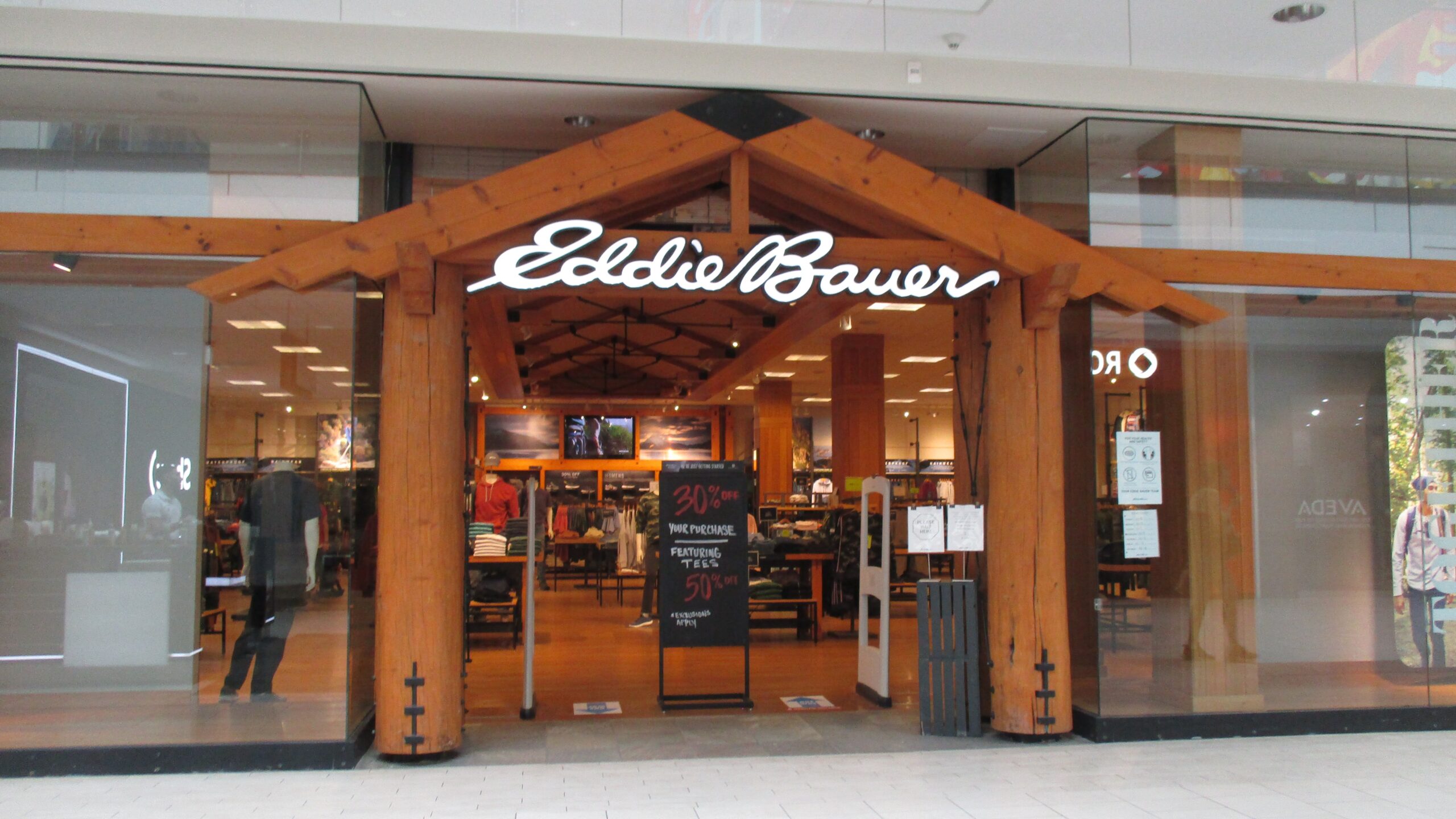
Eddie Bauer is turning its stores into liquidation outlets as the outdoor retailer’s operator works through Chapter 11 bankruptcy. The move underscores how urgently the company needs cash, because selling jackets, boots, and gear is one of the fastest ways to raise money while the court decides what happens next. For shoppers, the all-store sale looks like a bargain hunt. For lenders and possible buyers, it is a real-time test of how much value is left in a once-dominant brand.
The Chapter 11 process in New Jersey covers both Eddie Bauer’s United States and Canadian operations, so the shake-up stretches across North America instead of staying in one country. Court filings and news summaries describe a “dual-track” plan: the company is trying to sell the business while also preparing for a full shutdown if no acceptable buyer appears. As a result, the liquidation is more than a simple clearance event. It is a way to measure investor interest and see whether the Eddie Bauer name can still support a smaller but viable business.
Bankruptcy filings set the stage
The decision to liquidate across the chain flows directly from Eddie Bauer LLC’s move into Chapter 11. Public court records show that Eddie Bauer LLC, identified as the main U.S. retail operator, filed for protection in the New Jersey Bankruptcy Court under case number 2:26-bk-11422. A matching petition lists Eddie Bauer of Canada Corporation with case number 2:26-bk-11424, and both were filed on the same day. That pairing confirms that the restructuring covers a cross-border network of stores rather than a single domestic chain.
In the filings and related summaries, Eddie Bauer LLC is described as the entity that runs day-to-day retail operations, so its Chapter 11 case is where decisions about leases, inventory, and jobs will be made. The company has laid out a dual-track process that pursues a sale while also planning for a possible wind-down. This structure is common when a retailer is unsure whether a buyer will emerge at a price that satisfies lenders. It also explains why liquidation sales can start while a sale process is still open: clearing out stores raises cash and reduces future rent and payroll, which can make the business more attractive to bidders or, if no buyer steps up, smooth the path to closure.
Liquidation sale hits every store
Against that backdrop, Eddie Bauer has launched a chainwide liquidation sale that reaches across its store base. Reporting that draws on bankruptcy documents and regional notices describes Eddie Bauer liquidating stores amid bankruptcy, with clearance events advertised across locations instead of a few weak outlets. One account focused on the Philadelphia area uses state layoff filings and court records to show that local stores are part of a broader sell-off, signaling that the strategy is tied to the overall Chapter 11 plan rather than a narrow regional cutback.
That distinction matters because some retailers use “store closing” banners as a marketing tactic while keeping the broader chain intact. In this case, the direct link to Chapter 11 and the cross-border filings for Eddie Bauer LLC and Eddie Bauer of Canada Corporation suggest a more sweeping reset. The liquidation sale is the public face of what the court docket describes behind the scenes: a process that will either hand the brand to new owners or wind down the operating companies. For shoppers, that means discounts on familiar products. For landlords and employees, it means every location is under review instead of being protected by geography or past performance.
Dual-track strategy: sale or shutdown
The company’s roadmap, as reflected in court documents and summarized by major wire services, describes a dual-track approach. On one track, Eddie Bauer LLC is running a sale process aimed at finding a buyer for the business or for key assets such as trademarks and online operations. On the other, the company is preparing for a potential wind-down if bids fall short. This setup lets management and creditors keep options open while still moving quickly to stabilize finances. The existence of parallel Chapter 11 cases for the U.S. and Canadian entities, both in the New Jersey Bankruptcy Court, suggests that any sale decision will likely consider the North American footprint as a single package.
The same structure also shapes what the liquidation means in practice. If a buyer emerges who wants to keep some or many stores open, the current clearance events could be followed by a re-merchandising phase under new ownership, with fresh inventory and a smaller store count. If the wind-down track becomes the default, the current sale may be the last chapter for Eddie Bauer’s physical stores, with the brand surviving only as an intellectual property asset. In recent retail bankruptcies, bidders have often focused on trademarks, customer lists, and e-commerce rights rather than large lease portfolios. If that pattern holds, the most likely outcome is a leaner, more online-focused Eddie Bauer even if a sale succeeds.
Regional fallout and WARN notices
While the bankruptcy filings are national and cross-border, the impact is local, and early evidence from one region shows how the liquidation is spreading. Coverage that relies on bankruptcy records and state paperwork describes Eddie Bauer liquidating stores amid bankruptcy and highlights Philadelphia-area locations that have started store-closing sales. Those reports reference Worker Adjustment and Retraining Notification (WARN) notices, the formal alerts employers must file with state agencies when they plan significant layoffs. The presence of WARN filings tied to Eddie Bauer stores in that region shows that job losses are not just a risk on paper; they are being planned and documented as part of the restructuring.
WARN data is often one of the first clear signs of how a corporate bankruptcy will affect specific communities. Here, the notices tied to Eddie Bauer stores suggest that employees are being warned of possible layoffs as liquidation moves forward. Because the same Chapter 11 process covers Eddie Bauer LLC and Eddie Bauer of Canada Corporation, and because both filings landed in the New Jersey Bankruptcy Court on the same date, it is reasonable to expect similar patterns of store-closing sales and job risk in other states and provinces. More local reports are likely as additional WARN notices appear, building a patchwork map of closures that mirrors the chainwide liquidation strategy.
Key numbers from the court process
Bankruptcy cases often turn on a few core figures that show how much money is at stake and how urgent the process has become. In Eddie Bauer’s restructuring, court summaries point to at least three important numbers that shape the debate. One filing references a proposed debtor-in-possession financing package of about $698 million, which would give the company short-term funding to keep operating stores during the sale process. Another set of documents lists roughly 50,849 creditors and other parties in interest, a count that includes landlords, vendors, and service providers whose claims must be sorted out before the case can close. A separate schedule identifies around 7,807 employees across the United States and Canada, underscoring how many jobs are tied to the outcome of the Chapter 11 cases.
These figures help explain why the liquidation sale is so broad and why the court is moving quickly. A financing facility in the range of $698 million is large enough to support operations only if cash keeps coming in, which makes the all-store clearance central to the plan. A creditor list that runs to 50,849 names means there are many parties watching the case and pressing for repayment, from small suppliers to major landlords. And a workforce of 7,807 people shows why regulators and local officials are paying attention to WARN notices and store-closing plans. Together, these numbers highlight the scale of the restructuring and the pressure on Eddie Bauer to turn inventory into cash.
More From The Daily Overview
*This article was researched with the help of AI, with human editors creating the final content.

Grant Mercer covers market dynamics, business trends, and the economic forces driving growth across industries. His analysis connects macro movements with real-world implications for investors, entrepreneurs, and professionals. Through his work at The Daily Overview, Grant helps readers understand how markets function and where opportunities may emerge.