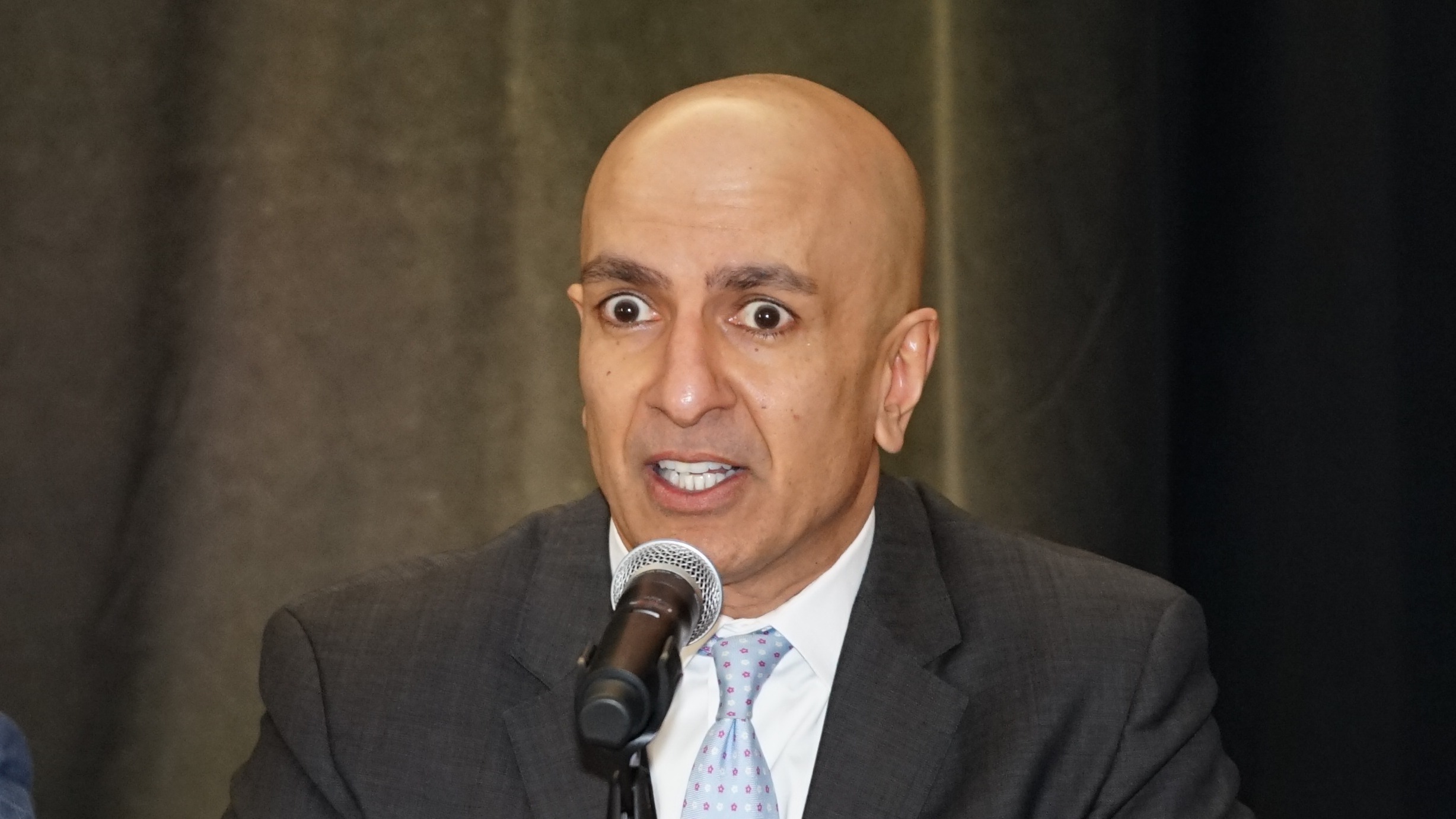
Minneapolis Federal Reserve President Neel Kashkari is putting a sharper edge on a long‑running tension in Washington, arguing that the Trump administration’s recent threats toward the central bank are fundamentally about who controls the path of interest rates. By framing the clash as a fight over monetary policy rather than personalities, he is signaling that the stakes reach far beyond any single confrontation and into the credibility of the Federal Reserve itself.
His comments land at a moment when the economy’s resilience is already complicating the case for cutting rates, making political pressure even more fraught. If the White House is seen as leaning on the Fed just as inflation and growth data are sending mixed signals, the risk is not only a policy mistake but also a hit to the institution’s hard‑won independence.
Why Kashkari sees a monetary power struggle
Neel Kashkari has never been shy about speaking plainly, and his latest remarks cut through the diplomatic language that usually surrounds disputes between the White House and the central bank. By saying the Trump administration’s actions and threats toward the Federal Reserve are “about monetary policy,” he is arguing that the real objective is to influence decisions on interest rates and the broader stance of credit conditions, not to resolve some narrow legal or procedural dispute. In other words, the conflict is about who gets to decide how tight or loose financial conditions should be as the expansion matures.
That interpretation matters because it casts recent moves from President Donald Trump’s team as an attempt to tilt the balance of power away from technocrats and toward elected officials who are more sensitive to short‑term political incentives. Kashkari’s warning, reported after he spoke as Minneapolis Federal Reserve President, suggests he sees a pattern in which the administration’s threats are aimed at nudging the central bank toward easier policy that could support growth and markets ahead of key political milestones, rather than letting the Federal Open Market Committee follow its usual data‑driven process. His characterization of the administration’s “actions against” the Fed as fundamentally about the direction of rates has been linked directly to these recent threats.
The economic backdrop: strong growth, tricky choices
Kashkari’s diagnosis of the political pressure comes against a backdrop that is far from straightforward for policymakers. Speaking during a virtual town hall hosted by the Wisconsin Bankers Association, he noted that the economy’s underlying strength is making it harder to justify rapid or aggressive rate cuts. Inflation has been moving closer to the Federal Reserve’s target, but not in a straight line, and the labor market has remained resilient enough that slashing borrowing costs too quickly could risk reigniting price pressures. In that environment, the central bank’s instinct is to move carefully, not to rush into a new easing cycle.
That caution was evident when Kashkari, addressing bankers and business leaders, took a more measured tone on how soon the Federal Reserve should pivot to easier monetary policy. He acknowledged that markets have been eager for signals of imminent cuts, yet he emphasized that the data do not clearly support a decisive shift. The combination of solid growth and only gradually cooling inflation, he argued, complicates the case for lowering rates in the near term. His remarks at the Wisconsin Bankers Association event underscored that, in his view, the bar for “decisively” lowering rates remains high as long as the economy continues to show this kind of momentum.
Independence under pressure from the White House
When a sitting president publicly leans on the Federal Reserve, the immediate question is whether the central bank will bend or hold its ground. Kashkari’s insistence that the Trump administration’s threats are really about steering monetary policy is a reminder that independence is not an abstract principle but a practical shield against short‑termism. If the White House can credibly threaten consequences for unwelcome rate decisions, investors and households may start to doubt that the Federal Reserve will do what is necessary to keep inflation in check when it becomes politically inconvenient.
That erosion of confidence would have real‑world costs. If markets suspect that rate decisions are being shaped in the Oval Office rather than around the Federal Open Market Committee table, long‑term interest rates could rise as investors demand compensation for higher inflation risk, even if the Fed is trying to hold its policy rate steady. For households shopping for a 2026 Ford F‑150 on credit or locking in a 30‑year mortgage, that would translate into higher borrowing costs regardless of what the official policy rate is. Kashkari’s comments, by framing the administration’s actions as a direct challenge to the Fed’s authority over monetary policy, highlight how quickly political pressure can spill over into higher financing costs for consumers and businesses.
Markets caught between data and politics
Financial markets are already navigating a confusing mix of signals, and Kashkari’s remarks add another layer of complexity. On one side, traders see an economy that has not cracked under higher rates, which argues for patience before cutting. On the other, they hear a White House that appears eager for looser policy and a central banker warning that those political demands are aimed squarely at the Fed’s rate decisions. That tension can feed volatility as investors try to handicap not only the next inflation print but also the next presidential broadside.
For portfolio managers and corporate treasurers, the practical question is whose signal to trust. If they take Kashkari at his word that the Federal Reserve will prioritize its mandate over political threats, they may assume that policy will stay tighter for longer as long as growth and employment hold up. If they suspect that the Trump administration’s pressure campaign will eventually sway the central bank, they might instead bet on earlier cuts, driving rallies in rate‑sensitive sectors like homebuilders and high‑yield credit. The result is a market environment where each new comment from Minneapolis Federal Reserve President Neel Kashkari or President Donald Trump can move yields and stock prices as much as a fresh batch of economic data.
What Kashkari’s stance signals for the path ahead
By explicitly tying the administration’s threats to a struggle over monetary policy, Kashkari is also sending a message to his colleagues and to the public about how he intends to approach upcoming meetings. His emphasis on the economy’s strength and on the complications it creates for rate cuts suggests he will argue for a cautious, data‑driven approach, even if that means disappointing investors or clashing with the White House. For a central banker who has at times been among the more dovish voices on the committee, that shift toward restraint underscores how seriously he takes the risk of cutting too soon.
At the same time, his comments hint at a broader institutional strategy: to confront political pressure not with silence, but with clear explanations of why the Federal Reserve is making the choices it is. By laying out the case that strong growth and only gradually cooling inflation do not justify rapid easing, and by framing the administration’s threats as an attempt to override that judgment, Kashkari is trying to build public support for the Fed’s independence. Whether that effort succeeds will shape not only the trajectory of interest rates over the next year, but also the credibility of the central bank the next time a president decides to test its resolve.
More From TheDailyOverview

Silas Redman writes about the structure of modern banking, financial regulations, and the rules that govern money movement. His work examines how institutions, policies, and compliance frameworks affect individuals and businesses alike. At The Daily Overview, Silas aims to help readers better understand the systems operating behind everyday financial decisions.

