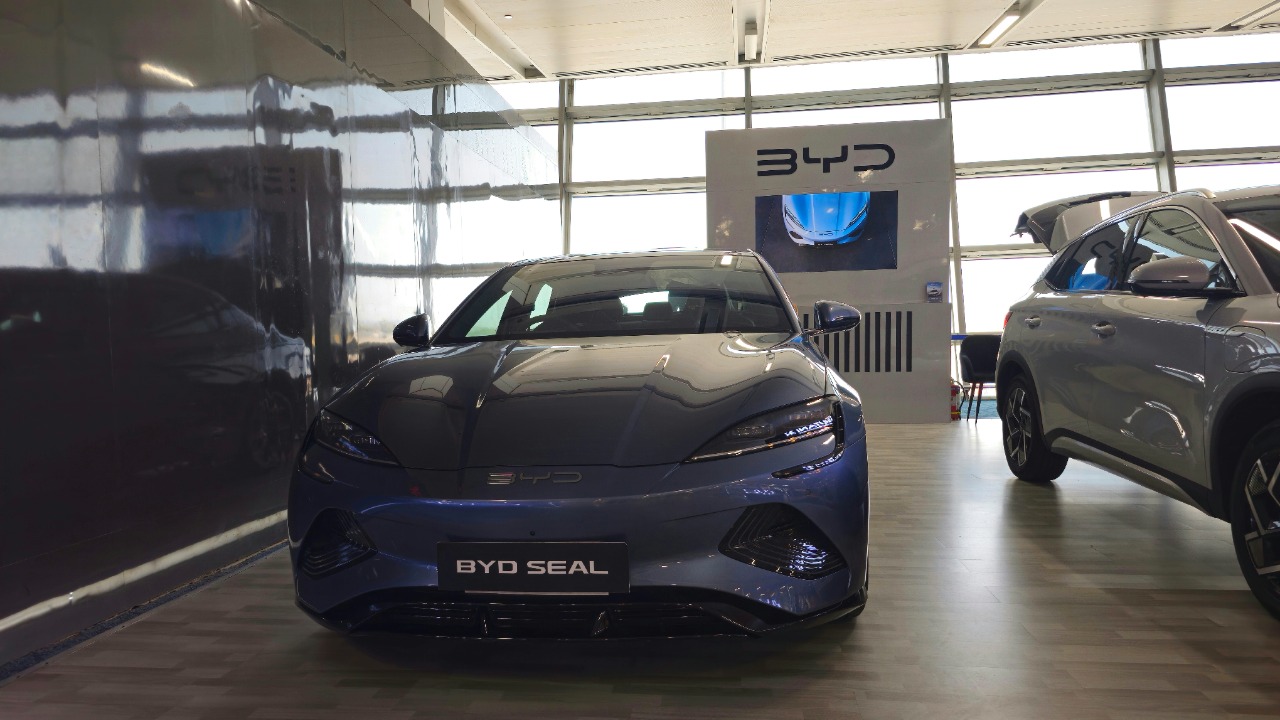
China’s car industry is no longer just catching up to Detroit and Tokyo; it is rewriting the hierarchy that once defined global auto power. As China’s factories push output and exports to new records, BYD has surged past Ford Motor Company in global sales, overturning long‑held assumptions about who leads and who follows. The collision between Ford’s legacy business and BYD’s electric-first strategy shows how quickly the center of gravity in the car world is shifting toward China.
The change is not only about one company leapfrogging another. It reflects a deeper structural shift, where state-backed industrial planning, aggressive investment in batteries and software, and a huge domestic market give Chinese manufacturers an edge that traditional carmakers are still struggling to match. The result is a historic inversion: Ford, once a symbol of industrial modernity, is now being outpaced by a Chinese brand that barely registered in Western showrooms a decade ago.
China’s record-breaking auto surge
Any story about BYD’s rise has to start with the scale of China’s car industry. Official figures compiled by the China Association of Automobile Manufacturers show that China’s total vehicle output and sales in 2024 reached new highs, with both production and domestic demand rising from the previous year. Those same figures highlight how exports and the share of new energy vehicles within overall sales have also climbed, turning China into a powerhouse not just at home but in overseas markets as well. The data confirms that this is not a marginal uptick; it is a sustained expansion of industrial capacity and consumer appetite.
CAAM’s headline numbers, reported through official industry totals, track production, sales, exports, and the portion of the market captured by new energy vehicles. In those statistics, new energy vehicles reached 9.98 million units in 2024, and exports of all vehicles hit 4.6084 million units, both record highs that underline China’s growing reach. That level of detail matters because it shows how quickly electric and hybrid models are moving from niche status into the mainstream of China’s auto market, reshaping demand for batteries, metals, and shipping space.
BYD’s 4.6 million-vehicle breakthrough
Within that broader surge, BYD has become the clearest symbol of China’s new clout. According to one detailed analysis of global sales, BYD Co. has officially surpassed Ford Motor Company in vehicle deliveries for 2025, selling approximately 4.6 million vehicles worldwide. That figure, cited in a report on how BYD overtook Ford, places the Chinese group in a tier that used to be reserved for established American, European, and Japanese giants. It also confirms that BYD’s growth is not confined to electric-only charts; it is competing head-on in total volume.
The same analysis notes that BYD’s 4.6 million tally includes a strong mix of plug-in hybrids and battery-electric models, while Ford has been slower to move its portfolio away from combustion engines. The report highlights that BYD’s deliveries rose by about 9.9 percent year on year, while Ford’s global volume grew far more slowly, widening the gap between them. By tying the sales outcome directly to strategic choices on electrification, the comparison between BYD and Ford becomes a case study in how quickly the industry’s hierarchy can change when consumer demand and industrial policy both favor electric powertrains.
Ford’s stalled EV pivot
Ford’s position in this story is uncomfortable but revealing. For years, the company relied heavily on high-margin trucks and large SUVs, especially in North America, to fund gradual investments in electric models. That strategy delayed the full-scale shift to batteries and left Ford exposed once electric demand accelerated and competitors with more electric-heavy lineups could scale faster. The report that documents BYD’s 4.6 million sales frames Ford’s lagging numbers as a direct result of the costs and complexity of its EV transition, which have eaten into profits without yet delivering comparable volume.
According to the analysis of how BYD overtook Ford, the American group’s slower roll-out of electric platforms has left it vulnerable in markets where policy support and consumer interest are moving quickly toward zero-emission vehicles. The piece links Ford’s relative underperformance to the financial strain of retooling factories and supply chains while still carrying the weight of legacy combustion programs. That reading suggests Ford is trying to straddle two eras at once, and that the cost of that balancing act is now visible in the global sales league table.
How China flipped the car hierarchy
BYD’s edge over Ford is not just a story of one company making better bets. It reflects the way China has structured its auto sector around long-term goals, including support for new energy vehicles and exports. CAAM’s reporting on record 2024 output and sales shows that China is not only the largest car market but also a leading production base, with factories geared to produce both combustion and electric models at scale. As those plants increasingly turn out plug-in hybrids and battery cars, they tilt the global market toward the technologies where Chinese firms are strongest.
Policy support for new energy vehicles, combined with the sheer size of the domestic customer base, has given Chinese brands the volume they need to refine products and cut costs before pushing into foreign markets. The official CAAM figures show that exports of finished vehicles rose sharply in 2024, and that new energy vehicles made up a larger share of those outbound shipments than ever before. In that context, BYD’s 4.6 million global sales and its move past Ford look less like an isolated upset and more like the visible tip of a broader power shift anchored in China’s industrial planning and manufacturing scale.
Why BYD’s model beats Ford’s playbook
One of the most striking differences between BYD and Ford lies in how they build cars and manage costs. BYD has long invested in its own battery technology and key components, reducing its dependence on outside suppliers and giving it more control over pricing and product timing. That kind of vertical integration is not spelled out in the official data, but it aligns with the pattern seen in CAAM’s numbers, where new energy vehicles take an ever larger share of China’s record 2024 output. A company that can secure batteries and power electronics in-house is better placed to ride that wave than one that must buy those parts on the open market.
Ford, by contrast, has had to juggle investments in new battery plants and software platforms with the ongoing demands of its combustion-engine business. The report that details how BYD surpassed Ford links the American company’s struggles to the cost of this transition, portraying it as a drag on profitability that has not yet produced enough volume to offset the pain. That reading suggests BYD’s structure is better matched to a world where electric and plug-in models are gaining share quickly, while Ford’s traditional playbook of large vehicles and incremental change has lost ground in a market reshaped by China’s rapid shift toward new energy vehicles.
Global fallout: pricing, politics, and alliances
The flip in rankings between BYD and Ford has wider consequences for pricing and trade. When a Chinese manufacturer that grew up in a highly competitive domestic market starts selling millions of vehicles globally, it can sustain thinner margins and still make money, especially if it has control over key components like batteries. Combined with China’s record 2024 output and growing exports reported by CAAM, that scale gives Chinese brands room to cut prices or offer more features at the same price point, putting pressure on Western rivals that still rely on higher margins to fund their transitions.
There are political and strategic angles too. As Chinese exports of new energy vehicles expand, governments in Europe and North America face pressure from local manufacturers who fear being undercut by cheaper imports. The official data on China’s 2024 exports shows that this is not a hypothetical concern; the volumes are already significant and rising from a base of several million units. That raises the likelihood of new trade barriers or incentives aimed at supporting domestic EV production, which could in turn shape where companies like BYD choose to build factories and how Ford and its peers structure partnerships or joint ventures to stay competitive.
What analysts may be missing about Ford vs BYD
Much of the commentary around BYD surpassing Ford frames the story as a simple morality play: a nimble electric specialist humiliates a slow-footed legacy giant. That view captures part of the truth, but it risks ignoring the structural advantages and constraints each company faces. CAAM’s record 2024 figures for China’s total output, sales, and new energy vehicle share show that BYD operates in an environment designed to support exactly the kind of products it sells. Ford, by contrast, is still deeply tied to markets and segments where combustion engines dominate and where policy support for EVs is more fragmented.
The report that details how BYD’s 4.6 million sales moved it ahead of Ford links the American group’s problems to the cost of its EV pivot, but it does not fully account for the political and regulatory headwinds Ford must deal with in multiple regions at once. That context matters when comparing the two. BYD’s rise is a sign of its own strengths, but it is also a reflection of China’s broader industrial and policy framework, as captured in the official CAAM data. Ford’s stumble, meanwhile, is not only about corporate missteps; it is also about the challenge of transforming a century-old business in markets that still send mixed signals on how fast they want to abandon combustion engines.

Grant Mercer covers market dynamics, business trends, and the economic forces driving growth across industries. His analysis connects macro movements with real-world implications for investors, entrepreneurs, and professionals. Through his work at The Daily Overview, Grant helps readers understand how markets function and where opportunities may emerge.

