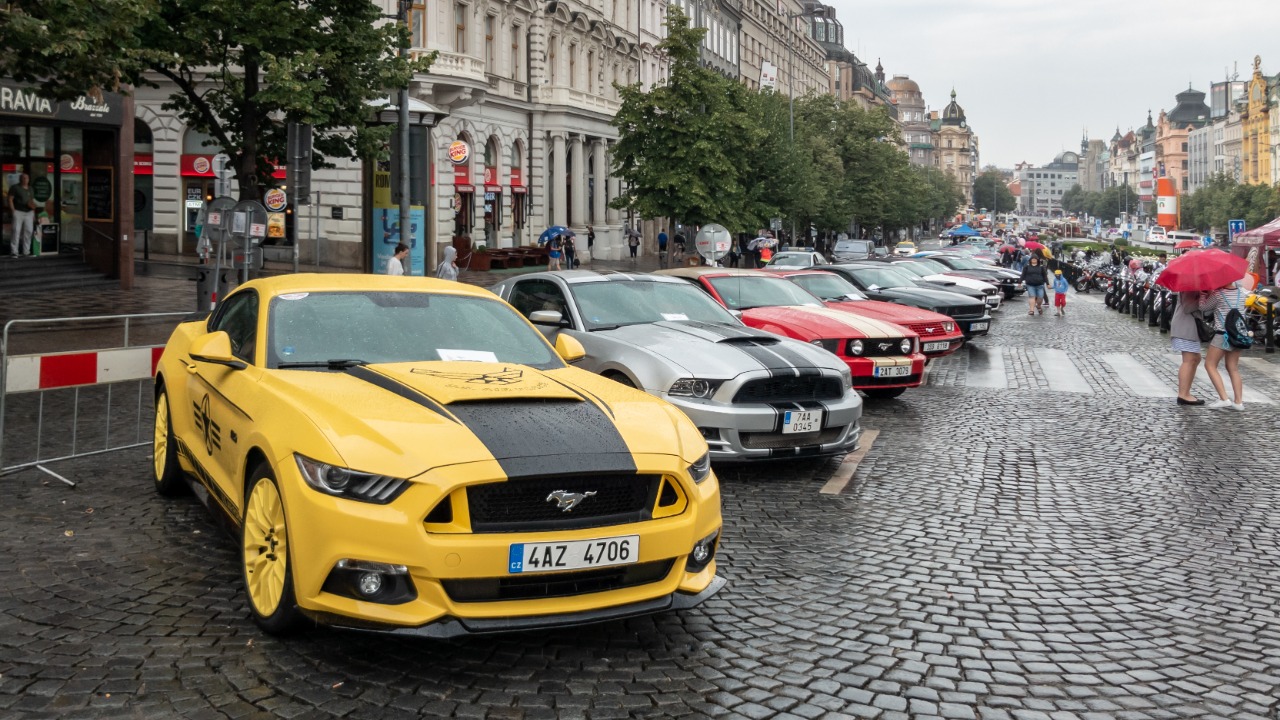
Ford’s latest sales mix shows just how stubborn American car buyers can be. In January, the company sold more than twice as many gasoline Mustangs as it did all of its electric vehicles combined, underscoring how far traditional performance coupes still outrun battery-powered models in the showroom. The result lands at a moment when the company is trying to convince Wall Street and Main Street that its electric strategy can coexist with its profitable legacy business.
The numbers highlight a tension at the heart of Ford’s future: the brand’s most iconic pony car is thriving with a V8 under the hood, while its newer electric offerings are losing momentum. That imbalance is not just a curiosity for enthusiasts, it is a signal about consumer priorities, pricing power, and how quickly the market is really shifting toward plug-in models.
Gas Mustang leaves Ford’s EVs in the dust
The clearest takeaway from Ford’s January performance is that the traditional Gas Mustang is still the star of the show. According to reporting by Chris Chilton, the Gas Mustang outsold the electric Mach by more than three to one, and when all of Ford’s battery-powered models are added together, the company still moved over twice as many gasoline Mustangs as EVs. That means a single nameplate, built around sound, speed, and nostalgia, is beating Ford’s entire electric portfolio at a time when the company has poured billions into battery plants and new platforms. The fact that the Gas Mustang is galloping ahead while the Mach struggles to keep pace shows how uneven demand is inside Ford’s own lineup, even before cross-town rivals are factored in, and it reinforces how much of the company’s cash flow still depends on internal combustion performance cars and trucks rather than cutting edge tech.
For enthusiasts, the sales gap is not hard to understand. The Gas Mustang offers a familiar formula, from its long hood to its available V8, and it sits in showrooms at prices that feel attainable compared with many premium EVs. The Mach, by contrast, is an electric crossover that leans on the Mustang badge but asks buyers to accept a different body style, a higher curb weight, and the realities of charging infrastructure. When I look at the data that shows the Gas Mustang outselling the Mach by more than three to one, as detailed in the analysis by Chris Chilton, it is clear that the emotional pull of a classic coupe still outweighs the appeal of a newer electric crossover wearing the same horse logo.
EV slump drags on Ford’s broader sales
The Mustang story sits inside a tougher month for Ford overall. Earlier this year, Ford Motor Co reported that its January sales slipped 5.3 percent, a setback that executives linked in part to a sharp drop in electric deliveries. Analyst Faizan Farooque noted that the company’s EV volumes did not just soften, they plunged, turning what had been a growth narrative into a drag on the top line. When a legacy automaker is counting on electric models to offset the natural decline of some aging vehicles, a 5.3 percent slide tied to weaker EV demand is a warning sign that the transition is not yet paying off in the way investors had hoped.
That slump is especially striking because it comes while SUVs and trucks are still doing the heavy lifting. The same reporting that highlights the Gas Mustang’s strength also points out that SUVs and pickups continue to dominate Ford’s sales mix, while some older models fade into the background. In that context, the fact that EV deliveries plunged enough to help pull total sales down 5.3 percent suggests that the electric side of the house is not just underperforming, it is actively weighing on the company’s momentum. When Faizan Farooque describes how the market has already priced in a roughly 50 percent drop in expectations for Ford Motor Co’s near term performance, as reflected in his analysis of Ford Motor Co, I read that as a sign that investors are bracing for a longer, bumpier EV ramp than the company once projected.
What the Mustang gap says about EV demand
When a single gasoline sports car outsells an entire electric portfolio, it raises questions about how deep real-world EV demand runs outside early adopters. The fact that Ford Sold Over Twice As Many Gas Mustangs As All in the same month that its EV deliveries plunged suggests that mainstream buyers are still more comfortable with proven technology, especially when it is wrapped in a familiar badge. I see that as a reminder that the early surge in EV interest was driven by a mix of incentives, novelty, and high-income buyers, and that converting the broader market will require a different playbook focused on cost, charging convenience, and long-term ownership value.
The Mach is a useful case study. It was designed to bridge the gap between heritage and innovation, borrowing the Mustang name while delivering a battery-powered crossover aimed at families. Yet the sales data shows that the Gas Mustang is not just holding its own, it is overwhelming the Mach and the rest of Ford’s EVs combined. That imbalance tells me that branding alone cannot overcome concerns about range, charging speed, and resale value, especially when interest rates are high and monthly payments are under pressure. The community analysis that spells out how Ford Sold Over Twice As Many Gas Mustangs As All EVs Last Month, with the Gas Mustang outpacing the Mach so decisively, underscores how much work remains to convince everyday buyers that an electric crossover is a better bet than a traditional coupe, even when they share a nameplate, as detailed in the breakdown on Ford Sold Over.
Ford’s balancing act between profit and transition
For Ford’s leadership, the Mustang gap is both a blessing and a headache. On one hand, the Gas Mustang, along with SUVs and trucks, is helping pay the bills at the Blue Oval, generating the margins needed to fund battery plants, software development, and new electric platforms. On the other hand, every month in which gasoline performance cars and big trucks carry the company while EVs stumble makes it harder to argue that the transition is on track. I see that tension in the way executives talk about “choice” and “flexibility,” leaning on the idea that Ford can serve both traditional and electric customers without picking a side too quickly.
The risk is that the company ends up straddling two worlds longer than its balance sheet can comfortably support. If EV deliveries continue to plunge while legacy models slowly age, Ford could find itself investing heavily in products that are not yet delivering volume, even as regulators and competitors push the market toward stricter emissions rules and more aggressive electrification. The strong performance of the Gas Mustang buys Ford time, but it also masks the urgency of fixing pricing, marketing, and product gaps on the electric side. As I read the latest sales breakdowns, the message is clear: the pony car is still running hard, but unless the Mach and its EV siblings start closing the gap, Ford’s transition will look less like a sprint and more like a long, expensive jog.
More From The Daily Overview
*This article was researched with the help of AI, with human editors creating the final content.

Grant Mercer covers market dynamics, business trends, and the economic forces driving growth across industries. His analysis connects macro movements with real-world implications for investors, entrepreneurs, and professionals. Through his work at The Daily Overview, Grant helps readers understand how markets function and where opportunities may emerge.