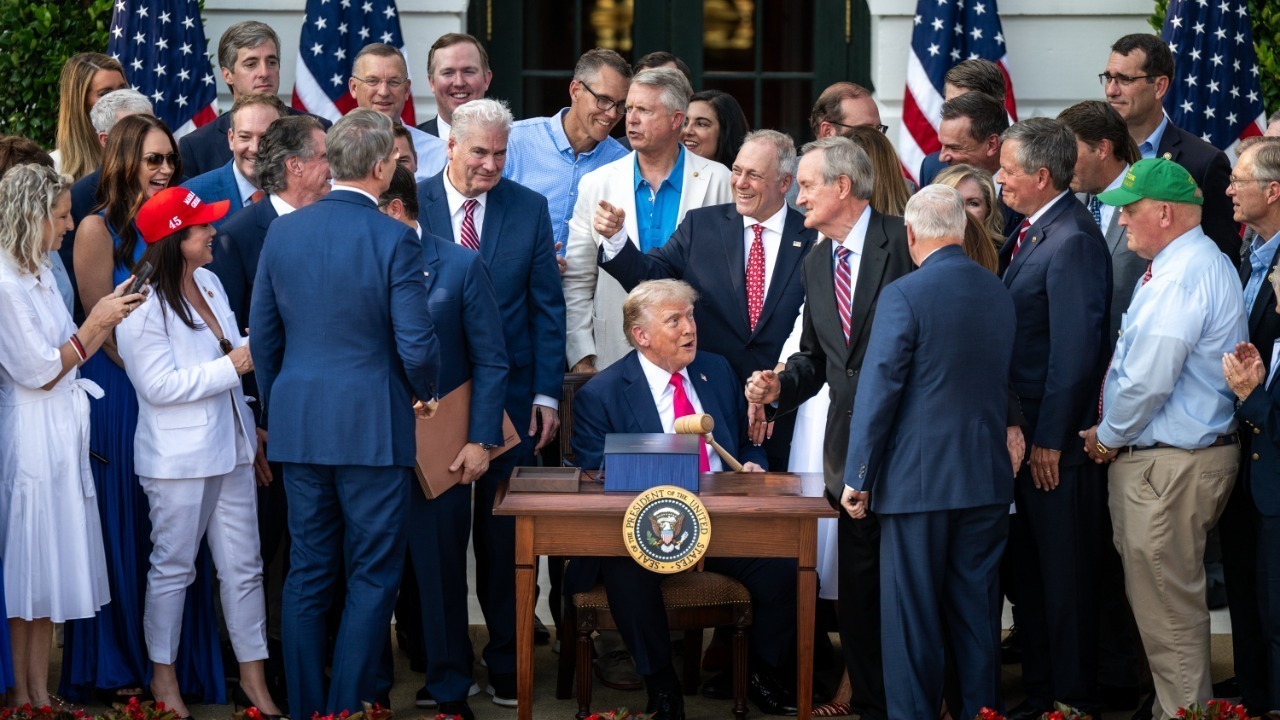
President Trump is selling his new tax law as a windfall for working families, pointing to bigger refund checks and fresh breaks that kick in for the 2026 filing season. The reality is more complicated. Many households will see short term gains, but the structure of the changes quietly shifts more of the long term benefits to the top and leaves others exposed to higher costs elsewhere in the economy.
The One Big Beautiful Bill Act reshapes the tax code just as earlier Trump era cuts were set to expire, and it does so in ways that are easy to market but harder to sustain. I see a pattern in the data: headline friendly perks up front, paired with back loaded trade offs that will hit lower and middle income Americans in their paychecks, their state services, and their cost of living.
How Trump’s “beautiful” bill rewires the tax code
At the heart of President Trump’s tax agenda is the One Big Beautiful Bill Act, which he and his allies frame as a reset of the expiring Tax Cuts and Jobs Act rules. The law locks in a new rate structure, adjusts deductions, and extends several preferences that were otherwise on track to sunset, all under the banner of a simpler, more generous system. According to an Overview of Trump Tax Plan, the president’s approach is explicitly shaped by the One Big Beautiful Bill Act, often shortened to OBBBA, and is pitched as a way to keep overall tax burdens low while rewarding work and investment.
Yet when I look at distributional estimates, the generosity is far from evenly spread. An analysis of the tax provisions in the Trump megabill finds that More than 70 of the net tax cuts will go to the richest fifth of households, a figure that undercuts the populist branding around working families. That same research shows high income taxpayers capturing the largest share of permanent rate relief and preferential treatment of capital income, while many middle income filers see only modest changes once they factor in lost deductions and the interaction with state and local taxes.
Short term sugar high: refunds, brackets and inflation tweaks
The White House is leaning heavily on the promise of bigger checks to sell the law, and there is real money on the table in the near term. Administration talking points highlight that Many Americans could see heftier tax refunds when they file their 2025 returns, crediting President Trump’s Working Families Tax changes with delivering the largest refund season in U.S. history and touting billions in total tax savings in 2026. Independent tax analysts agree that refunds will likely jump in the first year as withholding tables lag behind the new rules and as households claim fresh credits and expanded write offs.
One explanation lies in how the law interacts with existing mechanics of the code. A review of Refunds under the One Big Beautiful Bill Act notes that refund sizes can swell when withholding overshoots actual liability, especially in the first year of a major change, and that some filers will benefit from an expanded SALT cap and other targeted tweaks. At the same time, the IRS has released tax inflation adjustments for tax year 2026 that raise bracket thresholds and standard deduction amounts, which will further reduce taxable income for many households in the short run.
The quiet catch: who pays more and who loses services
Once the initial refund glow fades, the distributional tilt of the law becomes harder to ignore. Detailed modeling of how the Trump megabill will change Americans’ taxes in 2026 shows that in In 44 states, the poorest fifth of taxpayers will either see tax increases or negligible cuts, while the richest residents enjoy substantial reductions. That same analysis warns that federal spending cuts tied to the package will squeeze state budgets, with particular concern for rural communities that could see hospital closings and reduced public services as funding is pulled back.
Advocacy groups tracking the broader economic fallout argue that the tax law cannot be separated from the rest of President Trump’s agenda. A detailed rundown of harms in TRUMP’S TERRIBLE 2025 describes how Trump and Republicans in Congress paired tax cuts tilted to the wealthy with efforts to scale back health care, nutrition assistance, and other supports that low income families rely on. In that context, a modest tax cut on paper can be more than offset by higher out of pocket costs for medical care or child benefits that no longer keep pace with need, leaving many Americans worse off even if their nominal tax bill dips slightly.
Tariffs, trade wars and the hidden tax on consumption
Taxes do not only show up on IRS forms, and Trump’s economic program illustrates that clearly. Alongside the One Big Beautiful Bill Act, President Trump has leaned on the International Emergency Economic Powers Act to impose new levies on imports, a strategy that has pushed average tariff rates to their highest levels in decades. A set of Key Findings on Trump tariffs notes that President Trump used International Emergency Economic Powers Act (IEEPA) authority to raise duties on a wide range of trading partners, resulting in the highest average rate since 1946 and effectively layering a consumption tax on many everyday goods.
Those trade moves carry measurable macroeconomic costs that rarely show up in refund season talking points. According to Studies of the 2025 tariff regime, the imposed duties are projected to reduce the U.S. growth rate by 0.23 percent in 2025 and by 0.62 percent over the long term, as higher import costs ripple through supply chains and dampen investment. For households, that slowdown shows up as weaker wage growth and higher prices on items from washing machines to smartphones, effectively clawing back part of the statutory tax relief through a stealthier, less transparent channel.
Bracket creep, expiring perks and the long game for households
Even within the formal tax code, the structure of the changes matters as much as the headline rates. The IRS has detailed Notable changes under the One, Big, Beautiful Bill, including new tax items for tax year 2026 that apply to married couples filing jointly and other statuses, and those adjustments interact with inflation indexing in ways that will shape who moves into higher brackets over time. A separate look at what is Income tax brackets in 2026 notes that the IRS increased bracket thresholds for inflation, which raises the income levels at which higher rates apply for single filers and married couples filing jointly (MFJ), offering some protection against bracket creep but not enough to fully shield fast growing earners in high cost regions.
On top of that, the calendar of when specific provisions phase in or out can trip up families trying to plan. Guidance on tax law changes explains that many of the original Tax Cuts and Jobs Act rules were set to expire, and that the new framework under the One Big Beautiful Bill Tax Law Changes for 2026 and beyond reshuffles which breaks are extended and which are allowed to lapse. A focused summary of One Big Beautiful notes that As the TCJA provisions were set to expire, most of the changes in the new law take effect in 2026 and then phase down thereafter for 2026 through 2029, which means some of the most visible benefits are temporary while several revenue raising measures are locked in for longer. For many Americans, that is the nasty catch: a shiny bump in refunds today, paired with a tax and economic structure that quietly shifts more risk and cost onto them over the rest of the decade.
More From The Daily Overview
*This article was researched with the help of AI, with human editors creating the final content.

Julian Harrow specializes in taxation, IRS rules, and compliance strategy. His work helps readers navigate complex tax codes, deadlines, and reporting requirements while identifying opportunities for efficiency and risk reduction. At The Daily Overview, Julian breaks down tax-related topics with precision and clarity, making a traditionally dense subject easier to understand.


