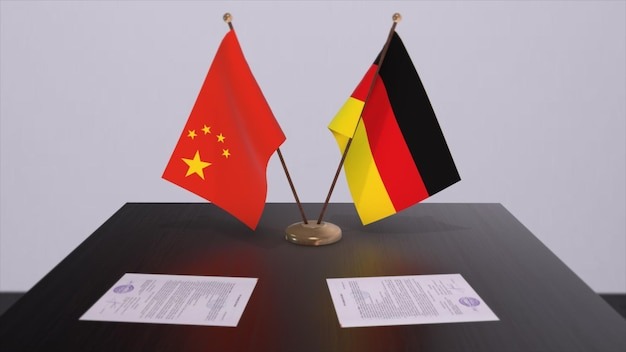
German companies poured money into Chinese factories, research centers and joint ventures in 2025, even as political rhetoric in Washington and Berlin warned of overreliance on Beijing. Investment flows reached their highest level in four years, turning the threat of a new trade war into a catalyst for deeper corporate entanglement with the world’s second‑largest economy. For boardrooms in Frankfurt, Munich and Stuttgart, the fear of being caught in the crossfire of escalating tariffs outweighed calls to decouple. The surge reflects a hard‑headed calculation: if the United States and its partners tighten access to their markets, German firms want a stronger foothold inside China’s vast consumer base and industrial ecosystem. Rather than retreating, they are doubling down, betting that proximity to Chinese demand and supply chains will offer a hedge against President Donald Trump’s aggressive trade policies and the uncertainty they inject into global commerce.
Trade war anxiety meets four-year investment high
At the core of the story is a simple fact: investment by German companies in China climbed to its highest level in four years in 2025, even as talk of tariffs and sanctions intensified. Data compiled by the IW German Economic Institute show that commitments in the country rose to more than seven billion euros, a sum that one report translated as about $10.5 billion, underscoring how far corporate decisions have diverged from political messaging. The same research highlighted that this was not a one‑off spike but the culmination of several years in which companies quietly prepared for a more fragmented trading system. Analysts tie this acceleration directly to fears that a renewed trade conflict led by Washington could disrupt access to key markets or critical inputs. A detailed breakdown of Investment Growth Statistics shows that the 2025 total outpaced any year recorded between 2010 and 2024, even as public debate in Berlin focused on risk reduction. For many firms, the logic is defensive: if tariffs or export controls limit what can be shipped from Europe, producing inside China becomes a form of insurance.
China’s pull: market size, trade flows and sector bets
The attraction of China is not abstract. Trade data from the General Administration of China indicate that foreign trade between China and Germany reached $253 billion in 2025, the highest level in four years, even as global trade growth slowed. That figure captures both the continued appetite of Chinese consumers for German cars, machinery and chemicals, and the reliance of German manufacturers on Chinese components and intermediate goods. When executives look at those numbers, they see a relationship that is still expanding, not shrinking. Sector‑specific data reinforce that picture. One detailed analysis of German companies found that their investments in China rose by 55.5% compared with the previous year, with automotive, chemicals and high‑end manufacturing leading the way. Carmakers are expanding electric vehicle production lines, chemical groups are building new specialty plants, and industrial equipment makers are adding engineering hubs close to their Chinese customers. For these firms, the country is not just a low‑cost workshop but a central market for premium products and a laboratory for new technologies.
Trump’s trade brinkmanship as a catalyst
What turned a long‑running commercial partnership into a 2025 investment surge was the renewed threat of a trade war driven by Washington. A detailed economy‑focused assessment of German Investments argued that President Donald Trump’s aggressive trade policies, including new tariff threats on European goods and talk of broader sanctions, pushed German multinationals to accelerate projects they had previously paced more cautiously. Rather than wait to see whether new duties would hit exports from Europe, companies chose to localize more production inside China, where they could serve Asian customers without crossing contested borders. Several reports describe how this calculus played out in boardrooms. One account of German investment decisions noted that firms increasingly saw China as an alternative market if access to the United States deteriorated. Executives reasoned that a stronger presence in Chinese provinces could offset potential losses from higher tariffs on exports to North America. In effect, Trump’s brinkmanship, intended to squeeze Beijing and its partners, has nudged at least part of German industry to deepen its exposure to the Chinese economy instead.
Corporate strategy: hedging, not decoupling
From the perspective of German managers, the 2025 surge is less a vote of confidence in Chinese policy than a pragmatic hedge against geopolitical risk. A live briefing on Germany’s economy quoted Uliana Sydorzhewski describing how German companies increased their investments in China in 2025, reaching the highest level in four years, even as domestic debates focused on supply chain vulnerabilities. The same coverage stressed that many of these decisions were taken independently of one another, suggesting a broad consensus across sectors that the risks of staying out of China now outweigh the dangers of staying in. Other detailed breakdowns of Investment Growth Statistics from BERLIN and FRANKFURT, compiled by Reuters, underline that the boom in 2025 was driven by geopolitical shifts rather than purely by cyclical demand. Companies are building redundancy into their global footprints, adding capacity in China while also exploring sites in Southeast Asia, Eastern Europe and North America. The goal is not to abandon Western markets but to ensure that no single tariff decision or export control can choke off access to customers or critical inputs overnight.
Political backlash and the limits of de-risking
The investment wave has not gone unnoticed in Berlin, where officials have spent the past two years talking about “de‑risking” from China. Yet the numbers suggest that, for now, corporate behavior is moving in the opposite direction. A detailed report on German firms noted that their investments in China boomed in 2025 on U.S. trade war worries, even as policymakers warned against excessive dependence on a single partner. The same analysis highlighted that many companies explicitly framed China as an alternative if access to the United States became more constrained, a logic that runs counter to official calls to diversify away from Beijing. That tension is sharpened by the broader geopolitical context. As the United States and its allies debate new restrictions on advanced technology exports, German industrial champions are racing to secure their place in Chinese supply chains before the window narrows. A closer look at German Investment patterns shows that many of the 2025 projects were in high‑value sectors such as electric vehicles, automation and green technologies, areas that are likely to be at the center of future trade disputes. For now, however, the corporate instinct is clear: when political risk rises, the response is not to pull back from China but to embed more deeply inside its economy. More From TheDailyOverview
*This article was researched with the help of AI, with human editors creating the final content.
Corrected on 2/4/26 at 11:35 a.m. CST: Corrects the China-Germany bilateral trade volume from $19.89 billion to $253 billion to reflect typical annual levels.

Grant Mercer covers market dynamics, business trends, and the economic forces driving growth across industries. His analysis connects macro movements with real-world implications for investors, entrepreneurs, and professionals. Through his work at The Daily Overview, Grant helps readers understand how markets function and where opportunities may emerge.

