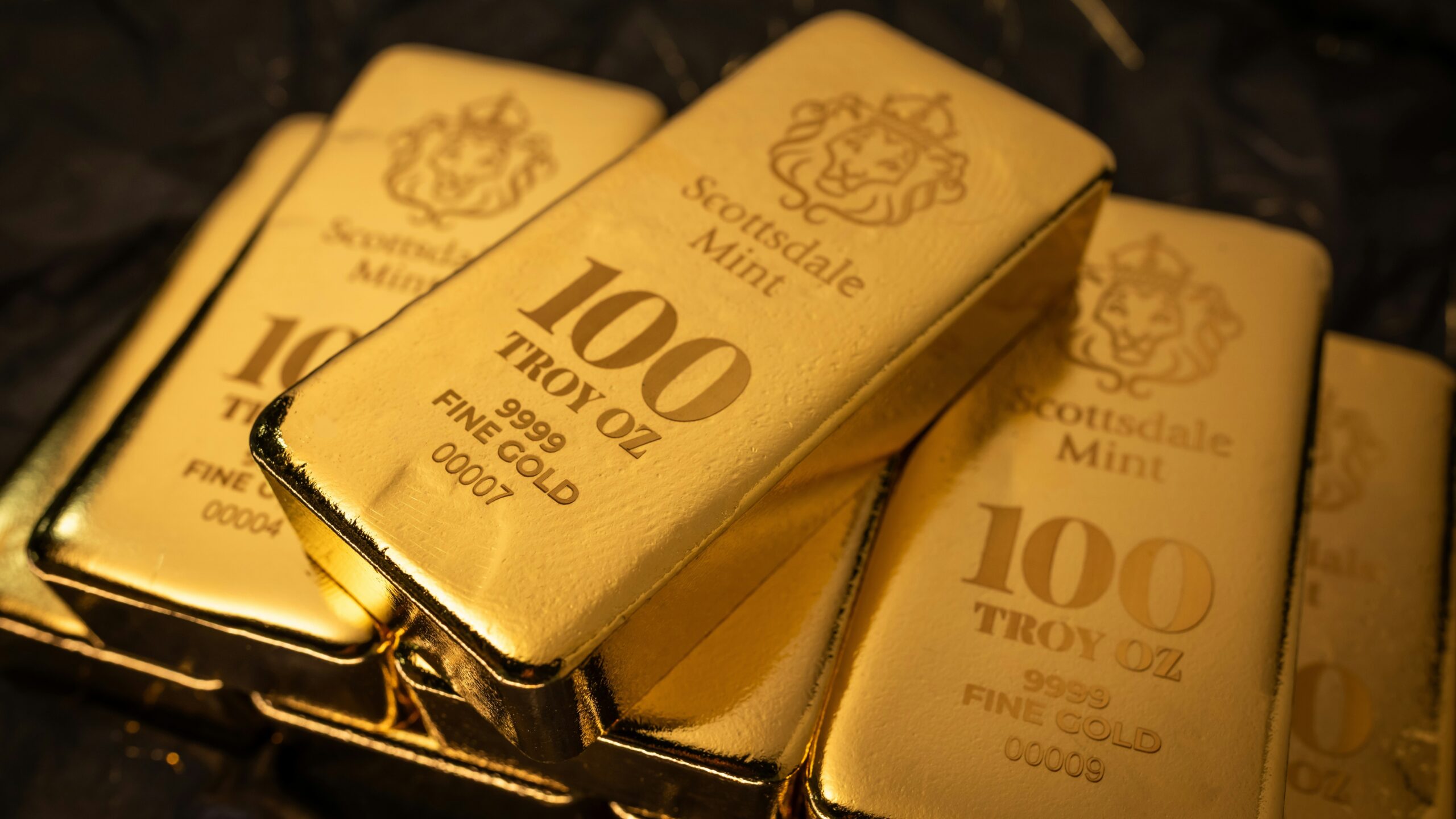
Gold’s violent pullback has rattled latecomers to the trade, but for long term investors it may be the last deep breath before a speculative sprint toward $10,000. With forecasts for four and even five digit prices colliding with algorithm driven calls for a parabolic spike, the real question is not whether to own gold, but how to position across miners and ETFs before the next leg higher.
I see the current reset as a chance to build a focused basket of six names, blending one core miner, three complementary producers, and two exchange traded funds that track bullion. The goal is not to guess the exact top, but to use this sell off to assemble exposure that can survive volatility if the $10,000 narrative proves too aggressive, yet still participate if it comes anywhere close.
Why a brutal sell off can still point to $10,000
The recent slide in bullion has unfolded against a backdrop of extraordinary price action, with Gold trading near $5,139.6 per ounce on Jan. 30 before momentum stalled. Even after that setback, AI driven models and human forecasters are still entertaining scenarios in which Gold could reach $10,000 an ounce in a compressed window, framing the pullback as a pause in a powerful trend rather than the end of the story. One widely cited machine learning forecast even projects that Gold could hit $10,000 by April, a path that would require extreme volatility but helps explain why dip buyers are so quick to reappear.
Traditional analysts are not quite as aggressive, yet they are moving in the same direction. Market veteran Ed Yardeni has argued that Gold Will Reach $5,000 Next Year and could climb to $10,000 by 2030, a view that treats the metal as a long duration hedge against policy risk rather than a short term trade. Large institutions are also ratcheting up their expectations, with UBS lifting its XAU/USD target to $6200 per ounce for several key 2026 quarters, up from a previous $5000 forecast, while still acknowledging that prices can overshoot on the upside in a speculative phase. When I put those calls alongside AI projections that Gold could hit $10,000 and the observation that industrial metals like Silver, platinum and copper have not collapsed in tandem, suggesting more of a currency reset than a classic recession, the case for treating this sell off as a buying window looks stronger than the fear in the tape.
How Wall Street and AI are framing the new gold cycle
On the human side of the ledger, the most striking shift is how mainstream strategists now talk about four digit bullion as a base case rather than a tail risk. Ed Yardeni, one of the best known voices on Wall Street, has tied his $5,000 and $10,000 milestones to a decade long backdrop of fiscal strain, geopolitical tension and persistent demand from central banks that want to diversify away from fiat currencies. At the same time, banks like UBS are building those assumptions into formal price decks, with their raised XAU/USD targets signaling that institutional models are catching up to what the futures market has already been hinting at. That kind of alignment between marquee strategists and big balance sheet dealers is rare, and it tends to underpin multi year cycles rather than fleeting spikes.
On the algorithmic side, AI systems trained on macro data and market history are spitting out even more aggressive paths, including scenarios in which Gold could break over $10,000 per ounce by April as the rally accelerates. Those projections are not guarantees, but they do capture how quickly sentiment can flip from complacency to panic buying when a perceived safe haven starts to run. I also pay attention to how related assets behave, and the relative stability in Silver, platinum and copper prices as Gold surged earlier this year suggests the move is less about collapsing industrial demand and more about investors repricing currencies and financial assets. That backdrop favors vehicles that give direct exposure to bullion and high quality miners rather than leveraged or highly speculative plays that could be wiped out if the AI scenarios prove too optimistic.
Six stocks and ETFs to grab on weakness
The most straightforward way to express a bullish view is through a mix of physical backed funds and miners, and I see six core vehicles as a sensible starting point. On the ETF side, I would anchor a position with a large, liquid bullion fund such as SPDR Gold Shares, which is the GLD product many investors already know from their brokerage screens. Recent commentary on GLD has stressed that, despite the volatility, most analysts do not see Gold About to Crash and some major banks even see prices climbing past $6,000 this year, which makes a low cost, physically backed structure an efficient core holding. For investors who prefer a smaller share price and slightly lower fee drag, I would pair GLD with a mini ETF like SPDR Gold MiniShares, known by the GLDM ticker, or the iShares Gold Trust, IAU, both of which have been compared directly on total cost and tracking efficiency.
On the equity side, I would start with Agnico Eagle Mines, which trades under the AEM ticker and has emerged as one of the most popular gold miners among institutional allocators. Agnico Eagle appears in Citywire’s Global Elite Companies index and is frequently cited for its high volume, high grade mines and some of the lowest all in sustaining costs in the sector, attributes that matter enormously if bullion prices remain volatile. To round out the six pack, I would add three more producers with complementary profiles: one senior diversified miner with multiple jurisdictions, one mid tier growth name with a strong project pipeline, and one royalty or streaming company that collects cash flow from other operators. The logic is simple. If the sell off in Gold and Silver truly is the last stop before $10,000, as some analysts argue, then a basket that blends GLD, GLDM or IAU with AEM and three carefully chosen peers should capture both the torque of rising bullion and the operational leverage of well run miners.
How to size positions and manage the downside risk
Even if I accept the bullish case, I do not treat $10,000 as a certainty, and that shapes how I would size these positions. For most diversified portfolios, I see a total Gold allocation in the mid single digits as a reasonable starting point, with perhaps half of that in bullion ETFs like GLD, GLDM or IAU and the rest spread across AEM and three other miners. Within that slice, I would tilt more heavily toward the ETFs for investors who want a purer hedge and use the miners as a satellite for those comfortable with equity style volatility. It is also worth remembering that holding physical Gold and Silver directly, whether through coins, bars or allocated accounts, remains an option for those who want to avoid paper contracts altogether, although that comes with storage and liquidity trade offs.
Risk management starts with acknowledging that even respected institutions can be wrong. UBS may now see XAU/USD at $6200 in its base case and AI models may talk confidently about $10,000, but those are still forecasts, not guarantees. I would therefore avoid leverage, keep individual miner positions small enough that a single operational setback cannot derail the portfolio, and use broad market tools like Google Finance to monitor price swings and news flow in real time. I also pay attention to cross currents in other metals. After strong gains through 2025, two rare metals hit record highs in January 2026, and their ability to hold those levels while Gold corrects will tell me whether the broader commodity cycle is intact or starting to fray. If the latter happens, I would be quicker to trim miners while maintaining a core in bullion ETFs that can still serve as a hedge against financial system stress.
More From TheDailyOverview
This article was researched with the help of AI, with editors refining and creating the final content.

Grant Mercer covers market dynamics, business trends, and the economic forces driving growth across industries. His analysis connects macro movements with real-world implications for investors, entrepreneurs, and professionals. Through his work at The Daily Overview, Grant helps readers understand how markets function and where opportunities may emerge.