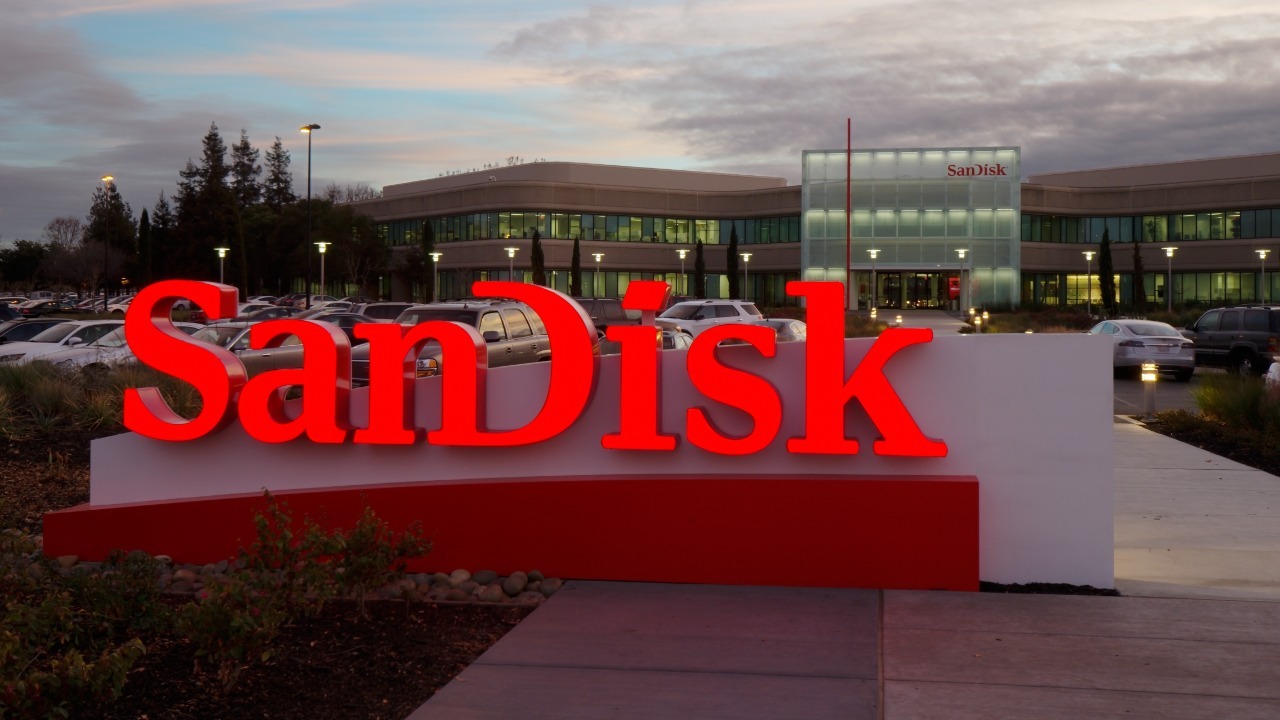
SanDisk has become the rare legacy chip name that suddenly looks like a hyper‑growth story, and Wall Street is scrambling to catch up. After a blistering run in its solid-state drive franchise, Goldman Sachs has pushed its price target to $320, framing the company as a prime beneficiary of a structural shift toward SSD-heavy computing and AI infrastructure. I see that call as less about a single stock and more about a market that is being rebuilt around flash storage economics.
The rally is not happening in a vacuum. SanDisk, trading under the SNDK ticker, entered 2026 with powerful momentum in both its share price and its fundamentals, helped by a surge in demand for high-performance SSDs across data centers, personal computers, and handsets. The question for investors now is whether this is a late-stage melt-up or the early innings of a longer “memory supercycle” that could keep rewarding patient holders.
Goldman’s $320 call and the SSD demand shock
Goldman Sachs has zeroed in on one simple thesis: SanDisk’s SSD business is riding a demand wave that is still building. The firm’s new $320 target on Sandisk Corporation, which trades on the NASDAQ under SNDK, rests on the view that the company is one of the best young stocks to buy and hold for three years as SSDs displace hard drives in data centers, personal computers, and handsets. By highlighting how Goldman Sachs sees SanDisk’s flash portfolio as central to that transition, the call effectively frames SSDs as the new baseline for modern computing rather than a premium add‑on.
What makes the $320 figure notable is that it lands on top of an already spectacular run. SanDisk shares have rocketed higher, with one report noting that 718% gains over the past six months have not stopped the stock from “rocketing again.” When a stock has already multiplied like that, fresh upside calls usually get dismissed as late to the party. Instead, the Goldman move has been echoed by other bullish revisions, suggesting that analysts see SSD demand as something closer to a structural reset than a cyclical spike.
A legacy flash pioneer reborn for the AI era
SanDisk’s sudden star turn is easier to understand if I rewind to its roots. Sandisk Corporation is an American multinational computer technology company based in Milpitas, California, that helped pioneer early flash memory and built its brand around removable storage cards and embedded NAND. That history, detailed in profiles of Sandisk Corporation, gave the company deep process know‑how but also left it pigeonholed for years as a “legacy” storage name rather than a cutting-edge AI supplier.
The pivot came as management embraced what one analysis describes as a strategic spinoff aligned with an AI memory supercycle, positioning SanDisk as a direct play on the explosion of data created by generative models and cloud workloads. In that telling, the company’s “Introduction” to this new chapter, framed under the phrase “In the” context of a rapidly shifting semiconductor landscape, has turned SanDisk into a favorite among institutional investors in 2026 who are looking for leveraged exposure to AI infrastructure. That narrative of a flash “resurrection” is captured in coverage of the AI memory supercycle, and it helps explain why the stock is now treated less like a mature hardware vendor and more like a high‑beta AI proxy.
From “From Legacy Tech Firm” to Wall Street favorite
SanDisk’s transformation has been years in the making. One detailed look at SNDK’s evolution traces the story “From Legacy Tech Firm” to one of Wall Street’s most dynamic plays, noting that Sandisk was founded in 1988 as SunDisk and quickly established itself in flash memory technology. That history of execution, combined with a willingness to lean into tight NAND supply amid surging demand, has turned Sandisk into a stock that traders now treat as a barometer for the entire storage complex.
The market’s response has been emphatic. One recent session saw SandiskSNDK trade at $384.50, a move described as a $384.50 print with a 0.17% gain as the stock rode a wave of price target hikes toward a new record. That kind of action, on top of the 718% surge over six months, is why I see SanDisk less as a quiet compounder and more as a momentum engine that is now central to growth‑oriented portfolios.
“Kicks Off 2026 Strong” and the anatomy of a supercycle
The fundamental backdrop has largely kept pace with the share price. SanDisk (SNDK) entered 2026 with considerable momentum, with one analysis noting that the company “Kicks Off” the year “Strong” and asking “Can SNDK” and its “Stock Rally Hold” as it benefits from secular tailwinds in SSD adoption. That framing of SNDK as a top beneficiary of these dynamics underscores how deeply SSDs are now embedded in everything from gaming rigs to hyperscale data centers.
SanDisk’s recent financial performance backs up that optimism. A detailed “The Renaissance of Storage” analysis describes a “Deep Dive” into SanDisk (SNDK)’s “Historic” 2025 “Performance and” 2026 outlook, highlighting how the company has navigated a volatile semiconductor landscape while still delivering standout results. As of early January, the stock was cited with a figure of 202, a shorthand that reflects how far the valuation has climbed as investors price in a multi‑year upcycle in flash.
Segments, guidance, and the risk of overheating
Under the hood, SanDisk has reorganized itself to better capture that demand. The company has realigned operations into three core market-facing segments, with “Primary Business Segments” and “Products” now grouped around Datacenter, client, and consumer lines. In that structure, the Datacenter unit, which is explicitly cited at 28%, has become the growth engine as hyperscale customers deploy more SSDs to feed AI inference and high‑throughput workloads, a shift detailed in coverage of Datacenter trends.
Guidance has reinforced the bullish narrative. A breakdown of SanDisk’s “September Quarter Blowout and Roaring Guidance” notes that “Guidance for the” second quarter was even stronger, with Sandisk projecting EPS growth that reflects both pricing power and volume gains. That same report highlights how EPS expectations have climbed by 130%, a staggering revision that helps explain why short sellers have been squeezed and why long‑only funds have been forced to chase the stock higher.
More From TheDailyOverview

Grant Mercer covers market dynamics, business trends, and the economic forces driving growth across industries. His analysis connects macro movements with real-world implications for investors, entrepreneurs, and professionals. Through his work at The Daily Overview, Grant helps readers understand how markets function and where opportunities may emerge.

