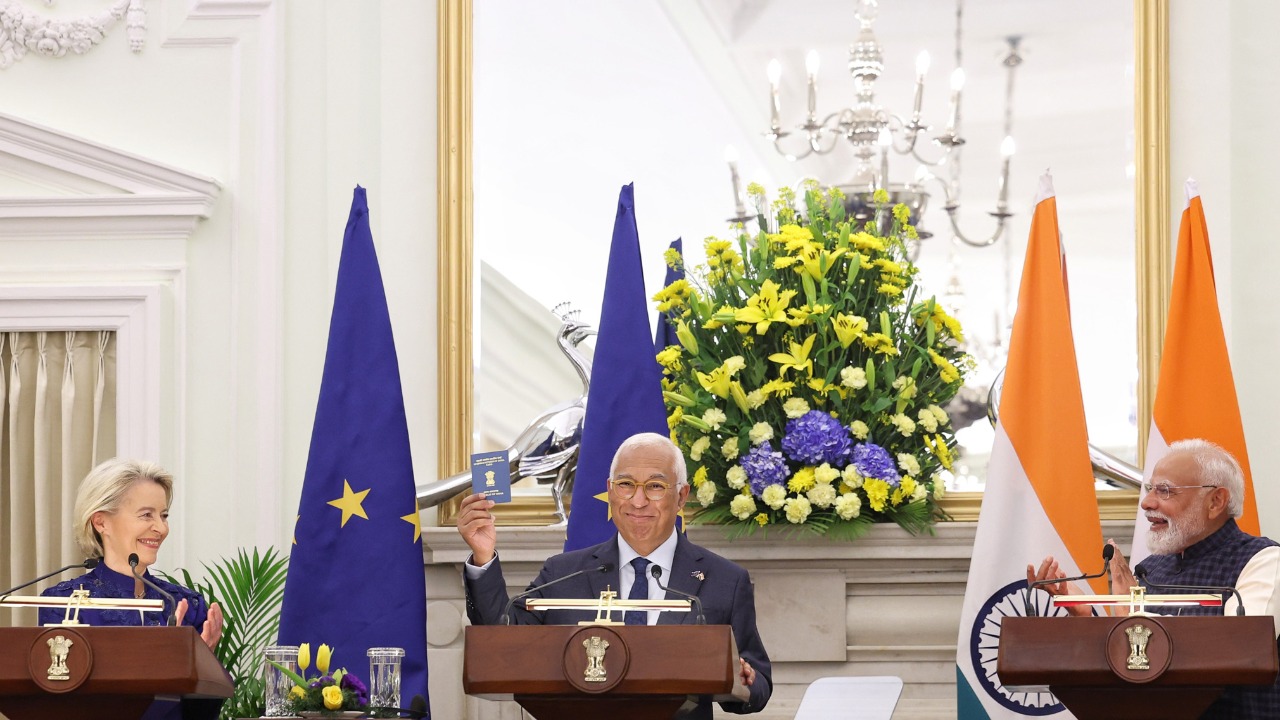
India and the European Union have finally closed a free trade agreement that negotiators chased for two decades, creating what leaders are calling the “mother of all” deals. The pact links one of the world’s fastest growing large economies with its biggest trading bloc, knitting together markets that account for a vast share of global output and commerce. After years of stalled talks and shifting geopolitics, the accord signals a deliberate attempt by both sides to reshape supply chains, investment flows and strategic alignments.
The agreement is being sold in New Delhi and Brussels as more than a tariff-cutting exercise, framed instead as a long term economic and political partnership. With leaders highlighting its scale in terms of GDP, trade and population, the deal is already being positioned as a counterweight to turbulence in ties with the United States and to wider uncertainty in the global trading system.
How a 20‑year courtship finally produced a deal
The free trade talks between India and the European Union have been on and off for roughly twenty years, a reflection of how hard it has been to reconcile the priorities of a rapidly developing giant and a highly regulated single market. Earlier efforts collapsed over disagreements on tariffs for cars and wines, data rules and the movement of professionals, even as India deepened ties with other partners in Asia and beyond. The breakthrough came at an India‑EU summit in New Delhi, where negotiators finally aligned on a package that leaders judged big enough to justify the political risk of opening sensitive sectors.
European Commission President Ursula von der Leyen hailed the outcome at the India‑EU Summit Highlights as the “mother of all” trade deals, underscoring how India and Europe had pushed through to conclusion despite earlier stalemates and domestic scepticism on both sides, according to summit highlights. In a separate framing of the same gathering, leaders stressed that India and the EU had clinched what they called the Mother Of All Deals and unveiled a “strategic shield” against global turbulence, a phrase that captured the sense that this was as much about resilience and security as about commerce, as reflected in the summit live coverage.
The scale of a $27 trillion marketplace
What sets this accord apart is its sheer economic footprint. By linking India and the European Union in a comprehensive Free Trade Agreement, the deal is expected to cover around a quarter of global GDP and create a free trade zone that touches roughly one third of world trade, according to assessments of how much of global output and commerce the two partners represent, as described in GDP estimates. That scale is why officials on both sides have been comfortable using superlatives, arguing that the agreement will be a reference point for future mega‑regional pacts.
Analysts have highlighted that the combined market created by the accord could be worth about 27 trillion dollars, a figure that reflects the size of the economies involved and the depth of integration envisaged, according to a major assessment of the agreement. The same analysis stresses that this major agreement was reached after 20 years of negotiations and against the backdrop of ongoing tensions with the US, which helps explain why both sides were willing to make concessions that had eluded them in earlier rounds.
What is actually in the Free Trade Agreement
Beyond the rhetoric, the text of the Free Trade Agreement sets out a dense web of tariff cuts, regulatory commitments and cooperation mechanisms. The EU and India have described it as a historic and ambitious pact that goes well beyond goods, with chapters on services, investment, digital trade and sustainable development, as laid out in the agreement overview. The same document notes that the agreement has a dedicated section on long term sustainable industrial transformation, signalling that climate and green technology are baked into the economic relationship rather than treated as add‑ons.
Officials in Brussels have underlined that the EU and India concluded this landmark Free Trade Agreement in New Delhi, with a formal press communication detailing how the accord will be implemented and monitored, including references to dispute settlement and joint committees, according to the European Commission press material. On the Indian side, Prime Minister Narendra Modi has called the mega FTA New Delhi’s biggest trade deal ever and stressed that India and the Europe bloc together account for about one third of global trade, a framing that appeared in top news coverage of his remarks.
Tariffs, sectors and who stands to gain
The most immediate impact of the deal will be felt in tariffs, where India and the European Union have agreed to reduce or eliminate duties on a wide range of products. Trade analysts point to significant openings for Indian exports of textiles, leather goods, agricultural products and gems and jewelry, alongside improved access for European cars, wines and industrial machinery, as outlined in a breakdown of tariffs and exports. The same analysis notes that India and the European Union have finalized a trade deal that is expected to reshape export patterns for both sides, with Indian manufacturers gaining a clearer path into high value European markets.
European officials have emphasised that the accord will also open India more fully to investment from the bloc, with the EU, despite long clashing with Indian officials on trade policy, now focused on paring back its economic reliance on the US and China by deepening ties with partners like India, according to an assessment of how The EU is recalibrating its strategy. That same reporting highlights that Indian negotiators secured concessions on services and mobility that they see as crucial for the country’s skilled workforce, with both sides set to benefit from more predictable rules and lower barriers.
Strategic stakes from New Delhi to Brussels
For New Delhi, the agreement is being framed as a historic FTA that will boost investment between India and the European Union and bring together Indian services and skills with European capital and technology. Modi has publicly lauded the deal as a historic step that will expand opportunities for Indians to work and invest in the EU region, according to coverage that described the pact as a Historic FTA. The same reporting notes that Indian ministers see the pact as a way to anchor the country more firmly in global value chains at a time when multinational companies are looking to diversify manufacturing and sourcing.
European leaders, for their part, have been explicit that the deal is part of a broader effort to reduce vulnerability to US policy swings and to assert greater strategic autonomy. One account of the negotiations described how the EU, despite long clashing with Indian officials on trade, is now determined to pare back its economic reliance on the US and to use this agreement as a signal that it can build deep partnerships elsewhere, a point underscored in analysis of how Indian ties fit into that strategy. The political symbolism was reinforced when India and the European Union announced Tuesday the mother of all deals during a summit that coincided with India’s Republic Day parade, where European Council leaders were present as guests, as reported in coverage of how India and the staged the announcement.
More From TheDailyOverview
*This article was researched with the help of AI, with human editors creating the final content.

Grant Mercer covers market dynamics, business trends, and the economic forces driving growth across industries. His analysis connects macro movements with real-world implications for investors, entrepreneurs, and professionals. Through his work at The Daily Overview, Grant helps readers understand how markets function and where opportunities may emerge.

